

09 Oct How a Minor Dental Problem Can Progress Into an Emergency Requiring More Complex Treatment
A toothache that starts on a Friday night might feel manageable at first. You take over-the-counter pain relievers, apply a cold compress, and tell yourself it will pass by morning. But what happens when it does not? Ignoring a dental emergency is one of the most common mistakes people make, and the consequences can go far beyond the original problem.
This article walks you through what actually happens when you delay urgent dental care, which warning signs should never be ignored, and how acting fast can protect both your health and your wallet. You will also find practical guidance on what to do before you reach a dental clinic near me, and why same-day care is often the most important decision you can make.
Key Takeaways
- Delaying treatment for a dental emergency can turn a manageable problem into a serious, costly one.
- A dental abscess left untreated may spread infection to the jaw, neck, or airway.
- A knocked-out tooth has the best chance of survival when replanted within approximately 30 minutes.
- Swelling with fever, difficulty swallowing, or trouble breathing requires immediate emergency care.
- Same-day urgent dental care in San Francisco is available around the clock, including weekends and holidays.
- Most dental emergencies worsen over time and do not resolve on their own.
Understanding the real consequences of waiting is the first step toward making a better decision when pain or trauma strikes.
What Happens When You Ignore a Dental Emergency at a Dental Clinic
Most people delay dental care for understandable reasons: cost concerns, fear of the procedure, difficulty finding a dental clinic near me that is open after hours, or simply hoping the pain will go away. The problem is that dental emergencies rarely improve without treatment. In most cases, they get worse, sometimes significantly.
When you ignore an urgent dental issue, the underlying cause continues to progress. A cracked tooth can fracture further. An infection can deepen and spread. Bleeding that seems minor may signal tissue damage that needs prompt attention.
Here is a closer look at what can happen depending on the type of emergency you are facing.
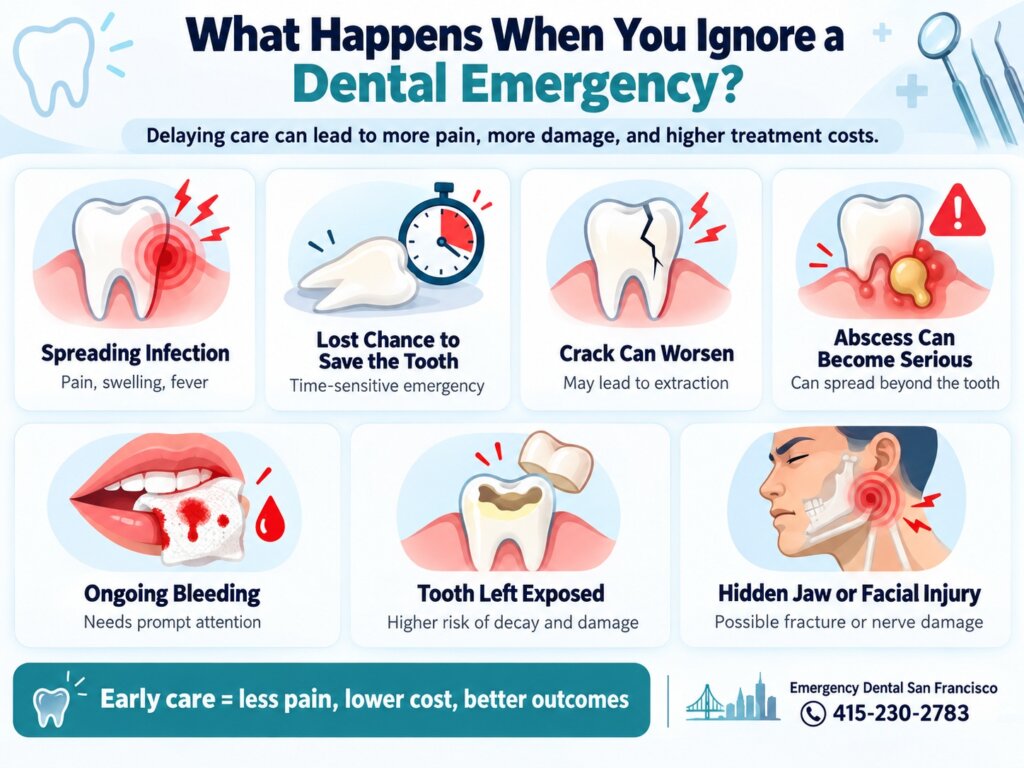
1. A Toothache Can Signal a Spreading Infection
Severe tooth pain is rarely just discomfort. It often points to nerve involvement, deep decay, or early abscess formation. If left alone, the bacteria causing the infection can move beyond the tooth root and into surrounding tissue.
A dental abscess may cause intense facial or jaw swelling, fever, difficulty opening your mouth, and swollen neck glands. At that point, what might have been treated with a root canal or drainage procedure becomes a more complex medical situation.
2. A Knocked-Out Tooth Becomes Unrestorable
Time is the single most important factor when a permanent tooth is knocked out. Research indicates that replantation within approximately 30 minutes is associated with the highest survival rates for the tooth. Every minute beyond that window reduces the chance of successful reimplantation.
If you wait hours or until the next day, the tooth may no longer be viable. You would then be looking at a dental implant or bridge, which is significantly more involved and more expensive than same-day replantation.
3. A Cracked Tooth Can Lead to Extraction
A small crack might not seem urgent, especially if the pain comes and goes. But deeper tooth fractures carry a real infection risk, and the crack can extend further with normal chewing. What starts as a repairable chip can become a fracture that reaches the root, making extraction the only option.
Saving fragments and avoiding hard foods can help in the short term, but prompt dental evaluation is the only way to know how serious the damage is.
4. An Abscess Can Threaten More Than Your Tooth
This is where delayed care becomes genuinely dangerous. A dental abscess that is not drained and treated can spread infection to the jaw, neck, and in rare but documented cases, the airway or chest. The NHS notes that difficulty breathing, swallowing, or speaking, along with swelling near the eye or throat, requires immediate emergency services, not just a dental visit.
If you notice any of those symptoms alongside tooth pain or facial swelling, call 911 or go to the nearest ER. For infections without airway involvement, Emergency Dental San Francisco offers same-day abscess drainage and infection control, available 24 hours a day, including weekends and holidays. Call 415-230-2783 if you are unsure which level of care you need.
5. Uncontrolled Bleeding Can Worsen Without Intervention
Bleeding after a tooth extraction or oral injury is expected to slow and stop within 15 to 30 minutes when you bite down firmly on clean gauze. If bleeding persists well beyond that window, it may indicate a clotting issue or tissue damage that needs clinical attention.
Leaving persistent bleeding unaddressed can lead to significant blood loss, delayed healing, and increased infection risk at the site.
6. Lost Crowns and Fillings Expose Vulnerable Tooth Structure
A missing crown or filling leaves the underlying tooth exposed to bacteria, temperature sensitivity, and physical pressure. The longer that exposure continues, the greater the chance of decay advancing into the pulp. What could have been a simple recementation becomes a root canal or extraction if you wait too long.
7. Jaw Injuries and Facial Trauma Carry Hidden Risks
Facial trauma from a fall, sports injury, or accident may look like bruising on the outside but involve fractures, nerve damage, or tooth displacement underneath. The NHS advises seeking immediate emergency services for serious facial or jaw injuries. Delaying evaluation means delayed diagnosis of injuries that may be harder to treat the longer they go unaddressed.
Each of these scenarios has one thing in common: early care leads to better outcomes, lower costs, and less pain overall.
How Delaying a Dental Emergency Affects Your Long-Term Health and Costs
Beyond the immediate risks, ignoring a dental emergency creates a ripple effect that touches your overall health, your schedule, and your finances. The connection between oral health and systemic health is well-documented, and untreated oral infections are not contained to the mouth.
Consider the cost comparison below, which illustrates how early treatment compares to delayed care across common emergency scenarios.
| Dental Emergency | Early Treatment Option | Delayed Treatment Consequence |
|---|---|---|
| Knocked-out tooth | Replantation (within 30 min) | Implant or bridge needed |
| Dental abscess | Drainage and antibiotics | Hospitalization, IV antibiotics |
| Cracked tooth | Crown or bonding repair | Extraction and replacement |
| Lost crown or filling | Recementation or refill | Root canal or full crown replacement |
| Persistent bleeding | In-office hemostatic treatment | ER visit, possible transfusion |
You might be wondering whether your insurance covers emergency dental visits. Emergency Dental San Francisco accepts most dental insurance plans, including those accessible through the MetLife dental provider login and similar networks. For patients without coverage, financing options are available for those who qualify, and we accept cash and all major credit cards. Transparent, upfront estimates are provided before any treatment begins, so there are no surprises.
If you have been searching for a dental clinic near me that is open late or on weekends, our team serves San Francisco, Oakland, Berkeley, Daly City, Fremont, Alameda, and San Leandro, with walk-in availability and same-day appointments around the clock.
Warning Signs That Make a Dental Emergency Impossible to Ignore at Any Dental Clinic
Some symptoms are easier to dismiss than others. A mild ache might feel like something that will pass. But certain signs indicate that waiting is not safe, regardless of the time or day.
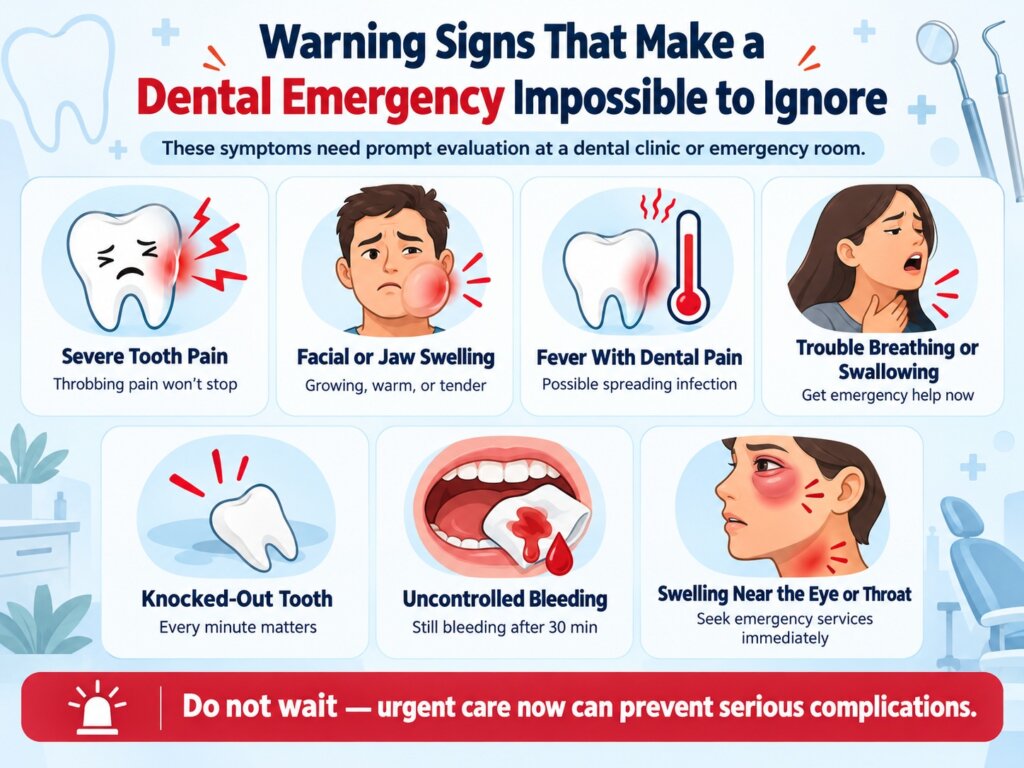
The following warning signs require prompt evaluation, either at an urgent dental clinic or, in severe cases, at an emergency room.
- Severe, throbbing tooth pain that does not respond to over-the-counter pain relievers
- Facial or jaw swelling that is visibly growing or feels warm to the touch
- Fever alongside dental pain, which may indicate an active infection spreading beyond the tooth
- Difficulty swallowing, breathing, or opening your mouth, which requires immediate emergency services
- A knocked-out or partially displaced tooth, where every minute matters for potential replantation
- Uncontrolled bleeding that does not slow after 30 minutes of firm gauze pressure
- Swelling near the eye or throat, which the NHS identifies as a sign requiring emergency services immediately
If you are experiencing any of the above, do not wait for a regular appointment. Call 415-230-2783 now. Our team triages every patient promptly and focuses on pain relief first.
What to Do Before You Reach an Emergency Dentist for a Dental Emergency
Getting to care quickly matters, but a few steps before you arrive can make a real difference in your outcome. These are not substitutes for professional treatment. They are short-term measures to manage pain and protect the tooth or tissue until you are seen.
1. For a Knocked-Out Tooth
Handle the tooth by the crown, not the root. Gently rinse it without scrubbing, reinsert it into the socket if possible, or keep it moist in milk or between your cheek and gum. Get to a dental clinic within 30 minutes for the best chance of saving the tooth.
2. For Severe Toothache or Swelling
Rinse with warm salt water and apply a cold compress to the outside of your face in short intervals. Do not place aspirin directly on your gums, as this can cause tissue damage. Avoid very hot or very cold foods and drinks.
3. For a Broken or Chipped Tooth
Save any fragments you can find and store them in a clean container. Avoid hard, crunchy, or sticky foods until you are evaluated. Rinse your mouth gently with warm water.
4. For a Lost Crown or Filling
Keep the area clean and avoid chewing on that side. If you have the crown intact, bring it to your appointment. Dental cement from a pharmacy may offer temporary protection, but it is not a permanent fix.
5. For Persistent Bleeding
Bite firmly on clean gauze for 15 to 30 minutes without lifting it to check. If bleeding continues beyond that, contact us or go to an emergency room. Do not rinse vigorously, spit forcefully, or use a straw, as these actions can dislodge the clot.
When you arrive at our clinic, bring a government-issued ID, your insurance card, a list of current medications and allergies, and any recent dental records or X-rays. Arriving about 15 minutes early helps us start your triage quickly and get you to pain relief faster.
Why Prompt Care at Emergency Dental San Francisco Makes a Difference for a Dental Emergency
There is a real difference between waiting it out and getting same-day care from a team that handles dental emergencies every day. Our clinic is built specifically for urgent situations, not as an afterthought to routine cleanings.
Every visit at Emergency Dental San Francisco follows a clear, patient-first flow: triage and immediate pain control, diagnostic imaging and exam, a plain-language explanation of your options with an upfront estimate, treatment when indicated, and written aftercare instructions with follow-up as needed. Our clinicians follow CDC and OSHA infection-control standards, with strict sterilization protocols and appropriate PPE at every step.
Our core emergency services include urgent exams and X-rays, tooth extractions, root canal therapy, abscess drainage and infection control, crown and filling repair, soft-tissue injury management, and same-day denture repair through our lab network. Whether you found us through a MetLife dental login search, a referral from a dental assistant at another practice, or simply a late-night search for an emergency dentist San Francisco, you will receive the same level of focused, respectful care.
We also offer pediatric urgent care for children dealing with knocked-out teeth, broken braces, or sports injuries. If cost is a concern, ask about our financing options or verify your coverage using the MetLife dental provider login or your insurer’s portal before your visit.
Final Thoughts on Ignoring a Dental Emergency
Waiting on a dental emergency rarely makes it smaller. Most urgent dental problems grow more complex, more painful, and more expensive the longer they go without care. If something feels wrong, trust that instinct and act on it. Emergency Dental San Francisco is available 24 hours a day, every day of the year, with walk-ins welcome and same-day appointments ready across the Bay Area. Call 415-230-2783 or book online now to get the relief and answers you need today.
Emergency Dental San Francisco specializes in same-day urgent dental relief before small problems become serious. We treat abscesses, cracked teeth, and severe pain fast. Call 415-230-2783 or get started today.
FAQs
What Is Considered a Dental Emergency?
A dental emergency is any mouth or tooth problem that needs prompt care to stop severe pain, control bleeding, treat infection, or save a tooth—such as a bad toothache, swelling/abscess, knocked-out or broken tooth, uncontrolled bleeding, or facial swelling.
What Should I Do If I Have a Dental Emergency?
Call an emergency dentist right away for same-day guidance and treatment. If there’s bleeding, apply gentle pressure with clean gauze; for swelling, use a cold compress; for a knocked-out tooth, keep it moist (milk or saliva) and bring it in immediately. Avoid placing aspirin on the gums.
When Should You Go To The ER For A Dental Emergency?
Go to the ER (or call 911) if you have trouble breathing or swallowing, rapidly spreading facial/neck swelling, fever with severe swelling, heavy uncontrolled bleeding, or trauma with possible jaw fracture. The ER can stabilize you; a dentist will handle definitive dental treatment.
How Do You Know If A Tooth Infection Is An Emergency?
It’s an emergency if you have facial swelling, severe or worsening pain, fever, pus drainage, a bad taste, swollen lymph nodes, or pain that won’t respond to medication—especially if swelling is spreading or you feel sick. Infections can progress quickly and should be evaluated promptly.
Can I Go To Urgent Care For A Dental Emergency?
Medical urgent care can help with pain control, antibiotics when appropriate, or basic wound care, but they usually can’t fix the dental cause (like draining an abscess, performing a root canal, or treating a broken tooth). For fastest relief and a clear next-step plan, an emergency dental clinic is typically the best choice.

Emergency Dental San Francisco is a dental office focused on providing same-day dental appointments to patients in San Francisco and the surrounding area. We provide urgent dental care services during weekends, evenings and holidays.
We accept several forms of payment and have financing options available to those who qualify. We accept most dental insurance.