

29 Oct Emergency Dental Implant Removal: When Is Immediate Extraction Necessary?
A dental implant is designed to last decades. But sometimes things go wrong—and when they do, the situation can move fast. Pain that builds overnight, swelling that spreads to your jaw, or an implant that feels suddenly loose are not symptoms to sleep on. These are signs that something has failed, and waiting may make it worse.
This article walks you through the clinical reasons emergency dental implant removal becomes necessary, what warning signs demand same-day attention, how the removal process typically works, and what your options look like afterward. If you are already in pain, call Emergency Dental San Francisco at 415-230-2783 now—same-day appointments are available, including evenings, weekends, and holidays.
Key Takeaways
- Not every implant complication requires removal, but some situations make immediate extraction medically necessary.
- Signs like severe pain, spreading infection, implant mobility, or bone loss are urgent red flags.
- Emergency dental implant removal is a clinical procedure performed under local anesthesia with imaging guidance.
- Delaying removal when infection is present can lead to systemic complications.
- Same-day evaluation at a dental clinic near me—like our practice—can determine whether removal is the right step.
- Replacement options exist and can be discussed immediately after extraction.
When Emergency Dental Implant Removal Becomes Necessary
Most patients assume that once an implant is placed and healed, it is permanent. That is largely true. But implant failure does happen, and when it does, the question shifts from whether to remove it to how quickly. Research published in PMC (2025) identifies peri-implantitis—an inflammatory condition affecting the tissue and bone around an implant—as one of the leading causes of implant failure requiring intervention.
Peri-implantitis is similar to periodontitis but differs in that it affects the implant site rather than a natural tooth root. Left untreated, it destroys the surrounding bone rapidly. At a certain threshold of bone loss, the implant can no longer be saved, and removal becomes the safest path forward.
You might be wondering: how do I know if my implant has crossed that threshold? The answer usually comes from a combination of clinical symptoms and imaging. A dental provider will take X-rays, assess mobility, probe for pocket depth, and evaluate bone levels before recommending extraction.
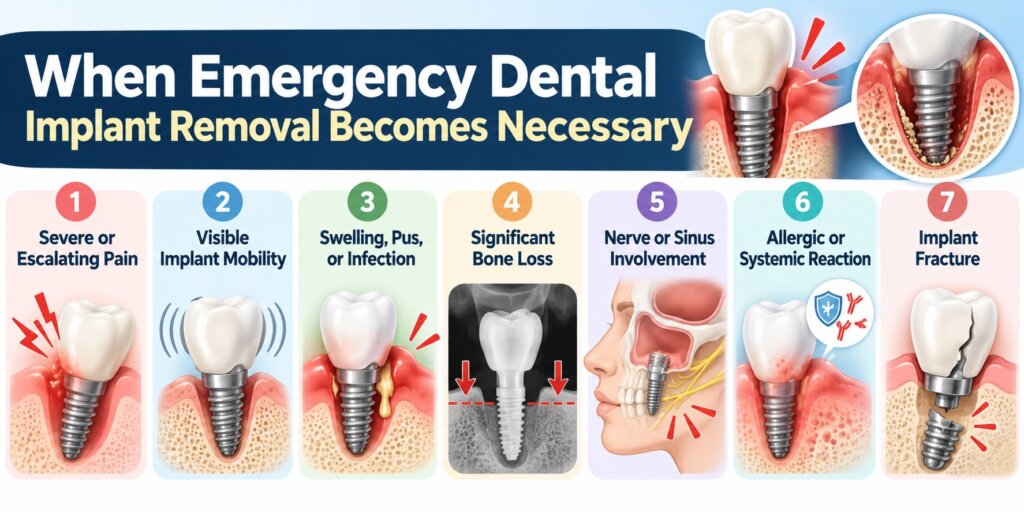
1. Severe or Escalating Pain Around the Implant Site
Some tenderness after implant placement is expected. Pain that returns months or years later—or that intensifies instead of resolving—is not normal. This kind of pain often signals active infection or structural failure at the bone-implant interface.
If over-the-counter pain relief is not touching it, that is a reason to seek same-day care.
2. Visible Implant Mobility
A properly integrated implant does not move. If you can feel the implant shifting when you press on it or bite down, osseointegration—the process by which bone fuses to the titanium post—has likely failed. Mobility is one of the clearest clinical indicators that removal is necessary.
This can happen early (within weeks of placement) or late (years after a successful restoration), and both scenarios warrant urgent evaluation.
3. Swelling, Pus, or Signs of Active Infection
Localized swelling around an implant site, discharge, or a foul taste in your mouth are signs of infection. According to research indexed in PMC (2021), bacterial biofilm accumulation at the implant-tissue junction is a primary driver of peri-implant disease. When infection becomes acute, it can spread to adjacent teeth, the jaw, or deeper tissue planes.
If you have swelling with fever, do not wait. This is a same-day situation.
4. Significant Bone Loss Confirmed by Imaging
Bone loss around an implant is measured radiographically. Studies suggest that bone loss exceeding 2–3 mm after the first year of loading is considered pathological. When bone loss is severe enough that the implant has lost structural support, removal is often recommended to preserve the remaining ridge for future restoration.
5. Nerve or Sinus Involvement
Implants placed too close to the inferior alveolar nerve or into the maxillary sinus can cause persistent numbness, tingling, or pressure. These complications, while not always emergencies on day one, can become urgent if symptoms worsen or if sinus infection develops. Removal may be necessary to resolve the neurological or sinus issue.
6. Allergic or Systemic Reaction to Implant Material
Titanium allergy is rare but documented. Patients may experience chronic inflammation, rash, or unexplained immune responses. A 2023 study referenced in PMC notes that metal hypersensitivity, though uncommon, can drive peri-implant tissue breakdown that does not respond to standard treatment. In these cases, removal and replacement with a zirconia implant may be the appropriate clinical path.
7. Implant Fracture
The titanium post itself can fracture under excessive occlusal load, especially in patients who grind their teeth. A fractured implant body cannot be restored and must be surgically removed. This is typically not a pain emergency on day one, but it does require prompt attention to prevent bone damage and infection.
If any of these situations sound familiar, the next step is a professional evaluation—not more waiting. Our team provides same-day urgent exams and digital X-rays to assess implant status quickly and clearly.
What the Emergency Dental Implant Removal Process Looks Like at a Dental Clinic Near Me
Understanding what happens during the procedure can reduce anxiety significantly. The process is more straightforward than most patients expect, especially when handled by experienced clinicians using current equipment.
| Stage | What Happens | Time Estimate |
|---|---|---|
| Triage and Imaging | X-rays and clinical exam to confirm removal is indicated | 15–30 minutes |
| Anesthesia | Local anesthetic applied; area is fully numb before any instrumentation | 5–10 minutes |
| Implant Removal | Reverse torque or piezoelectric tools used to detach the implant from bone | 20–45 minutes |
| Site Management | Bone grafting or socket preservation may be placed if future reimplantation is planned | 10–20 minutes |
| Aftercare Instructions | Written post-op instructions, prescriptions if needed, and follow-up plan provided | 5–10 minutes |
The procedure is performed under local anesthesia, so you should not feel sharp pain during extraction. Pressure is normal. Sedation options may be available depending on the case. Our licensed clinicians follow CDC and OSHA infection-control standards throughout, with strict sterilization protocols and appropriate PPE at every step.
After removal, the site is typically closed and may be packed with a bone graft material to preserve ridge volume for future implant placement. You will leave with written aftercare instructions, a prescription if indicated, and a clear follow-up plan.
Emergency Dental Implant Removal and Peri-Implantitis: What the Research Says
Peri-implantitis is the most studied driver of implant failure. A 2025 systematic review in PMC found that peri-implantitis affects an estimated 20–30% of implant patients over a 10-year period, with higher rates in patients who smoke, have a history of periodontal disease, or have poor glycemic control. The same review noted that non-surgical treatment is often insufficient once bone loss exceeds a critical threshold.
This matters because it reframes the decision to remove an implant. It is not a failure of the patient or the original procedure in every case. It is sometimes the medically correct response to a condition that has progressed beyond conservative management.
Research from PMC (2021) also highlights that delayed removal in cases of acute peri-implant infection can increase the risk of osteomyelitis—a serious bone infection that is far more difficult and costly to treat than the original implant complication. Early intervention protects the surrounding bone and adjacent teeth.
If you are searching for a dental clinic near me after reading something like this, that instinct is right. Getting an imaging-based evaluation is the only way to know for certain whether your implant is failing and whether removal is warranted.
What Happens After Emergency Dental Implant Removal
Removal is not the end of the story. Most patients who lose an implant are candidates for a replacement—sometimes placed at the same appointment, more often after a healing period of three to six months.
Your options after removal typically include:
- Delayed reimplantation: After the site heals and bone volume is confirmed, a new implant can be placed. This is the most common path.
- Bone grafting at time of removal: Placing graft material during extraction preserves ridge width and height, shortening the timeline to reimplantation.
- Bridge or partial denture: A fixed bridge or removable partial can restore function while the site heals, or as a long-term solution if reimplantation is not pursued.
- Monitoring without replacement: In some posterior sites, particularly in older patients, no replacement may be the practical choice depending on bite function and adjacent tooth stability.
The right option depends on your bone volume, medical history, and personal goals. Our team explains each path in plain language, with realistic timelines and cost estimates, so you can make a decision that fits your life—not just your chart.
For patients concerned about cost, we accept most dental insurance plans and offer financing options for those who qualify. Patients without insurance can pay with cash or any major credit card. If you want to check coverage before your visit, many providers offer a MetLife dental login or MetLife dental provider login portal to verify benefits in advance—our front desk can also help you confirm what your plan covers when you call.
Warning Signs That Mean Call Right Now
Some implant complications are urgent but not immediately dangerous. Others require same-day care. Here is how to tell the difference.
Call 415-230-2783 immediately if you have:
- Swelling that is spreading toward your throat or eye
- Fever above 101°F combined with oral swelling
- Difficulty swallowing or breathing
- Uncontrolled bleeding from the implant site
- Sudden, severe pain that is not controlled by any over-the-counter medication
Schedule a same-day appointment if you notice:
- Implant mobility or movement when biting
- Persistent dull ache that has lasted more than a few days
- Localized swelling or pus with no fever
- A loose crown on top of the implant
- Numbness or tingling near the implant site
The first list may require an emergency room visit if airway involvement is suspected. The second list is exactly what Emergency Dental San Francisco handles—same-day, with imaging and a clinical plan ready when you arrive.
How to Prepare for Your Same-Day Emergency Implant Evaluation
Getting to us quickly matters. A few things can make your visit faster and more productive.
- Bring any existing dental records or X-rays. If you had your implant placed elsewhere, prior imaging helps our team assess changes in bone level over time.
- List your current medications. Some medications—particularly bisphosphonates, blood thinners, and immunosuppressants—affect how we approach implant removal and healing.
- Note when symptoms started and how they have changed. A timeline helps with diagnosis.
- Bring your insurance card. We accept most major plans. If you use a provider portal like MetLife dental provider login, having your member ID ready speeds up verification.
- Arrive 15 minutes early. This gives us time to complete intake paperwork before your exam, so we get to pain relief faster.
Walk-ins are welcome. Same-day appointments are available. You can book online or call 415-230-2783 at any hour—our team is reachable 24/7.
We serve patients across San Francisco and the greater Bay Area, including Oakland, Berkeley, Alameda, Daly City, Fremont, San Leandro, and South San Francisco. Whether you are commuting from the East Bay or walking in from the Mission District, we are set up to see you quickly and get you answers the same day.
Dental assistant jobs at practices like ours require working within a fast-paced, clinically precise environment—and that standard of care is what every patient receives here, regardless of when they arrive or what brought them in.
Final Thoughts on Emergency Dental Implant Removal
Implant failure is not something to manage with hope and over-the-counter pain relief. When the signs are there—mobility, infection, escalating pain, confirmed bone loss—removal is often the most protective decision you can make for your long-term oral health. Getting evaluated quickly preserves your options and prevents complications that are harder to treat the longer they go unaddressed. If something feels wrong with your implant, trust that instinct and call our team at 415-230-2783 today.
Emergency Dental San Francisco specializes in same-day urgent extractions when a failing implant demands immediate care. We serve the Bay Area daily, including evenings, weekends, and holidays. Call 415-230-2783 or book online—get started today.
FAQs
Can a Dental Implant Be Removed in an Emergency?
Yes. If an implant is loose, painful, infected, or causing swelling, bleeding, or bite problems, it can sometimes be removed urgently to stop the problem from worsening. We’ll evaluate the implant, surrounding bone and gums, and your overall health, then recommend the safest same-day plan for relief and next steps.
What Are the Signs That a Dental Implant Needs to Be Removed?
Common warning signs include increasing pain or pressure, swelling or pus, bleeding that doesn’t improve, a bad taste or odor, gum recession around the implant, a loose implant or crown, difficulty chewing, or fever/facial swelling. These can indicate infection or implant failure and should be checked promptly.
How Painful Is Dental Implant Removal?
Most patients feel pressure more than pain because we use effective local anesthesia, and we can discuss additional comfort options if needed. After removal, soreness is common for a few days and is usually manageable with appropriate medications and aftercare instructions.
How Much Does Emergency Dental Implant Removal Cost?
Cost depends on the complexity of the removal, whether imaging is needed, and if infection treatment or bone/gum care is required. We accept most dental insurance plans, offer financing for those who qualify, and can provide a clear estimate after an exam so you know what to expect before treatment.
What Happens After a Dental Implant Is Removed (Can It Be Replaced)?
After removal, we focus on controlling infection, protecting the site, and supporting healing, sometimes with antibiotics or a bone graft if indicated. In many cases, an implant can be replaced later, but timing and options depend on how much bone and gum support remains and why the implant failed.

Emergency Dental San Francisco is a dental office focused on providing same-day dental appointments to patients in San Francisco and the surrounding area. We provide urgent dental care services during weekends, evenings and holidays.
We accept several forms of payment and have financing options available to those who qualify. We accept most dental insurance.