

25 Jun Emergency Tooth Extraction: When a Damaged Tooth Cannot Be Saved
Tooth pain that wakes you up at 2 a.m. is hard to ignore. But knowing whether that pain means you need an emergency tooth extraction—or something else entirely—is not always obvious. The difference matters, and acting fast can protect your health in ways that go beyond just stopping the pain.
This article walks you through the specific situations where a dental emergency tooth extraction becomes necessary, what the procedure involves, and what you can expect before, during, and after your visit. You will also learn when to call a dentist immediately versus when you can wait, and how our team handles urgent cases across San Francisco and the Bay Area.
Key Takeaways
- Not every severe toothache requires extraction—diagnosis comes first.
- Certain conditions, like deep infection, severe fracture, or impacted wisdom teeth, often make extraction the safest option.
- According to the American Dental Association, dental emergencies include uncontrolled bleeding, airway-threatening infections, and severe pain from pulpal inflammation that may require immediate procedures.
- Post-extraction bleeding lasting more than 8 to 12 hours is the most common post-procedural emergency and needs prompt attention.
- Emergency Dental San Francisco provides same-day tooth extractions, including wisdom teeth, with walk-in availability seven days a week.
- Complicated dental infections can require hospital care if sepsis or airway compromise is involved—early treatment prevents escalation.
What Is a Dental Emergency Tooth Extraction and When Does a Dentist Recommend It?

A dental emergency tooth extraction is the urgent removal of a tooth that cannot be saved or that poses an immediate risk to your health if left in place. It is not a first resort. A dentist will always assess whether the tooth can be preserved through a root canal, crown, or other repair before recommending removal. But in some cases, extraction is the clearest path to stopping pain and preventing a worsening infection.
The American Dental Association identifies severe dental pain from pulpal inflammation, pericoronitis around wisdom teeth, localized abscesses with swelling, and tooth fractures causing soft tissue trauma as urgent conditions that may lead to emergency extraction. These are not minor issues you can manage at home for a week.
You might be wondering what separates an urgent extraction from a routine one. The answer is timing and risk. When a tooth is infected to the point that the surrounding tissue is swollen, or when a fracture extends below the gumline and makes the tooth non-restorable, waiting creates compounding problems. Bacteria spread. Pain intensifies. In some cases, a localized infection can become a diffuse soft tissue infection—cellulitis—that threatens the airway and requires hospital-level care.
Six Situations Where an Emergency Dental Care Dentist May Recommend Extraction
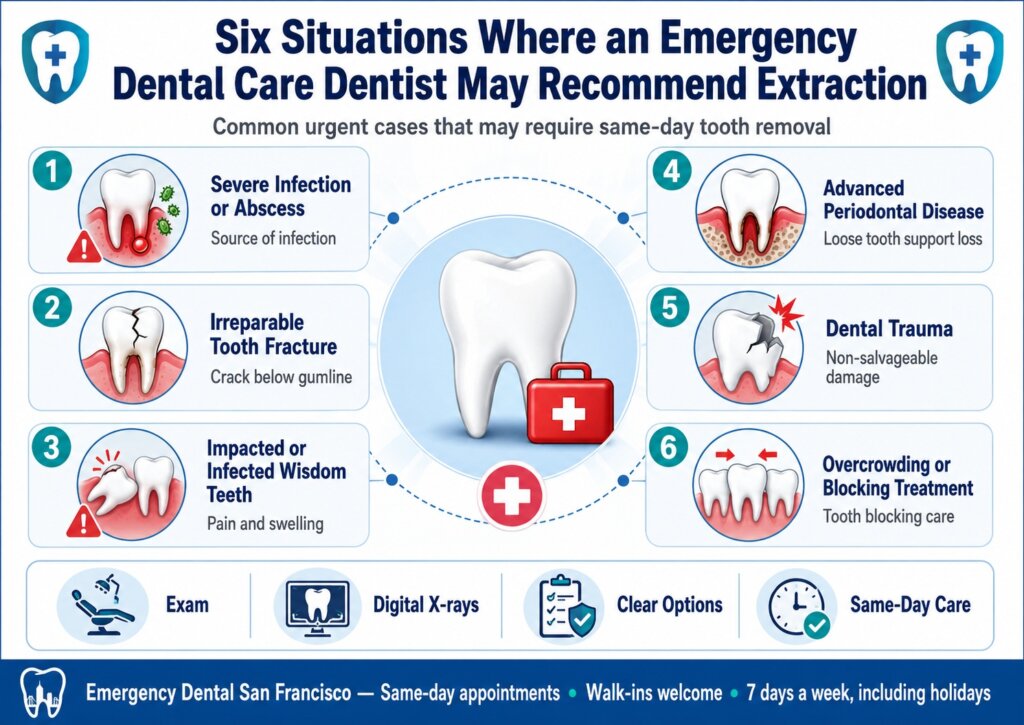
Each case is different, and no two mouths are exactly the same. That said, certain clinical scenarios come up repeatedly in urgent dental settings. Here are the most common reasons an emergency dental care dentist may recommend same-day or urgent extraction.
1. Severe Tooth Infection or Abscess That Has Not Responded to Treatment
A dental abscess is a pocket of bacteria that forms at the root of a tooth or in the surrounding gum tissue. If the infection is caught early, antibiotics and a root canal can often resolve it. When the infection is advanced, or when the tooth structure is too compromised to support a root canal, extraction removes the source of infection directly. Complicated dental infections sometimes require hospital admission under the care of oral and maxillofacial surgeons, particularly when sepsis is present—which is why early intervention at a dentist office near you matters.
2. Irreparable Tooth Fracture
A crack that runs vertically through the root of a tooth cannot be repaired. A fracture that extends below the gumline is similarly non-restorable in most cases. When a tooth breaks in a way that leaves no viable structure to work with, extraction is the practical and pain-relieving solution. Patients who come in after a fall, a sports injury, or biting down on something hard often fall into this category.
3. Impacted or Infected Wisdom Teeth
Third molars, commonly called wisdom teeth, are a frequent driver of emergency dental visits. Pericoronitis—an infection of the gum tissue surrounding a partially erupted wisdom tooth—causes significant pain and swelling. If the tooth is impacted and the infection is recurring or severe, extraction is typically recommended. This is one of the more common procedures handled at our clinic on a same-day basis.
4. Advanced Periodontal Disease Causing Tooth Mobility
When gum disease progresses to the point that the bone supporting a tooth has deteriorated significantly, the tooth may become loose. A mobile tooth that is causing pain, interfering with eating, or at risk of falling out on its own is often better removed in a controlled clinical setting. Leaving it in place can allow bacteria to continue damaging the surrounding bone and adjacent teeth.
5. Dental Trauma With Non-Salvageable Tooth Damage
Not every knocked-out or severely damaged tooth can be reimplanted or restored. If a tooth has been out of the socket for too long, or if the root is fractured beyond repair, extraction may be the appropriate next step. The goal in trauma cases is always to preserve the tooth if possible—but when that option is off the table, prompt removal prevents infection and allows for future restoration planning.
6. Overcrowding or Tooth Blocking Needed Treatment
In some urgent cases, a tooth that is blocking the eruption of another tooth, or one that cannot be accessed for a needed procedure, may require extraction as part of a broader treatment plan. While this is less common in pure emergency settings, it does come up—particularly with wisdom teeth that are pressing against adjacent molars and causing pain.
Understanding which situation applies to you starts with a proper exam and X-ray. At Emergency Dental San Francisco, we triage every patient on arrival, take digital X-rays, and give you a clear picture of your options before any procedure begins. Same-day appointments are available, and walk-ins are welcome seven days a week, including holidays.
How the Dental Emergency Tooth Extraction Process Works at a Dentist Office Near Me
Knowing what to expect can reduce anxiety significantly. The process at our clinic follows a straightforward sequence designed to get you out of pain as quickly and safely as possible.
| Stage | What Happens | Typical Duration |
|---|---|---|
| Triage and Pain Control | Clinician assesses severity, administers local anesthetic if needed | 10–15 minutes |
| Exam and X-Ray | Digital imaging to evaluate tooth, root, and surrounding bone | 10–20 minutes |
| Treatment Discussion | Clear explanation of options with upfront cost estimate | 5–10 minutes |
| Extraction Procedure | Tooth removal under local anesthesia; surgical technique if needed | 20–45 minutes |
| Aftercare Instructions | Written instructions, prescriptions, and follow-up plan provided | 5–10 minutes |
The extraction itself is performed under local anesthesia. You should feel pressure but not sharp pain. If you do feel pain during the procedure, tell the clinician immediately—additional anesthetic can be administered. Most simple extractions take under 30 minutes from numbing to completion.
What to Do Before You Arrive for an Emergency Tooth Extraction at a Dentist Near Me
A few steps before your visit can make the process smoother and help the clinical team treat you more effectively. These are not complicated, but they matter.
- Do not eat for at least two hours before the appointment if sedation is a possibility.
- Bring a list of all medications you are currently taking, including over-the-counter drugs and supplements.
- Bring your insurance card if you have one—we accept most dental insurance plans.
- Bring any recent dental X-rays or records if you have them; this can reduce imaging time.
- Arrange a ride home if you expect to receive sedation or if the procedure involves a surgical extraction.
- Avoid placing aspirin or any topical pain reliever directly on the gum tissue—this can cause chemical burns and complicate the exam.
If you are coming from Oakland, Berkeley, Fremont, or another Bay Area city, plan for traffic. Calling ahead at 415-230-2783 lets us prepare for your arrival and reduces wait time at the front desk.
Post-Extraction Care: What to Watch for After Seeing an Emergency Dental Care Dentist
Recovery after an emergency tooth extraction is manageable for most patients, but there are specific warning signs that require immediate follow-up. Post-extraction bleeding lasting longer than 8 to 12 hours is the most common post-procedural emergency in dental practice, according to clinical research, and it requires targeted management—not just waiting it out at home.
Here is what normal recovery looks like versus what warrants a call back to the clinic.
| Normal After Extraction | Call the Clinic Immediately If You Experience |
|---|---|
| Mild bleeding for up to 1 hour | Bleeding that does not slow after firm gauze pressure for 30 minutes |
| Swelling and mild bruising for 2–3 days | Swelling that increases significantly after day 3 |
| Soreness managed with prescribed or OTC pain relievers | Pain that intensifies rather than improves after 48 hours (possible dry socket) |
| Slight fever on day 1 | Fever above 101°F persisting beyond 24 hours |
| Difficulty opening mouth fully for 1–2 days | Jaw locking or severe difficulty swallowing or breathing |
Dry socket—where the blood clot at the extraction site dislodges before healing—is one of the more uncomfortable post-extraction complications. It typically presents as a sharp, radiating pain starting two to three days after the procedure. If that happens, contact us right away. We can place a medicated dressing to relieve the pain while the site heals.
When to Go to the ER Instead of a Dentist Office Near Me
Most dental emergencies, including infections, fractures, and extractions, are best handled at an urgent dental care clinic rather than a hospital emergency room. ER physicians are not equipped to perform extractions or root canals, and wait times can be long. That said, there are specific situations where the ER is the right call.
According to the American Dental Association, true dental emergencies include uncontrolled bleeding, diffuse soft tissue infection with swelling that may compromise the airway, and facial trauma affecting breathing. In those cases, call 911 or go directly to the nearest emergency room. For everything else—severe toothache, abscess, broken tooth, lost crown, wisdom tooth pain—an emergency dental care dentist is the faster and more appropriate option.
If you are unsure whether your situation qualifies as a dental emergency, call us at 415-230-2783. Our team can help you triage over the phone and determine the right next step. We serve patients across San Francisco, South San Francisco, Daly City, Alameda, Oakland, San Leandro, and surrounding communities—24 hours a day, every day of the year.
Conclusion
A dental emergency tooth extraction is sometimes the fastest and safest way to end severe pain and stop a spreading infection. Emergency Dental San Francisco provides same-day extractions, clear diagnosis, and honest treatment options with no unnecessary delays. Call 415-230-2783 now or book a same-day appointment online—relief is closer than you think.
Emergency Dental San Francisco specializes in same-day emergency tooth extractions with compassionate, professional care. We serve the Bay Area 24/7, including weekends and holidays. Call 415-230-2783 or book online—get started today.
FAQs
Can a Dentist Do an Emergency Tooth Extraction the Same Day?
Yes. If the tooth is causing severe pain, infection, or can’t be saved, we can often provide same-day extraction after an exam and X-rays to confirm it’s the safest option.
How Much Does an Emergency Tooth Extraction Cost?
Cost depends on the tooth’s condition, whether it’s simple or surgical, and what imaging or medications are needed. We accept most insurance, offer financing for those who qualify, and provide clear pricing before treatment.
When Is a Tooth Extraction Considered an Emergency?
It’s an emergency when delaying care could worsen pain or infection—such as facial swelling, an abscess, uncontrolled bleeding, a severely broken tooth, or a tooth that’s too damaged to repair.
What Should I Do Before Going to the Dentist for an Emergency Extraction?
Call ahead if possible, bring a list of medications and allergies, and bring any recent dental records or X-rays. Avoid eating right before your visit in case sedation is recommended, and don’t place aspirin directly on the gum.
Does an Emergency Tooth Extraction Hurt and What Anesthesia Is Used?
Most patients feel pressure, not pain, because we numb the area with local anesthesia; additional sedation options may be available based on your needs and medical history. Our priority is fast, safe relief with clear aftercare instructions.

Emergency Dental San Francisco is a dental office focused on providing same-day dental appointments to patients in San Francisco and the surrounding area. We provide urgent dental care services during weekends, evenings and holidays.
We accept several forms of payment and have financing options available to those who qualify. We accept most dental insurance.