
19 Jun Emergency Dentist vs. Hospital: Which Dental Symptoms Require Hospital Care?
Dental pain rarely waits for a convenient moment. It hits on a Sunday night, during a holiday weekend, or right after your regular dentist office closes for the day. When that happens, most people face the same question: do you drive to the nearest hospital emergency room, or do you search for an emergency dentist near me? The answer depends entirely on what is happening in your mouth right now.
This article breaks down the key differences between a dental emergency hospital visit and an urgent care dental clinic. You will learn which symptoms belong in an ER, which ones are better handled at a dental clinic near me, and how Emergency Dental San Francisco can help you get fast, professional relief the same day you call.
Key Takeaways
- Life-threatening dental emergencies like airway swelling or uncontrolled bleeding require a hospital emergency department immediately.
- Most urgent dental problems, including severe toothaches, abscesses, and cracked teeth, are best treated at an emergency dentist office near me.
- Hospital ERs can stabilize dental pain but typically cannot perform definitive dental procedures like extractions or root canals.
- Emergency Dental San Francisco offers same-day, after-hours, and weekend care across the Bay Area with walk-ins welcome.
- Knowing the difference before an emergency strikes can save you time, money, and unnecessary stress.
Dental Emergency Hospital vs. Emergency Dentist: Which One Do You Actually Need?
This is the question most people get wrong under pressure. When tooth pain is severe, the instinct is to go to the closest place possible, and that often means a hospital ER. That choice makes sense in certain situations, but for the majority of dental emergencies, a hospital is not the right first stop. Understanding the distinction can make a real difference in how quickly you get the right kind of help.
The American Dental Association defines dental emergencies as conditions that are potentially life-threatening and require immediate treatment to stop ongoing tissue bleeding, alleviate severe pain, or treat serious infection. The key phrase there is life-threatening. Examples include uncontrolled bleeding that will not stop, a diffuse soft-tissue infection with swelling that may compromise your airway, and facial bone trauma affecting breathing. These situations belong in a hospital emergency department, full stop.
For everything else, a dentist is the right call. Conditions that are urgent but not life-threatening, like a severe toothache, a knocked-out tooth, a cracked molar, or a painful abscess without airway involvement, are best directed to a dentist or dental clinic. Authoritative guidance from sources like the Cleveland Clinic confirms this: call your dentist first, and if unavailable, use urgent care or the nearest emergency room as a secondary option.
| Situation | Go to Hospital ER | Go to Emergency Dentist |
|---|---|---|
| Uncontrolled bleeding that won’t stop | Yes | No |
| Facial swelling affecting breathing or swallowing | Yes | No |
| Jaw fracture from trauma | Yes | No |
| Severe toothache with swelling | No | Yes |
| Knocked-out or avulsed tooth | No | Yes (within 30 min) |
| Cracked or broken tooth | No | Yes |
| Dental abscess without airway concern | No | Yes |
| Lost crown or filling causing pain | No | Yes |
| Broken denture | No | Yes |
Now that you have a clearer picture of the triage breakdown, it helps to understand why these two settings handle dental pain so differently.
What a Dental Emergency Hospital Can and Cannot Do for Your Teeth
Hospital emergency departments are equipped for medical crises. They have imaging technology, IV medications, and specialists on call for trauma, infection control, and airway management. When a dental problem crosses into medical territory, they are the right place to be. Pennsylvania state regulations, for example, require hospitals to maintain a well-organized plan for emergency dental care as an integral part of their overall emergency plan, which reflects how seriously hospital systems take oral and maxillofacial emergencies.
That said, most hospital ERs do not have a dentist on staff. They can manage pain, prescribe antibiotics, and stabilize bleeding. They can order imaging like CT scans for jaw fractures. What they generally cannot do is perform an extraction, place a filling, treat a root canal, or repair a broken tooth. After stabilizing you, they will refer you to a dentist or oral surgeon for the actual dental work.
This matters for two reasons. First, you may wait hours in an ER only to leave with a prescription and a referral, still needing dental treatment the next day. Second, ER costs for dental complaints are significantly higher than a visit to an urgent dental care clinic, and many dental insurance plans do not cover ER treatment for non-life-threatening oral issues. For patients without insurance, that gap in cost can be substantial.
When an Emergency Dentist Near Me Is the Right First Call
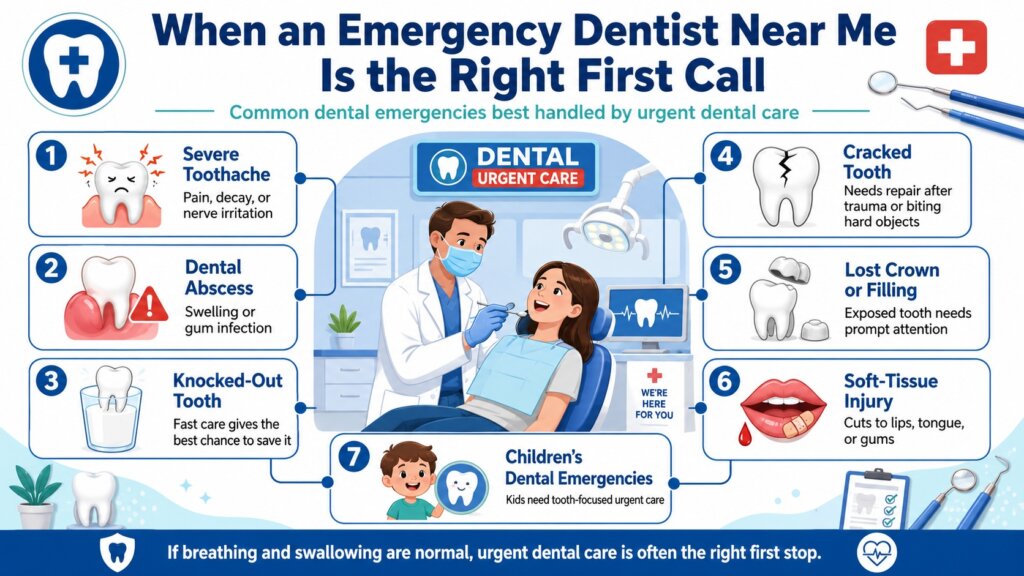
You might be wondering what qualifies as urgent enough to skip the ER and go straight to an emergency dentist. The short answer is: most dental pain qualifies. A dentist office near me that specializes in urgent care can address the full range of common dental emergencies with same-day treatment, proper imaging, and definitive procedures, not just temporary relief.
Here are the situations where calling an emergency dentist first is the right move.
1. Severe Toothache or Throbbing Pain
Intense tooth pain that disrupts sleep or daily function often signals infection, nerve involvement, or decay that has progressed deep into the tooth. An emergency dentist can take X-rays, identify the source, and provide targeted pain relief, whether that means a root canal, extraction, or prescription medication with a clear follow-up plan.
2. Dental Abscess Without Airway Symptoms
An abscess is a pocket of infection that can spread if left untreated. If you have localized swelling, a bad taste in your mouth, or a visible bump on your gum, but you can breathe and swallow normally, an urgent dental clinic is the right place. The dentist can drain the abscess, prescribe antibiotics, and treat the underlying cause in one visit.
3. Knocked-Out Tooth
Time is critical here. Clinical evidence shows that a knocked-out tooth has the best chance of being saved when reimplanted within 30 minutes. Handle the tooth by the crown, rinse it gently, try to reinsert it into the socket, or keep it moist in milk or between your cheek and gum, and get to a dental clinic near me immediately. A hospital ER cannot reimplant a tooth. An emergency dentist can.
4. Cracked or Fractured Tooth
A cracked molar from a fall, a sports injury, or biting down on something hard needs dental evaluation and repair, not an ER visit. Save any tooth fragments, avoid chewing on that side, and call an emergency dentist. Depending on the fracture, treatment may include bonding, a crown, or extraction.
5. Lost Crown or Filling
Losing a crown or filling exposes sensitive tooth structure and can cause significant pain. While not immediately life-threatening, it needs prompt attention to prevent further damage or infection. An emergency dentist can recement an existing crown or place a temporary restoration the same day.
6. Soft-Tissue Injuries or Gum Bleeding
Cuts to the lips, tongue, or gums from trauma can bleed significantly but are usually manageable at a dental clinic. If bleeding is controlled with pressure and you are not showing signs of a deeper injury, an emergency dentist is equipped to evaluate and treat soft-tissue damage without the wait times of a hospital ER.
7. Dental Emergencies in Children
Pediatric dental emergencies, including knocked-out baby teeth, sports injuries, severe toothaches, and broken braces, should be directed to a pediatric dentist near me or an urgent dental clinic with experience treating children. Experts note that managing non-life-threatening pediatric dental issues in a dental office reduces the burden on hospital emergency departments while ensuring kids get the right, tooth-focused care.
With a clearer sense of what an emergency dentist handles, here is how our clinic approaches your visit from the moment you walk in.
Same-Day Urgent Dental Care at Our Dental Clinic Near Me in San Francisco
Emergency Dental San Francisco is an urgent-care dental practice built specifically for moments like these. We offer same-day appointments, walk-in availability, and 24/7 phone access for patients across San Francisco, Oakland, Berkeley, Alameda, Daly City, Fremont, South San Francisco, and San Leandro. Whether it is a Sunday afternoon or a holiday evening, our team is ready to help.
Our visit flow is straightforward. You arrive, we triage and manage your pain first, then move into an exam and X-rays to identify the exact problem. From there, we walk you through your options with a clear cost estimate before any treatment begins. We perform the procedure that day when clinically appropriate, and you leave with written aftercare instructions, any necessary prescriptions, and a realistic follow-up plan.
Our core emergency services include urgent exams and X-rays, emergency tooth extractions, root canal therapy, infection drainage and abscess care, repair of broken or chipped teeth, crown and filling replacement, soft-tissue injury management, and same-day denture repair through our lab network. We also provide gentle urgent care for children experiencing knocked-out teeth, sports injuries, or severe toothaches.
We accept most dental insurance plans and offer financing options for patients who qualify. For those without insurance, we accept cash and all major credit cards. Our team works to keep emergency care accessible, and we provide up-front estimates whenever possible so there are no surprises at checkout. Call 415-230-2783 or book an appointment online to get same-day care today.
What to Do Before You Arrive at an Emergency Dentist Office Near Me
A few simple steps before your visit can protect your tooth, reduce pain, and help our team treat you faster. These are not complicated, but they make a real difference.
- For a knocked-out tooth: handle by the crown only, rinse gently with water, try to reinsert it, or store it in milk. Come in within 30 minutes if possible.
- For swelling or toothache: use a cold compress on the outside of your cheek and rinse with warm salt water. Do not place aspirin directly on the gum tissue.
- For a broken tooth: save any fragments in a clean container. Avoid hard or sticky foods until you are seen.
- For a lost crown: keep the area clean and bring the crown with you if you still have it.
- Arrive about 15 minutes early with a government-issued ID, your insurance card, a list of current medications and allergies, and any recent dental X-rays or records if you have them.
After your visit, watch for warning signs like rising pain or swelling, fever, or persistent bleeding. Contact us immediately if any of these occur.
Conclusion
When dental pain strikes, knowing where to go saves time and gets you the right care faster. Life-threatening symptoms belong in a hospital ER; everything else is best handled at an emergency dentist near you. Emergency Dental San Francisco provides same-day, after-hours, and weekend urgent dental care across the Bay Area with transparent pricing and licensed clinical staff. Call 415-230-2783 or book your same-day appointment now and get the relief you need today.
Emergency Dental San Francisco offers same-day emergency dental care without a hospital wait. We treat toothaches, abscesses, and cracked teeth fast. Call 415-230-2783 or book online—get started today.
FAQs
Can I Go to the Hospital for a Dental Emergency?
Yes—go to the ER for trouble breathing or swallowing, facial/neck swelling, uncontrolled bleeding, high fever, or serious trauma. For most urgent dental problems (severe toothache, broken tooth, lost filling/crown), an emergency dentist can usually diagnose and treat the cause faster and more definitively—often the same day.
Will the ER Treat a Tooth Infection or Abscess?
The ER can help stabilize severe infections (especially with spreading swelling or systemic symptoms) and may provide antibiotics and pain control, but they typically can’t perform dental procedures like drainage, root canal therapy, or extraction. An emergency dentist can treat the source of the infection and give clear next steps for lasting relief.
What Is Considered a Dental Emergency?
Common dental emergencies include severe tooth pain, facial swelling, a suspected abscess, a knocked-out or loose tooth, a cracked/broken tooth, uncontrolled bleeding, or trauma to the mouth or jaw. If you’re unsure, calling an emergency dental office can help you triage quickly and safely.
How Much Does an Emergency Dental Visit Cost at a Hospital?
Hospital ER visits are often more expensive than seeing an emergency dentist, and many ERs can only provide temporary symptom relief rather than definitive dental treatment. Costs vary widely by hospital and services provided; an emergency dental office can usually give clearer pricing and treatment options upfront.
Where Can I Find an Emergency Dentist Near Me Right Now?
If you’re in San Francisco or the Bay Area, Emergency Dental San Francisco offers same-day, after-hours, weekend, and holiday care. Call 415-230-2783 anytime or book online for immediate help.

Emergency Dental San Francisco is a dental office focused on providing same-day dental appointments to patients in San Francisco and the surrounding area. We provide urgent dental care services during weekends, evenings and holidays.
We accept several forms of payment and have financing options available to those who qualify. We accept most dental insurance.