

06 Nov Can I Get Emergency Dental Treatment While Taking Blood Thinners?
You’re dealing with a cracked tooth, a throbbing abscess, or bleeding gums—and you’re on blood thinners. The pain is real, and so is your concern about whether it’s safe to get treated. This is one of the most common questions we hear from patients calling our clinic, and the short answer is yes, you can get emergency dental treatment while taking anticoagulant medications. But the process does require some careful coordination between your dental provider and, in some cases, your prescribing physician.
This article walks you through what blood thinners actually do, which dental procedures are typically safe, how bleeding risk is managed in an urgent care setting, and what you should bring to your appointment. We’ll also cover what to expect at a dental clinic near me that handles medically complex patients—so you can walk in informed and leave with relief.
Key Takeaways
- Most emergency dental procedures can be performed safely on patients taking blood thinners with proper clinical precautions.
- Your dentist needs to know your medication name, dosage, and your most recent INR value if you take warfarin.
- Stopping blood thinners before dental treatment is rarely necessary and can carry its own serious risks.
- Local hemostatic measures—like pressure, sutures, and absorbable materials—are usually enough to control bleeding.
- Emergency Dental San Francisco provides same-day urgent care for patients on anticoagulants across the Bay Area.
- Always bring a current medication list to your appointment to help your care team plan safely.
Understanding the relationship between anticoagulant therapy and dental procedures is not just a clinical concern—it directly affects your safety and the decisions your provider will make in real time.
Can I Get Emergency Dental Treatment While on Blood Thinners at a Dental Clinic Near Me?
Yes, and in most cases, your treatment should not be delayed. Research published in the British Medical Journal confirms that continuing anticoagulant therapy during minor dental procedures—including extractions—is generally safe when local hemostatic measures are used appropriately. Postponing care because of anticoagulation is often more dangerous than proceeding with proper precautions in place.
Blood thinners like warfarin, apixaban (Eliquis), rivaroxaban (Xarelto), and dabigatran (Pradaxa) are prescribed to prevent strokes, blood clots, and other cardiovascular events. They reduce the blood’s ability to clot, which means that any procedure involving bleeding—like an extraction or abscess drainage—requires your dental team to plan ahead. The concern is not that treatment is impossible, but that it requires a more deliberate approach.
At Emergency Dental San Francisco, our clinicians are trained to assess bleeding risk before beginning any procedure. We ask about your medications, your condition, and when applicable, your INR level—a measure of how long it takes your blood to clot. This information shapes the treatment plan and helps us keep you safe from the first step to the last.
What Blood Thinners Do—and Why Dentists Need to Know
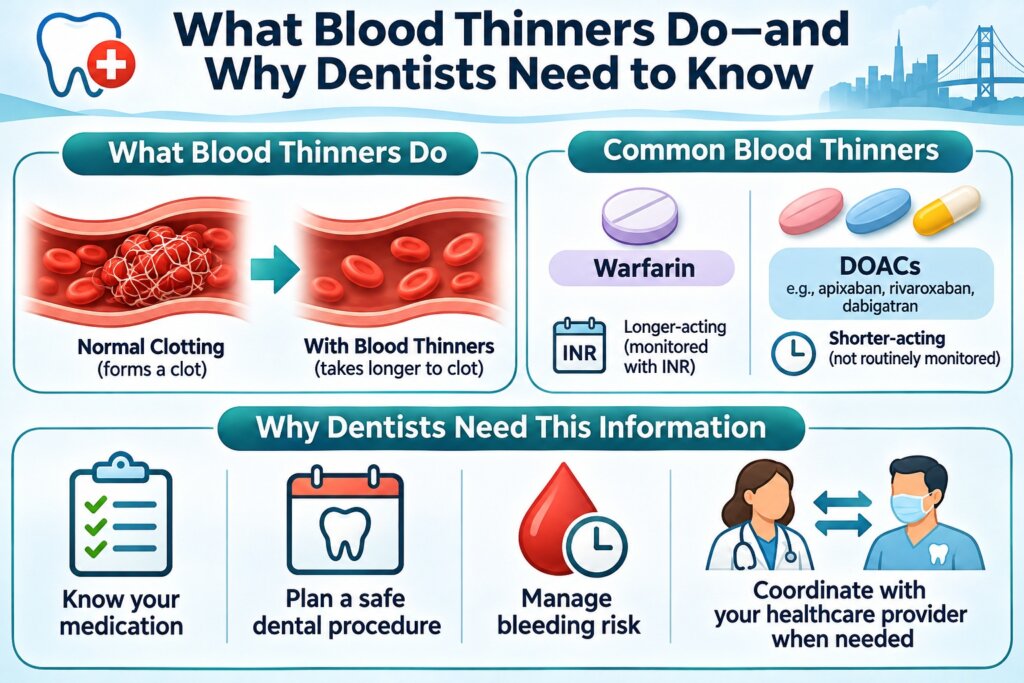
Anticoagulants work by interrupting different parts of the clotting cascade, the process your body uses to form a blood clot after an injury. Warfarin, for example, blocks vitamin K-dependent clotting factors, while newer direct oral anticoagulants (DOACs) like apixaban target specific clotting proteins. The result is the same: your blood takes longer to clot, which reduces the risk of dangerous clots forming inside blood vessels.
According to MedlinePlus, patients on anticoagulants need to be monitored regularly, and any changes to their routine—including dental procedures—should be communicated to their healthcare provider. This is not about creating obstacles to care. It’s about making sure the people treating you have the full picture.
You might be wondering whether your specific medication matters. It does. Warfarin has a longer half-life and is monitored with INR testing. DOACs are shorter-acting and not routinely monitored with a standard lab value, but they still affect bleeding. Your dentist needs to know which drug you take, the dose, and ideally when you last took it.
Can I Get Emergency Dental Treatment Without Stopping My Blood Thinner?
In the majority of cases, yes. The evidence strongly supports continuing anticoagulation therapy for most routine and emergency dental procedures. A study in the BMJ found that patients who continued warfarin during dental extractions had manageable bleeding that responded well to local measures, while those who stopped their medication faced a significantly higher risk of serious thromboembolic events—like stroke or pulmonary embolism.
Stopping a blood thinner without medical supervision is not something you should do on your own. The risks of an unplanned interruption often outweigh the bleeding risk of a dental procedure. Your prescribing physician is the right person to make that call, and they will typically advise continuing the medication unless the procedure is unusually complex or involves significant soft tissue surgery.
For most emergency dental situations—extractions, abscess drainage, root canals, broken tooth repair—local hemostatic techniques are effective and sufficient. These include applying direct pressure with gauze, using absorbable gelatin sponges or oxidized cellulose, placing sutures, and using tranexamic acid mouthwash post-procedure to reduce bleeding time.
Which Emergency Dental Procedures Can I Get While Taking Anticoagulants?
Most urgent dental procedures fall within a range that is manageable even for patients on blood thinners. The key factor is the extent of tissue disruption and the anticipated bleeding. Below is a general comparison of procedure types and their typical bleeding risk level.
| Procedure | Typical Bleeding Risk | Usually Safe on Blood Thinners? |
|---|---|---|
| Emergency exam and X-rays | None | Yes |
| Temporary filling or crown recementation | Minimal | Yes |
| Root canal therapy | Low to moderate | Yes, with precautions |
| Single tooth extraction | Moderate | Yes, with local hemostasis |
| Abscess incision and drainage | Moderate | Yes, with precautions |
| Multiple extractions or surgical removal | Higher | Requires physician consultation |
This table is a general guide, not a substitute for clinical judgment. Your provider will assess your individual situation before proceeding.
Emergency Dental San Francisco handles all of the procedures listed above. Whether you need same-day tooth extraction, urgent root canal therapy, or abscess drainage, our team evaluates your medical history first and builds the treatment plan around your safety. We serve patients across San Francisco, Oakland, Berkeley, Alameda, Fremont, and surrounding Bay Area communities—seven days a week, including holidays.
What to Tell Your Dentist Before Treatment Begins
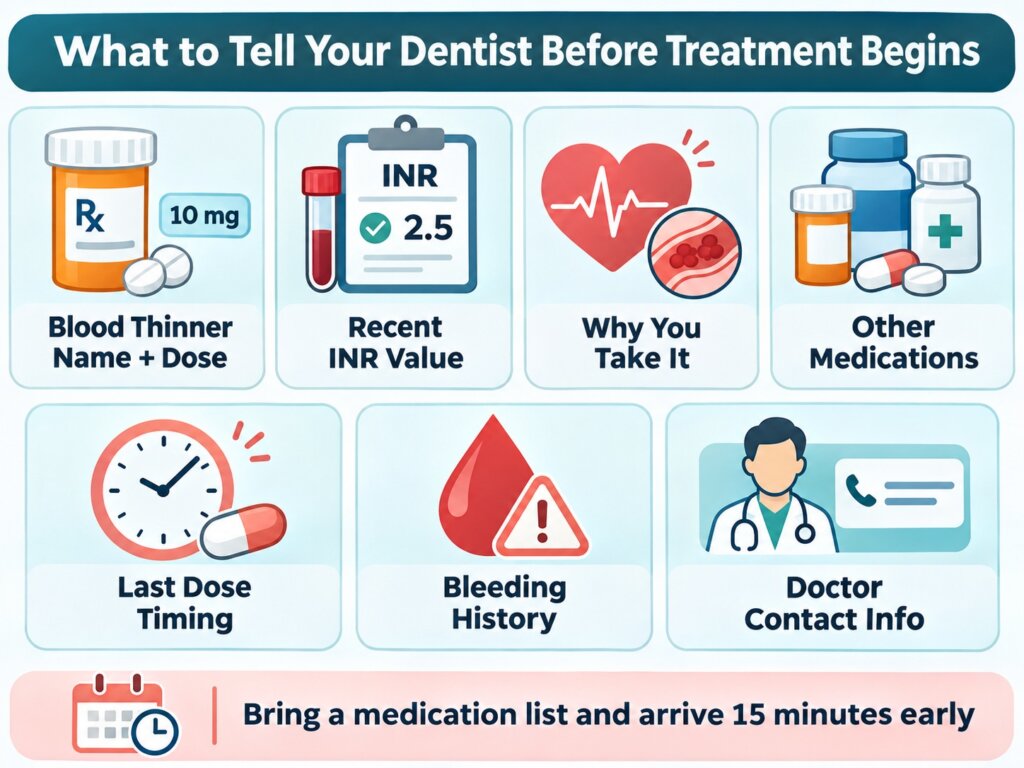
Being upfront with your dental provider is one of the most practical things you can do before any procedure. The more information your care team has, the better they can protect you. Here is what to share when you arrive:
1. The Name and Dose of Your Blood Thinner
Different anticoagulants carry different bleeding profiles. Knowing whether you take warfarin versus a DOAC changes how your dentist plans hemostasis.
2. Your Most Recent INR Value (for Warfarin Users)
An INR below 3.5 is generally considered acceptable for minor dental procedures. If your INR is higher, your dentist may consult your physician before proceeding.
3. The Condition You’re Being Treated For
Patients taking anticoagulants for atrial fibrillation, mechanical heart valves, or deep vein thrombosis each carry different interruption risks. This context matters.
4. Any Other Medications You Take
Some common drugs—including aspirin, NSAIDs, and certain antibiotics—can interact with anticoagulants and increase bleeding risk. A full medication list helps avoid complications.
5. Your Last Dose and Timing
For short-acting DOACs, knowing when you last took your medication helps estimate peak drug effect and plan procedure timing if needed.
6. Any History of Abnormal Bleeding
If you’ve had prolonged bleeding after past procedures or injuries, let your dentist know. This history helps calibrate the level of precaution required.
7. Your Primary Care or Cardiology Provider’s Contact Information
In complex cases, your dental team may want to speak directly with your prescribing physician. Having that contact ready speeds up coordination.
Bringing a written list of your medications and allergies is one of the simplest ways to make your visit safer and faster. We recommend arriving about 15 minutes early so our team has time to review your history before treatment begins.
How We Manage Bleeding Risk During Emergency Dental Procedures
When a patient on anticoagulants needs an extraction or other bleeding procedure, our approach focuses on local control rather than systemic changes. This means we use techniques at the treatment site to minimize and manage bleeding without requiring you to stop your medication.
Common local hemostatic measures include packing the socket with absorbable gelatin or oxidized cellulose, placing resorbable sutures, applying firm gauze pressure for an extended period, and prescribing tranexamic acid mouthwash for use after the procedure. These methods are well-supported by clinical evidence and are standard practice in anticoagulated patients undergoing minor oral surgery.
You might be wondering what happens if bleeding does not stop as expected. In that case, we apply additional pressure, use additional hemostatic agents, and monitor you before discharge. We also provide clear written aftercare instructions so you know exactly what normal post-procedure bleeding looks like versus something that warrants a call back to our clinic or a visit to the ER.
Can I Get Emergency Dental Treatment If My INR Is High?
This depends on how high. Research from the BMJ indicates that for patients with an INR between 2.0 and 4.0, single extractions and minor procedures can typically proceed with local hemostatic precautions. Above 4.0, the risk of uncontrolled bleeding increases, and your dentist may contact your physician to discuss whether dose adjustment or a brief delay is appropriate before elective or semi-urgent procedures.
For true dental emergencies—severe infection, uncontrolled pain, or spreading abscess—the calculus shifts. Delaying treatment for an active infection can allow it to spread to surrounding tissue or become systemic. In those cases, the risk of not treating often outweighs the bleeding risk, and your provider will proceed with appropriate caution and monitoring.
If you’re unsure about your current INR or haven’t had it checked recently, let our team know when you call. We can help you think through next steps before you come in. Reach us at 415-230-2783, and we’ll help you figure out the safest path forward—whether that means coming in right away or coordinating with your physician first.
Patients who use Delta Dental provider login portals or MetLife dental provider login tools to verify coverage before visiting should check whether their plan covers emergency procedures involving medically complex patients. We accept most dental insurance plans and can help verify your benefits when you arrive or call ahead.
What to Bring to Your Emergency Dental Appointment
Preparation makes a real difference, especially when you’re on blood thinners. Here’s a quick checklist for your visit:
- A government-issued photo ID
- Your dental insurance card (if applicable)
- A written list of all current medications, including your anticoagulant name, dose, and frequency
- Your most recent INR result if you take warfarin
- Your prescribing physician’s name and contact number
- Any recent dental X-rays or records
- A list of known drug allergies
If you’ve been searching for a dental clinic near me that understands medically complex patients, our team is equipped to handle your case with the clinical care it requires. We follow CDC and OSHA infection-control standards, use licensed clinicians, and provide up-front cost estimates before treatment begins.
We also accept most dental insurance plans, including those accessible through MetLife dental login and Delta dental provider login portals. For patients without insurance, we accept cash and all major credit cards, and financing options are available for those who qualify.
Conclusion
Emergency dental treatment while on blood thinners is safe in most cases when your provider uses proper hemostatic techniques and knows your full medication history. Delaying urgent care often carries more risk than proceeding with appropriate precautions. Contact Emergency Dental San Francisco at 415-230-2783 or book a same-day appointment online—we’re here around the clock to help you get relief safely.
Emergency Dental San Francisco specializes in safe, same-day emergency care for patients on blood thinners. Our licensed clinicians assess your medications and adjust treatment to protect you. Call 415-230-2783 or book online—get started today.
FAQs
Can I Go to the ER for Emergency Dental Treatment?
You can go to the ER for uncontrolled bleeding, facial swelling that affects breathing or swallowing, high fever, or a serious injury—but most dental problems are treated faster and more effectively by an emergency dentist. We can provide same-day exams, X-rays, pain relief, antibiotics when appropriate, and urgent procedures to address the source of the problem.
How Much Does Emergency Dental Treatment Cost?
Cost depends on the exam, X-rays, and the treatment needed (such as a filling, extraction, or root canal). We accept most dental insurance plans, offer financing options for those who qualify, and for self-pay patients we accept cash and major credit cards—call 415-230-2783 for a quick estimate based on your symptoms.
What Qualifies as a Dental Emergency?
Severe toothache, swelling or abscess, broken or knocked-out tooth, uncontrolled bleeding, signs of infection (pus, fever), or trauma to the mouth or jaw are dental emergencies. If you’re in significant pain or symptoms are worsening, it’s safest to be seen as soon as possible.
Can a Dentist See Me the Same Day for an Emergency?
Yes—many emergencies can be seen the same day, including after-hours, weekends, and holidays. You can walk in, book online, or call us 24/7 so we can triage your situation and get you in quickly.
What Can I Do at Home Until I Can See an Emergency Dentist?
Rinse gently with warm salt water, use a cold compress for swelling, and take over-the-counter pain medication as directed (avoid aspirin if you have bleeding risk unless your physician says it’s okay). Keep the area clean, don’t apply heat to facial swelling, and if a tooth is knocked out, place it in milk or saliva and come in immediately.

Emergency Dental San Francisco is a dental office focused on providing same-day dental appointments to patients in San Francisco and the surrounding area. We provide urgent dental care services during weekends, evenings and holidays.
We accept several forms of payment and have financing options available to those who qualify. We accept most dental insurance.