

06 Aug Emergency Dental Visit: How Dentists Decide Between Immediate Treatment and Temporary Relief
Dental pain rarely arrives at a convenient time. It shows up on a Sunday morning, during a holiday dinner, or in the middle of a work week when your regular dentist office is fully booked. According to the Healthcare Cost and Utilization Project (HCUP), there were roughly 2 million dental-related emergency department visits in the United States in 2018 alone—and most of those visits were for preventable, non-traumatic conditions like abscesses and tooth decay. That number tells you something: a lot of people are in pain and do not know where to turn or what to expect when they finally seek care.
This article walks you through exactly what happens during an emergency dental visit—from the moment you arrive to the moment you leave with a clear plan. You will learn what the clinical team looks for, which treatments are most common, how costs and insurance work, and what steps you can take before and after your visit to get the best outcome possible.
Key Takeaways
- Emergency dental visits follow a clear, step-by-step process designed to prioritize pain relief and your safety first.
- Most urgent dental conditions—abscesses, cracked teeth, knocked-out teeth—can be treated at a dedicated dental office, not just a hospital ER.
- Bringing your insurance card, medication list, and any recent X-rays helps the clinical team move faster.
- Emergency Dental San Francisco offers same-day appointments, walk-ins, and 24/7 phone access across the Bay Area.
- Understanding what to expect reduces anxiety and helps you make faster, calmer decisions during a dental crisis.
Knowing what to expect before you walk through the door changes everything. When you understand the process, you spend less time worrying and more time getting the care you actually need.
What Happens During Emergency Dental Visits: A Step-by-Step Breakdown
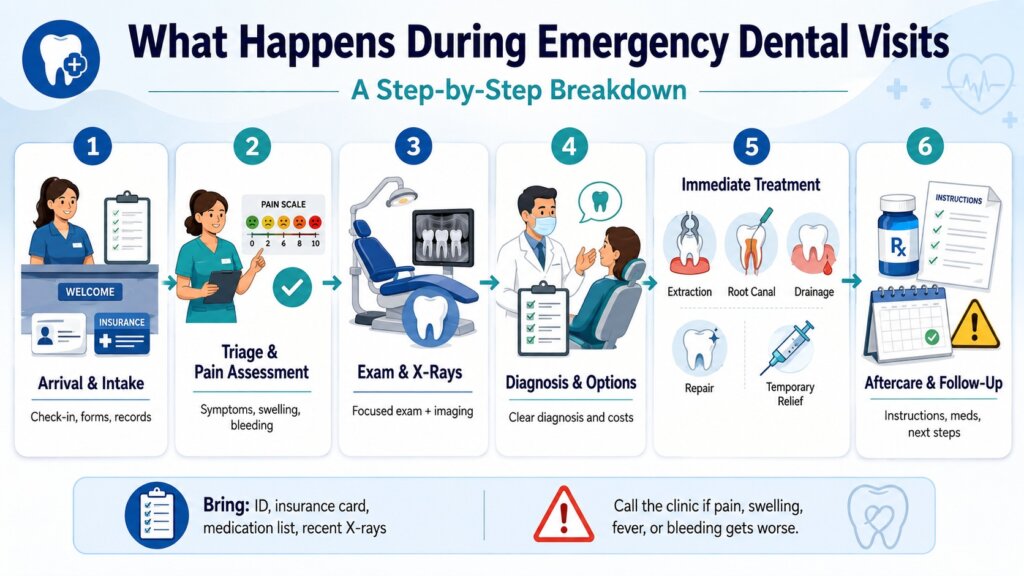
The process at a dedicated urgent care dentist office is more structured than most people realize. It is not chaotic or rushed—it follows a clinical sequence designed to get you out of pain as quickly and safely as possible. Here is what typically happens from start to finish.
1. Arrival and Intake at the Dentist Office Near Me
When you arrive, the front desk team checks you in and collects basic information—your name, contact details, insurance card if you have one, and a brief description of what is happening. This takes just a few minutes. If you called ahead, some of this may already be on file.
Bring a government-issued ID, your insurance card, a list of current medications and allergies, and any recent dental records or X-rays. Arriving about 15 minutes early helps move things along.
2. Triage and Pain Assessment During Emergency Dental Visits
A clinical team member will ask about your symptoms—where the pain is, how long it has been going on, whether there is swelling, and how severe it feels on a scale of one to ten. This triage step helps prioritize your care, especially if the clinic is treating multiple patients.
The goal here is not just paperwork. The team is actively screening for signs of serious infection, airway involvement, or uncontrolled bleeding—conditions that require immediate escalation. According to the National Institutes of Health (PMC), emergency departments often cannot provide definitive dental treatment and mainly focus on pain and infection control—which is exactly why seeing an emergency care dentist directly is the better path for most dental problems.
3. Clinical Exam and Diagnostic Imaging
Once you are in the chair, the dentist performs a focused exam. They check the affected tooth and surrounding tissue, look for signs of infection or fracture, and assess your bite and jaw alignment if relevant. This is thorough but targeted—not a full routine cleaning appointment.
Digital X-rays are taken in most cases. They give the dentist a clear picture of what is happening below the gum line, including bone loss, abscess formation, or root damage that is not visible to the eye. Modern imaging is fast and uses minimal radiation.
4. Diagnosis and Treatment Options Explained Clearly
After the exam and imaging, the dentist explains what they found in plain language. You will hear a clear diagnosis—something like a cracked molar, a periapical abscess, or a partially erupted wisdom tooth causing pressure—along with two or three realistic treatment options.
Each option comes with an explanation of what it involves, how long it takes, and an upfront cost estimate. At Emergency Dental San Francisco, we accept most dental insurance plans and offer financing options for patients who qualify. For those without insurance, we accept cash and all major credit cards—because urgent care should not be out of reach.
5. Immediate Treatment During Emergency Dental Care Dentist Visits
Once you choose a path forward, treatment begins. The most common procedures performed during emergency dental visits include:
- Emergency tooth extraction – When a tooth is too damaged to save, removal stops the pain and prevents further infection from spreading.
- Root canal therapy – If the nerve is infected but the tooth structure is intact, a root canal cleans the canal and eliminates the source of pain.
- Abscess drainage – For gum or periapical infections, the dentist may drain the abscess and prescribe antibiotics to control the spread.
- Crown or filling repair – Lost crowns and broken fillings are re-cemented or temporarily sealed to protect the exposed tooth.
- Soft tissue management – Lacerations or gum injuries from trauma are cleaned and, when needed, sutured.
- Temporary relief measures – When definitive treatment requires a follow-up visit, the dentist places a temporary restoration and prescribes appropriate pain management.
Local anesthesia is administered before any procedure, so you should feel pressure but not sharp pain. The team checks in with you throughout and adjusts if needed.
6. Aftercare Instructions and Follow-Up Planning
Before you leave, you receive written aftercare instructions specific to your procedure. These cover what to eat and avoid, how to manage any post-treatment soreness, and when to take prescribed medications. A follow-up appointment may be scheduled if your treatment requires a second step—like placing a permanent crown after a root canal.
Watch for warning signs after your visit: rising pain or swelling, fever above 101°F, or bleeding that does not slow with gentle pressure. Contact the clinic immediately if any of these occur.
Now that you understand the visit sequence, it helps to know what to do before you even arrive—because the right preparation makes the clinical team’s job faster and your experience smoother.
How to Prepare for Emergency Dental Visits at a Dentist Near Me
Preparation is not always possible during a dental crisis, but even small steps taken in the car or waiting room can make a real difference. The more information you bring, the faster the team can act.
| Situation | What to Do Before You Arrive |
|---|---|
| Knocked-out tooth | Handle by the crown only. Rinse gently. Reinsert if possible, or store in milk. Arrive within 30 minutes for the best chance of saving the tooth. |
| Severe toothache or swelling | Use a warm salt-water rinse. Apply a cold compress to the outside of the cheek. Do not place aspirin directly on the gum tissue. |
| Cracked or broken tooth | Save any fragments. Avoid hard, sticky, or very hot or cold foods. Cover sharp edges with dental wax if available. |
| Lost crown or filling | Keep the area clean. Bring the crown or restoration if it is intact. Avoid chewing on that side. |
| Abscess or facial swelling | Do not try to pop or drain it yourself. Apply a cold compress. Seek care immediately, especially if swelling affects your breathing or swallowing. |
You might be wondering whether your situation is serious enough to warrant an emergency visit. A useful rule of thumb: if the pain is severe enough to interrupt sleep, eating, or daily function—or if you notice visible swelling, a fever, or a tooth that has been knocked out—that qualifies as an urgent dental situation. Research published in PMC (National Institutes of Health) notes that emergency dental care use is disproportionately high among uninsured and Medicaid patients who lack access to a regular dentist—a gap that same-day urgent dental clinics are specifically designed to fill.
Understanding the difference between a dental emergency and a hospital ER visit also matters. ERs can manage pain and prescribe antibiotics, but they generally cannot perform extractions, root canals, or definitive repairs. That means you would still need to see a dentist afterward—sometimes within 24 to 48 hours. Going directly to an emergency care dentist skips that extra step entirely.
What Emergency Dental Visits Look Like for Pediatric Patients
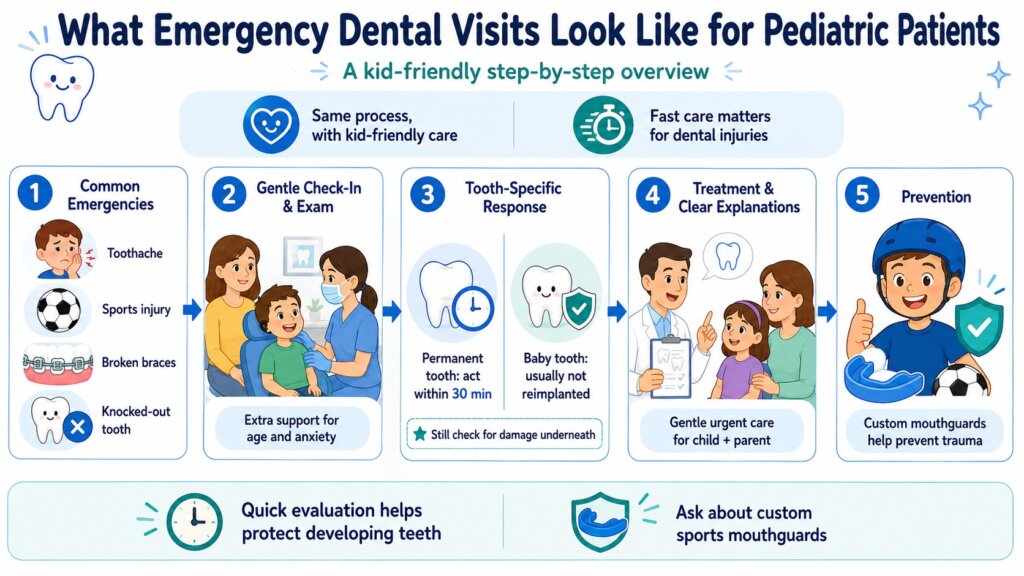
Children experience dental emergencies too—knocked-out baby teeth from playground falls, broken braces, sports injuries, and severe toothaches are all common. The clinical process for a pediatric patient follows the same general structure as an adult visit, with some adjustments for age, anxiety, and tooth development.
If your child has a knocked-out permanent tooth, the same 30-minute window applies. For a knocked-out baby tooth, reimplantation is typically not recommended—but the area still needs to be evaluated for damage to the developing permanent tooth underneath. Our team provides gentle pediatric urgent care and explains everything to both the child and the parent in clear, calm terms.
Custom mouthguards are worth mentioning here. If your child plays contact sports, a properly fitted mouthguard from a dentist office is one of the most effective ways to prevent dental trauma in the first place. It is a small investment compared to an emergency visit and potential tooth loss.
With pediatric cases handled, it is worth stepping back to look at the broader picture—specifically, what separates a dental emergency clinic from a general hospital ER and why that distinction matters for your care.
Emergency Dental Visits vs. Hospital ER: Understanding the Difference
This is a question that comes up often, and the answer is more practical than most people expect. Hospital emergency rooms are the right call when you have suspected facial fractures, uncontrolled bleeding that does not respond to pressure, or swelling that is affecting your ability to breathe or swallow. Those are medical emergencies that require imaging, IV medication, and a surgical team.
For everything else—severe toothaches, abscesses, cracked or knocked-out teeth, lost restorations, gum infections—a dedicated emergency care dentist is the faster and more effective option. ERs are not equipped to perform extractions or root canals. They treat the symptom, hand you a prescription, and send you to find a dentist anyway.
| Condition | Go to Emergency Dental Clinic | Go to Hospital ER |
|---|---|---|
| Severe toothache | Yes | No |
| Dental abscess (no breathing issues) | Yes | No |
| Knocked-out tooth | Yes – within 30 minutes | No |
| Cracked or fractured tooth | Yes | No |
| Swelling affecting breathing | No | Yes – immediately |
| Uncontrolled bleeding | No | Yes – immediately |
| Suspected jaw fracture | No | Yes – immediately |
Emergency Dental San Francisco serves patients across the Bay Area—including Oakland, Berkeley, Daly City, Fremont, Alameda, and San Leandro—with same-day appointments, walk-in access, and 24/7 phone support at 415-230-2783. Our clinic follows CDC and OSHA infection-control standards, uses licensed clinicians and modern diagnostic equipment, and provides upfront cost estimates so you are never left guessing. Whether you need an emergency tooth extraction, root canal therapy, abscess drainage, or a same-day crown repair, we are equipped to handle it in one visit whenever clinically possible.
Conclusion
Emergency dental visits follow a clear process—triage, exam, diagnosis, treatment, and aftercare—designed to get you out of pain safely and efficiently. Knowing what to expect removes the uncertainty that makes dental emergencies feel worse than they already are. If you or someone you know is dealing with sudden tooth pain, swelling, or trauma anywhere in the San Francisco Bay Area, call Emergency Dental San Francisco at 415-230-2783 or book a same-day appointment online—relief is closer than you think.
Emergency Dental San Francisco specializes in same-day emergency dental care for fast, compassionate pain relief. We serve the Bay Area seven days a week, including holidays. Call 415-230-2783 or book online—get started today.
FAQs
What Is Considered a Dental Emergency?
A dental emergency is any issue causing severe pain, swelling, bleeding, infection (abscess), trauma (cracked or knocked-out tooth), or anything that could worsen quickly. If you can’t eat, sleep, or function normally due to dental symptoms, it’s worth calling an emergency dentist for same-day guidance and care.
When Should I Go To The ER For A Dental Problem?
Go to the ER (or call 911) for trouble breathing or swallowing, swelling spreading to the face/neck, fever with worsening swelling, uncontrolled bleeding, signs of severe allergic reaction, or significant facial trauma. For most toothaches, broken teeth, and dental infections without airway concerns, an emergency dentist can treat the cause and provide faster relief.
How Much Does An Emergency Dental Visit Cost?
Costs vary based on the exam, X-rays, and treatment needed (such as drainage, a filling, root canal, or extraction). We accept most dental insurance plans, offer financing for those who qualify, and provide clear, up-front estimates so you understand options before treatment.
Can I Go To Urgent Care For A Toothache Or Dental Emergency?
Medical urgent care can help with basic pain control or antibiotics in limited situations, but they typically can’t do dental X-rays or procedures to fix the tooth. An emergency dental clinic is usually the best place for same-day diagnosis and definitive treatment.
What Can I Do At Home Until I Can See An Emergency Dentist?
Rinse with warm salt water, use a cold compress for swelling, and take over-the-counter pain relief as directed (avoid aspirin on the gum). Keep the area clean, avoid chewing on that side, and don’t place heat or crushed pills on the tooth/gums; if a tooth is knocked out, gently rinse it, store it in milk or saliva, and call immediately.

Emergency Dental San Francisco is a dental office focused on providing same-day dental appointments to patients in San Francisco and the surrounding area. We provide urgent dental care services during weekends, evenings and holidays.
We accept several forms of payment and have financing options available to those who qualify. We accept most dental insurance.