
21 Sep When a Dental Infection Becomes Serious Enough for an Emergency Room Visit
A dental emergency hits fast. One moment you’re fine, and the next you’re dealing with throbbing pain, a knocked-out tooth, or a jaw that won’t stop swelling. When that happens at 2 a.m. on a Saturday, your first instinct might be to head straight to the nearest emergency room. That reaction makes sense, but it’s not always the right move.
This article breaks down exactly when the ER is the right call, when an emergency dental care dentist is the better option, and what you can expect from each. You’ll also find a clear triage guide, a side-by-side comparison, and practical steps to take before you get any kind of care.
Key Takeaways
- The ER is appropriate for life-threatening dental symptoms like uncontrolled bleeding, difficulty breathing, or severe facial trauma.
- Most dental emergencies—including abscesses, severe toothaches, and cracked teeth—are best treated at a dentist office near me, not an ER.
- Emergency rooms can manage pain and infection temporarily but cannot perform dental procedures like extractions or root canals.
- An emergency dentist can provide same-day treatment, X-rays, and a full care plan in one visit.
- Knowing the difference between ER-level and dental-level emergencies can save you time, money, and unnecessary stress.
Can You Go to the ER for a Dental Emergency? The Direct Answer
Yes, you can go to the ER for a dental emergency—but whether you should depends entirely on your symptoms. The ER is equipped to handle medical crises, not dental procedures. Physicians there can prescribe antibiotics, manage pain, and stabilize you, but they cannot fill a cavity, perform a root canal, or reattach a knocked-out tooth.
According to the CDC, a significant number of ER visits for dental problems involve conditions that could be handled in a dental setting. That means many people are waiting hours in an emergency room only to be sent home with a prescription and told to see a dentist.
So the real question is not just whether you can go to the ER—it’s whether the ER is the place that will actually solve your problem.
When Can You Go to the ER for a Dental Emergency? Signs It Is the Right Call
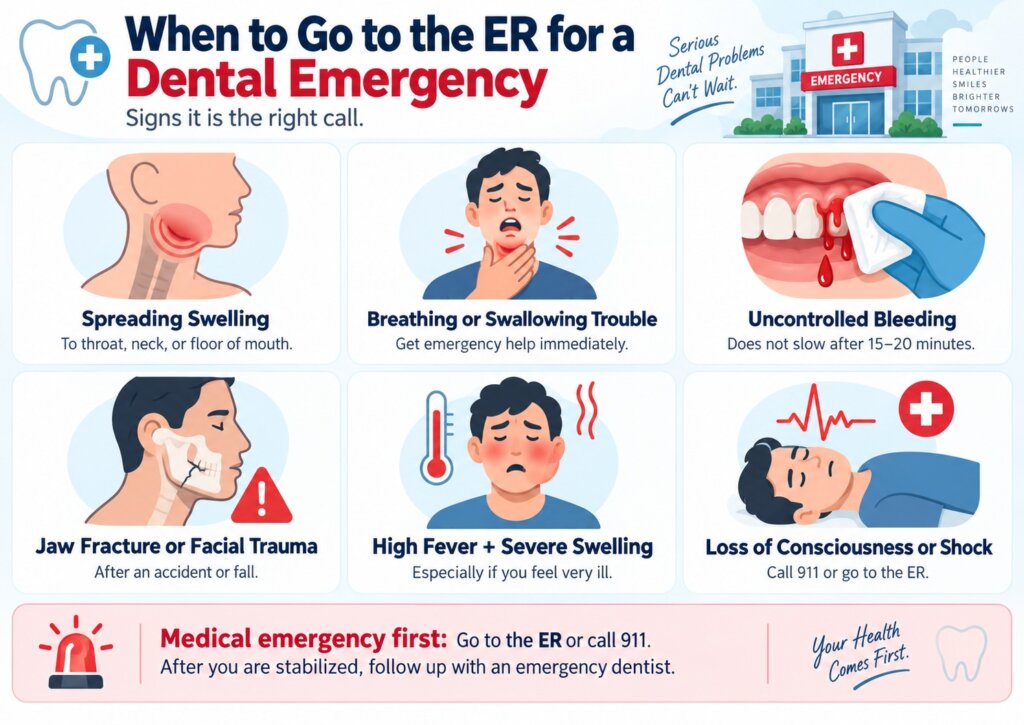
Some dental situations cross into medical territory, and those require emergency room care without delay. The American Academy of Pediatric Dentistry notes that dental emergencies can become life-threatening when there is uncontrolled bleeding, airway-compromising swelling, or significant facial trauma. These are the moments when the ER is not just appropriate—it is necessary.
MedlinePlus, published by the National Institutes of Health, advises seeking emergency care immediately for severe symptoms that go beyond tooth pain alone. If you’re unsure, err on the side of caution and call 911 or go to the ER first.
Go to the ER if you experience any of the following:
- Swelling that is spreading to your throat, neck, or floor of the mouth—this can block your airway
- Difficulty breathing or swallowing
- Uncontrolled bleeding that does not slow after 15 to 20 minutes of firm pressure
- Suspected jaw fracture or significant facial trauma from an accident or fall
- High fever combined with severe facial swelling, especially if you feel confused or extremely ill
- Loss of consciousness or signs of shock following oral or facial injury
These are medical emergencies first. Get to an ER or call 911. Once you are stabilized, follow up with an emergency dental care dentist for the dental side of treatment.
When Can You Go to the ER for a Dental Emergency? And When Should You Skip It
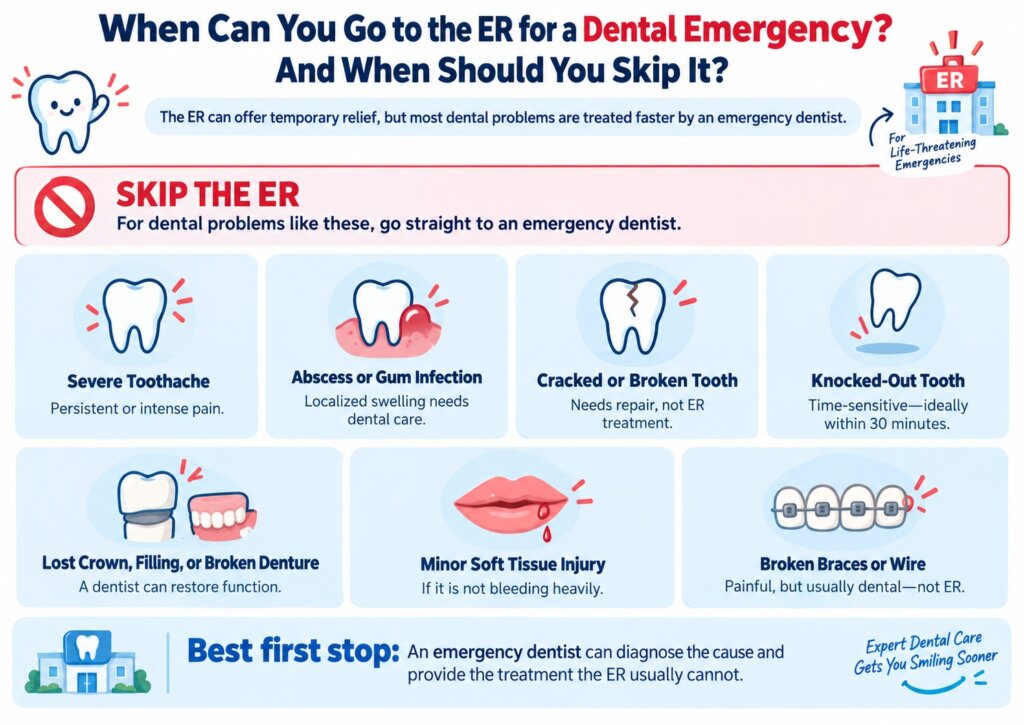
Here’s where it gets practical. A lot of people ask, can you go to the ER for a dental emergency when it’s a bad toothache or a broken tooth? Technically yes, but the ER will not fix either of those problems. They can offer temporary pain relief, but the underlying issue will remain until a dentist treats it.
The National Institute of Dental and Craniofacial Research (NIDCR) explains that dental emergencies—including severe pain, infection, bleeding, and trauma—warrant urgent care, but the type of care matters. For most dental-specific emergencies, a dentist office near me that offers urgent or same-day appointments is the faster, more effective route.
Skip the ER and go directly to an emergency dentist for:
- Severe or persistent toothache
- Dental abscess or gum infection with localized swelling
- Cracked, chipped, or fractured tooth
- Knocked-out tooth (time-sensitive—ideally within 30 minutes)
- Lost crown, filling, or broken denture
- Soft tissue injury inside the mouth that is not bleeding heavily
- Broken braces or orthodontic wire causing pain
For all of these, an emergency dental care dentist can do what the ER cannot: diagnose the problem with X-rays, treat the source of pain, and give you a real plan forward.
ER vs. Emergency Dentist: A Side-by-Side Comparison
It helps to see this laid out clearly. The table below compares what each setting can and cannot do for common dental emergencies.
| Situation | Emergency Room | Emergency Dentist |
|---|---|---|
| Severe toothache | Pain medication only | Diagnosis, treatment, pain relief |
| Dental abscess | Antibiotics, no drainage | Drainage, root canal, or extraction |
| Knocked-out tooth | Cannot reimplant | Can attempt reimplantation if timely |
| Cracked or broken tooth | No repair available | Repair, bonding, or extraction |
| Uncontrolled bleeding | Full medical management | Limited to dental-related bleeding |
| Facial fracture | Imaging, stabilization, surgery referral | Not equipped for fractures |
| Airway swelling | Immediate airway management | Not appropriate setting |
| Lost crown or filling | Cannot restore | Same-day recementation or temporary |
The pattern is clear. Life-threatening symptoms belong in the ER. Everything else—especially the dental procedures that actually fix the problem—belongs with an emergency dentist.
What Happens When You Go to an Emergency Dentist Instead
You might be wondering what an actual visit to an emergency dental care dentist looks like, especially if you’ve never needed one before. The process is more straightforward than most people expect, even when you’re in pain and stressed. At Emergency Dental San Francisco, the visit follows a clear sequence designed to get you out of pain as quickly as possible.
Here is what to expect, step by step:
1. Triage and Immediate Pain Control
The moment you arrive, the team assesses your symptoms and prioritizes pain relief. You are not left waiting without acknowledgment—comfort comes first.
2. Exam and Digital X-Rays
A licensed clinician performs a focused exam and takes digital X-rays to identify the source of the problem. This is something the ER cannot do for dental issues.
3. Clear Treatment Options and Upfront Estimate
You receive a plain-language explanation of what’s wrong and what can be done about it—extraction, root canal, repair, or temporary relief. Costs are discussed before anything begins.
4. Immediate Treatment When Appropriate
If treatment can be completed that day, it is. Most urgent dental procedures—including extractions, abscess drainage, and crown recementing—can be handled in a single visit.
5. Written Aftercare Instructions and Follow-Up Plan
You leave with written instructions, any needed prescriptions, and a clear plan for follow-up. No guessing, no vague next steps.
Emergency Dental San Francisco provides same-day urgent care across the Bay Area, including Oakland, Berkeley, Daly City, Fremont, and San Leandro. Walk-ins are welcome, and appointments are available 24/7—including weekends and holidays. Call 415-230-2783 or book online to be seen the same day.
What to Do Before You Arrive: Steps That Can Make a Difference
Getting to care quickly matters, but a few actions before you arrive can protect your tooth, reduce complications, and help the dentist treat you faster. These steps apply whether you are heading to a dentist office near me or waiting for an appointment slot.
1. Knocked-Out Tooth
Handle the tooth by the crown only—never the root. Rinse it gently, try to reinsert it into the socket, or keep it moist in milk or between your cheek and gum. Time matters here: the best outcomes happen within 30 minutes.
2. Severe Toothache or Swelling
Rinse with warm salt water and apply a cold compress to the outside of your face. Do not place aspirin directly on the gum tissue—it can cause a chemical burn.
3. Cracked or Broken Tooth
Save any fragments if possible. Avoid hard, sticky, or very hot or cold foods until you are seen. Rinse your mouth gently with warm water.
4. Lost Crown or Filling
Keep the area clean and avoid chewing on that side. If you still have the crown and it is intact, bring it with you—it may be recemented the same day.
5. Soft Tissue Injury or Bleeding
Apply gentle, firm pressure with clean gauze for 15 to 20 minutes. If bleeding does not slow, go to the ER. If it slows or stops, call an emergency dentist.
Can You Go to the ER for a Dental Emergency as a Child? Pediatric Considerations
Parents often face this question after a sports injury or a fall. Can you go to the ER for a dental emergency involving a child? The answer follows the same logic as for adults—go to the ER for airway issues, uncontrolled bleeding, or significant head and facial trauma. For dental-specific injuries like a knocked-out baby tooth, a cracked permanent tooth, or a severe toothache, a pediatric dentist near me or an emergency dental care dentist is the right call.
The American Academy of Pediatric Dentistry states clearly that dental emergencies in children can be life-threatening when they involve airway compromise or uncontrolled bleeding. Outside of those scenarios, a dentist who handles pediatric urgent care can treat the injury more effectively than an ER.
Our clinic provides gentle urgent care for children dealing with knocked-out teeth, sports injuries, broken braces, and severe toothaches. If you are searching for a pediatric dentist near me after hours or on a weekend, we are available to help. Call 415-230-2783 for immediate guidance on what to do next.
Insurance, Cost, and Access: What to Know Before You Go
One reason people default to the ER is uncertainty about dental costs. That concern is real, and it is worth addressing directly. ER visits for dental pain often result in higher out-of-pocket costs than a same-day dental visit—and they do not resolve the underlying problem, which means you will still need to see a dentist afterward.
At Emergency Dental San Francisco, we accept most dental insurance plans and offer financing options for patients who qualify. For those without insurance, we accept cash and all major credit cards. We provide upfront estimates before treatment begins, so there are no surprises. We work to keep emergency care accessible—because dental pain does not wait for a convenient time, and neither should your care.
If cost has been a barrier to seeking care, call us at 415-230-2783 to discuss your options before your visit. Our team will walk you through what to expect financially so you can make a clear decision.
Final Thoughts on Choosing the Right Care
Knowing where to go during a dental crisis can change the outcome. The ER handles what is life-threatening; an emergency dentist handles what is dental. When you choose the right setting, you get faster relief, proper treatment, and a clear path forward—without an unnecessary wait or an incomplete fix.
If you are in pain right now, do not wait to figure it out alone. Emergency Dental San Francisco is available same-day, after hours, and on weekends across the Bay Area. Call 415-230-2783 or book an appointment online and get the care that actually solves the problem.
Emergency Dental San Francisco offers same-day emergency dental care so you skip the ER wait. We treat toothaches, abscesses, and cracked teeth fast—any day, any hour. Call 415-230-2783 or book online. Get started now.
FAQs
Can I Go to the ER for a Tooth Infection?
Yes—go to the ER if you have facial/neck swelling, fever, trouble swallowing or breathing, or feel very ill, as these can be signs of a serious spreading infection. If it’s painful but stable, an urgent dentist can usually treat the source (such as draining an abscess or starting definitive care) faster than the ER; Emergency Dental San Francisco offers same-day and after-hours evaluation.
Will the ER Pull a Tooth or Treat Dental Pain?
Most ERs don’t extract teeth or provide definitive dental procedures; they typically manage pain, prescribe antibiotics when appropriate, and refer you to a dentist. For tooth removal or same-day dental treatment, Emergency Dental San Francisco can often provide in-office care and clear next steps.
What Will the ER Do for a Dental Emergency?
The ER will focus on ruling out life-threatening issues, controlling pain, addressing significant swelling or bleeding, and prescribing medications if needed, then refer you to a dentist for definitive treatment. An emergency dental clinic can usually diagnose with dental X-rays and treat the cause directly (like a cracked tooth, abscess, or knocked-out tooth).
How Much Does an ER Visit Cost for a Dental Emergency?
Costs vary widely, but ER visits are often more expensive than urgent dental care due to hospital facility fees, provider fees, and possible imaging or labs. If you want a clearer dental-specific estimate, Emergency Dental San Francisco accepts most insurance plans, offers financing for those who qualify, and provides transparent payment options for self-pay patients.
When Should I Go to the ER for a Dental Problem?
Go to the ER immediately for trouble breathing or swallowing, rapidly spreading facial/neck swelling, uncontrolled bleeding, high fever with severe swelling, signs of dehydration, or significant trauma (especially with jaw fracture concerns). For severe tooth pain, broken teeth, lost fillings/crowns, abscesses without airway symptoms, or a knocked-out tooth, an emergency dentist is usually the fastest route to relief and definitive care.

Emergency Dental San Francisco is a dental office focused on providing same-day dental appointments to patients in San Francisco and the surrounding area. We provide urgent dental care services during weekends, evenings and holidays.
We accept several forms of payment and have financing options available to those who qualify. We accept most dental insurance.