
27 Aug Emergency Room for Dental Problems: What They Can and Cannot Treat
You wake up at 2 a.m. with a throbbing jaw, a swollen cheek, or a tooth that just got knocked out. Your first instinct might be to head straight to the nearest hospital emergency room. That reaction makes sense—ERs are built for crises, and dental pain can feel like one. But the reality of what an ER can actually do for your teeth might surprise you.
This article breaks down exactly what emergency room staff can and cannot treat when it comes to dental problems. You will also learn when a dedicated emergency dental care dentist is the smarter, faster, and more effective choice—and what to do the moment something goes wrong with your teeth or mouth.
Key Takeaways
- Emergency rooms can manage pain and infection symptoms but generally cannot perform restorative dental procedures.
- Conditions like facial fractures, uncontrolled bleeding, or breathing difficulties require an ER visit immediately.
- A dentist office near me or an urgent dental clinic is the right first stop for most tooth-related emergencies.
- Knocked-out teeth, abscesses, cracked molars, and lost crowns are best handled by an emergency dental care dentist.
- Emergency Dental San Francisco offers same-day, after-hours, and weekend care across the Bay Area—call 415-230-2783 anytime.
What the Emergency Room for Dental Problems Can Actually Do
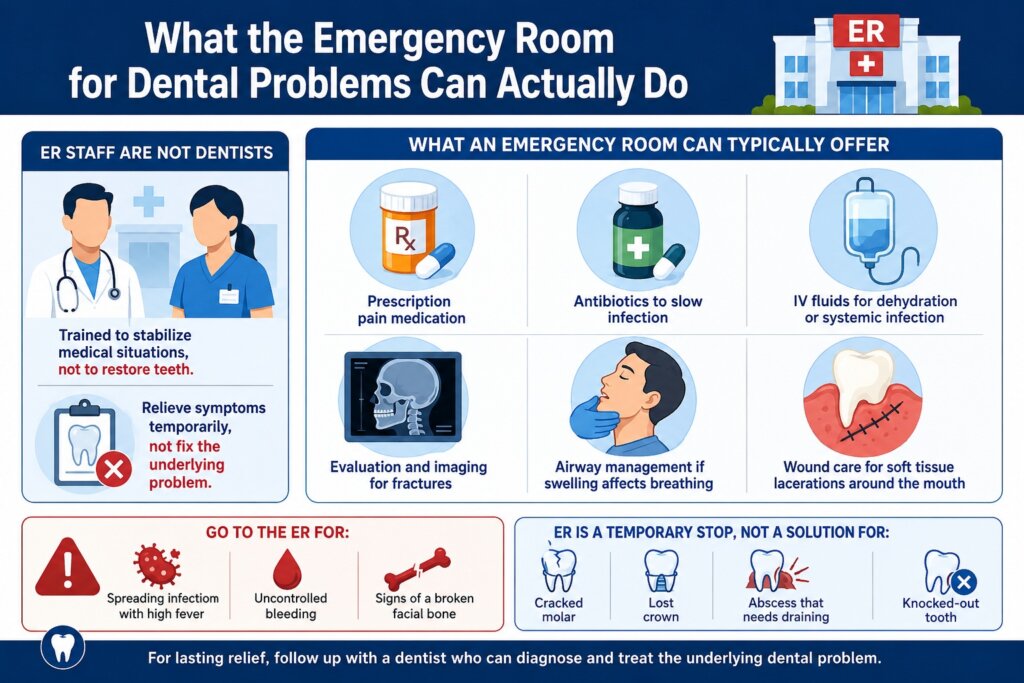
When you walk into a hospital ER with a dental complaint, the staff there are physicians and nurses—not dentists. They are trained to stabilize medical situations, not to restore teeth. That distinction matters more than most people realize when they are in pain and looking for answers fast.
According to the Cleveland Clinic, ER staff can relieve symptoms but generally do not provide restorative dental treatment. That means they can help you feel better temporarily, but they cannot fix the underlying dental problem.
Here is what an emergency room can typically offer for dental issues:
- Prescription pain medication to manage acute discomfort
- Antibiotics to slow the spread of a dental infection
- IV fluids if dehydration or systemic infection is a concern
- Evaluation and imaging for suspected facial or jaw fractures
- Airway management if swelling is affecting your ability to breathe
- Wound care for soft tissue lacerations around the mouth
These are meaningful interventions. If you have a spreading infection with a high fever, uncontrolled bleeding that will not stop, or signs of a broken facial bone, the ER is the right call. The Cleveland Clinic also notes that more serious injuries, such as broken facial bones, should go directly to the emergency room.
But for everything else—the cracked molar, the lost crown, the abscess that needs draining, the knocked-out tooth—the ER is a temporary stop, not a solution.
What the Emergency Room for Dental Problems Cannot Treat
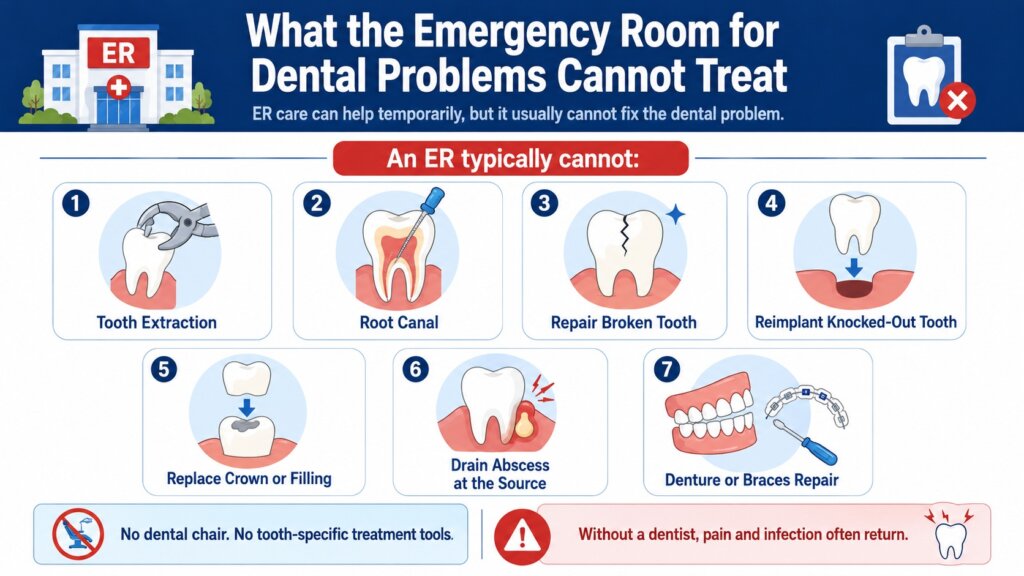
This is where most patients feel frustrated after an ER visit. They leave with a prescription and a referral, but the tooth is still broken, still infected, still missing. That is not a failure of ER staff—it is simply outside their scope of practice and equipment.
Emergency rooms are not equipped with dental chairs, X-ray systems calibrated for individual teeth, or the instruments needed for extractions, root canals, or crown replacements. A physician can identify that you have an abscess, but they cannot drain it the way a dentist can. They can prescribe antibiotics, but the source of the infection—the damaged or decayed tooth—remains untreated.
Here is what an ER typically cannot do for dental emergencies:
- Extract a damaged or infected tooth
- Perform a root canal or pulp treatment
- Repair a cracked, chipped, or broken tooth
- Reattach or reimplant a knocked-out tooth
- Replace a lost crown, filling, or dental restoration
- Drain a dental abscess at the source
- Provide same-day denture repair or orthodontic relief
You might be wondering what happens to patients who rely only on the ER for dental pain. In most cases, symptoms return within days once the antibiotics wear off and the pain medication fades—because the actual dental problem was never addressed.
A PubMed-indexed study on pediatric emergency dentistry highlights that proper management of dental emergencies requires preparation, appropriate equipment, and trained dental professionals—not just symptom relief. This applies to adult patients as well.
When the Emergency Room for Dental Problems Is the Right Choice
There are situations where going to the ER first is not just reasonable—it is necessary. Knowing the difference can protect your health and potentially save your life.
Go directly to the nearest emergency room if you experience any of the following:
1. Suspected Facial or Jaw Fractures
If your jaw feels misaligned after trauma or you cannot open or close your mouth normally, that requires imaging and orthopedic evaluation that only a hospital can provide. This is not something a dentist office near me can manage alone.
2. Uncontrolled Bleeding
Some bleeding after a tooth injury is normal. Bleeding that does not slow down after 20 minutes of firm pressure, or bleeding that is heavy and continuous, needs emergency medical attention right away.
3. Swelling That Affects Breathing or Swallowing
A dental abscess that spreads to the throat or airway can become life-threatening. If swelling is making it hard to breathe, swallow, or speak, call 911 or get to an ER immediately. This is a medical emergency, not a dental one.
4. High Fever with Signs of Systemic Infection
A fever above 101°F combined with dental pain and swelling may signal that an infection has moved beyond the tooth and into surrounding tissue or the bloodstream. ER evaluation is appropriate in this scenario.
5. Significant Facial Trauma
Car accidents, falls, or sports injuries that involve the face may include broken bones, deep lacerations, or concussions. These require a full medical workup before any dental treatment can begin.
Outside of these specific situations, a dedicated emergency dental care dentist is the more effective first stop. You will get faster dental treatment, proper diagnosis, and an actual solution—not just a temporary patch.
Emergency Room vs. Emergency Dentist: A Direct Comparison
It helps to see the difference laid out clearly. The table below compares what each setting offers for common dental emergencies.
| Situation | Emergency Room | Emergency Dentist |
|---|---|---|
| Severe toothache | Pain medication only | Diagnosis, X-ray, root canal or extraction |
| Dental abscess | Antibiotics, no drainage | Drainage, infection control, root canal |
| Knocked-out tooth | No reimplantation | Reimplantation if within 30–60 minutes |
| Cracked or broken tooth | No repair | Same-day bonding, crown, or extraction |
| Lost crown or filling | No restoration | Recementation or temporary restoration |
| Facial fracture | Full evaluation and imaging | Not equipped for this |
| Airway swelling | Airway management | Not equipped for this |
| Uncontrolled bleeding | Wound care and IV access | Limited to minor bleeding control |
The pattern is clear. For anything involving the tooth itself—pain, infection, fracture, or loss—an emergency dental care dentist is the right provider. For systemic or structural emergencies involving bones, airways, or uncontrolled bleeding, the ER is where you need to be.
What an Emergency Dental Care Dentist Can Do That the ER Cannot
Emergency Dental San Francisco exists specifically for the situations where the ER falls short. We are an urgent-care dental practice built around same-day, after-hours, weekend, and holiday access—because dental pain does not follow a schedule, and neither do we.
Our team handles the full range of dental emergencies that hospital ERs are not equipped to treat. From the moment you arrive, our focus is on pain relief first, then diagnosis, then a clear plan.
Our core emergency services include:
- Urgent dental exams and digital X-rays for accurate diagnosis
- Emergency tooth extractions, including case-dependent wisdom teeth
- Root canal therapy to treat infected pulp and relieve severe pain
- Repair of broken, chipped, or cracked teeth
- Recementation or replacement of lost crowns and fillings
- Abscess drainage and infection control
- Soft tissue injury management
- Same-day denture repair through our lab network
- Gentle pediatric urgent care for knocked-out teeth, sports injuries, and broken braces
A PubMed-indexed study on after-hours pediatric dental emergencies found that general practitioners often referred patients to an emergency department or saw them urgently, while pediatric dentists more commonly deferred care. That gap is exactly why having access to a qualified emergency dental care dentist matters—especially for children and families who need real treatment, not a referral.
The American Academy of Pediatric Dentistry also states that emergency care for infants, children, adolescents, and individuals with special health care needs is an essential duty of every dentist. We take that responsibility seriously at our clinic.
If you are searching for a dentist near me after hours or on a weekend, we serve San Francisco and the surrounding Bay Area—including Oakland, Berkeley, Alameda, Daly City, Fremont, South San Francisco, and San Leandro. Walk-ins are welcome, and same-day appointments are available. Call 415-230-2783 or book online to get started.
What to Do Before You Arrive at an Emergency Dentist Office Near Me
Getting to care quickly is the priority. But a few steps taken in the minutes before you arrive can make a real difference in outcomes—especially for knocked-out teeth, where time is a critical factor.
1. For a Knocked-Out Tooth
Handle the tooth by the crown, not the root. Gently rinse it without scrubbing, try to reinsert it into the socket if possible, or keep it moist in milk or between your cheek and gum—and get to us within 30 minutes for the best chance of saving it.
2. For a Severe Toothache or Swelling
Use a warm salt-water rinse and apply a cold compress to the outside of your cheek. Do not place aspirin directly on your gums—it can cause tissue damage and will not speed up relief.
3. For a Broken or Chipped Tooth
Save any fragments you can find and bring them with you. Avoid hard or sticky foods until you are seen, and rinse gently with warm water to keep the area clean.
4. For a Lost Crown or Filling
Keep the area clean and bring any intact restoration to your appointment. Dental cement from a pharmacy can be used as a very short-term temporary measure, but it is not a substitute for professional care.
5. What to Bring to Your Visit
Arrive a few minutes early with a government-issued ID, your insurance card if you have one, a list of current medications and allergies, and any recent dental X-rays or records. This helps us triage and treat you faster.
We accept most dental insurance plans and offer financing for qualified patients. For those without insurance, we accept cash and all major credit cards. Up-front estimates are provided whenever possible so there are no surprises. Check our insurance and financing page for details.
Conclusion
Emergency rooms can manage pain and systemic symptoms, but they cannot fix your teeth—that requires a trained dentist with the right tools. For most dental emergencies, Emergency Dental San Francisco is your fastest path to real relief and a clear treatment plan. Call 415-230-2783 or book a same-day appointment now—we are here around the clock, every day of the year.
Emergency Dental San Francisco provides same-day emergency dental care beyond what ERs offer. We treat toothaches, abscesses, and cracked teeth fast. Call 415-230-2783 or book online—get started today.
FAQs
Can I Go to the Emergency Room for a Toothache?
Yes—especially if you have facial swelling, fever, trouble breathing/swallowing, or severe uncontrolled pain. For most toothaches, an emergency dentist can typically diagnose the cause (often with X-rays) and provide same-day treatment to relieve pain and fix the problem; Emergency Dental San Francisco offers same-day, after-hours, weekend, and holiday care—call 415-230-2783 or book online.
Will the ER Treat a Dental Infection or Abscess?
The ER can help stabilize serious infections (especially with spreading swelling or systemic symptoms) and may prescribe medications, but they usually can’t provide definitive dental treatment like draining an abscess, root canal therapy, or extraction. An urgent-care dental office can often treat the source of the infection quickly and safely, with clear next steps.
What Will the ER Do for Dental Pain?
Most ERs focus on symptom control—pain relief, evaluation for dangerous swelling or infection, and sometimes antibiotics—then refer you to a dentist. Emergency Dental San Francisco is equipped to diagnose the cause and provide definitive dental care when appropriate, so you’re not just managing pain temporarily.
How Much Does an ER Visit Cost for Dental Pain?
Costs vary widely and are often higher than urgent dental care because ER billing may include facility fees, imaging, and physician charges. Emergency Dental San Francisco accepts most dental insurance, offers financing for those who qualify, and provides transparent payment options for uninsured patients.
Where Can I Go for Emergency Dental Care if I Don’t Have a Dentist?
You can visit an urgent-care dental practice that accepts walk-ins or same-day appointments. Emergency Dental San Francisco serves San Francisco and the Bay Area, is reachable 24/7 by phone, and can help you get fast relief and a clear follow-up plan—call 415-230-2783 or book online.

Emergency Dental San Francisco is a dental office focused on providing same-day dental appointments to patients in San Francisco and the surrounding area. We provide urgent dental care services during weekends, evenings and holidays.
We accept several forms of payment and have financing options available to those who qualify. We accept most dental insurance.