
20 Jul True Dental Emergency Signs: How to Distinguish Urgent Symptoms From Problems That Can Wait
Dental pain has a way of arriving at the worst possible time—late on a Friday, during a holiday weekend, or right before an important morning. When that happens, most people face the same question: is this serious enough to act on right now, or can it wait until Monday? The answer depends on what you’re experiencing, and getting it wrong in either direction can cost you. Waiting too long with a true emergency can lead to spreading infection or permanent tooth loss. Rushing to an ER for something manageable wastes time and money.
This article breaks down what is a true dental emergency, which symptoms signal immediate danger, and what separates a genuine crisis from an urgent but non-life-threatening situation. You’ll also find out what to do before you arrive at a dentist office near me, what to expect during your visit, and when calling 415-230-2783 is the right move.
Key Takeaways
- A true dental emergency involves conditions that are potentially life-threatening, including uncontrolled bleeding, airway-compromising swelling, or severe infection.
- The American Dental Association (ADA) distinguishes between true emergencies and urgent dental care—both need prompt attention, but the response differs.
- Signs like fever with facial swelling, a knocked-out tooth, or uncontrolled bleeding require you to act within minutes, not hours.
- A dentist, not an emergency room, is the right first call for most dental crises unless breathing or severe trauma is involved.
- Emergency Dental San Francisco offers same-day, after-hours, and weekend care across the Bay Area—walk-ins welcome, financing available.
What Is a True Dental Emergency According to the ADA?

The American Dental Association defines a true dental emergency as a potentially life-threatening condition that requires immediate treatment. Specifically, this means stopping ongoing tissue bleeding, addressing a serious infection, or relieving severe pain that cannot be managed with over-the-counter measures. These are not situations where waiting a few days is reasonable—they are situations where delay can cause real harm.
The ADA also separates true emergencies from what it calls urgent dental care. Urgent care covers conditions that need prompt attention to relieve severe pain or reduce infection risk, but are not immediately life-threatening. Think of a painful cracked tooth versus a swollen jaw that is making it hard to breathe—both need care, but the second one needs it faster and may require a different setting.
Understanding this distinction helps you make a faster, calmer decision when pain hits.
True Dental Emergency Signs That Dentists Treat as Immediate Threats
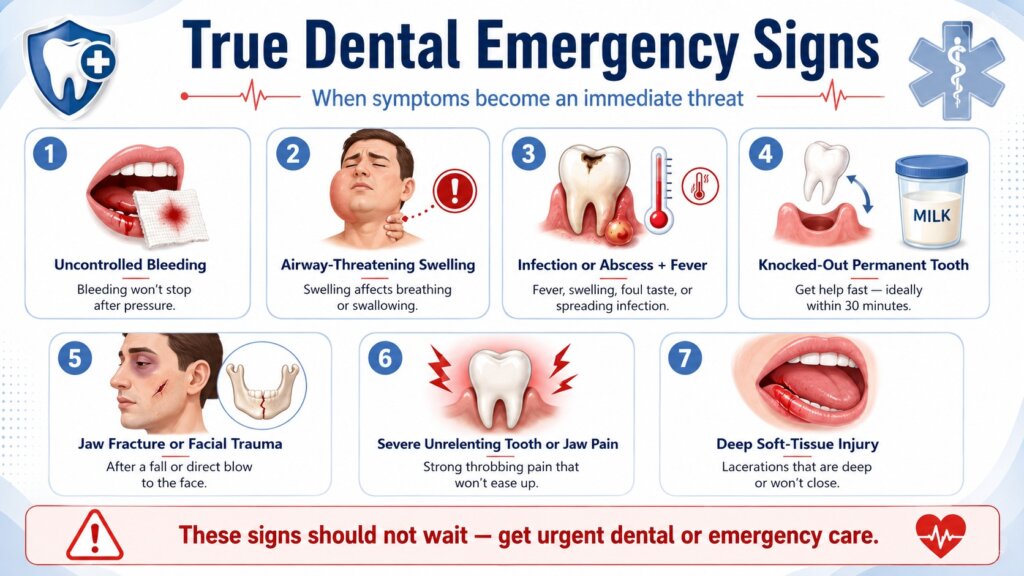
You might be wondering what specific symptoms actually qualify as a true dental emergency. The list is shorter than most people think, but each item on it carries real risk if ignored. These are the signs that tell a dentist—and you—that something is happening that cannot wait.
1. Uncontrolled Bleeding That Does Not Stop
Bleeding from the mouth after a tooth extraction or injury is expected for a short time. If firm pressure with gauze for 20 to 30 minutes does not slow or stop the bleeding, that is a dental emergency. Persistent oral bleeding can indicate a clotting issue, a torn blood vessel, or trauma that needs clinical intervention immediately.
2. Swelling That May Affect Your Airway or Breathing
Facial or neck swelling that feels like it is spreading downward—toward your throat or under your jaw—is one of the most serious dental emergencies possible. This type of diffuse soft-tissue infection can compromise your airway, which is a life-threatening situation. If you notice difficulty swallowing, speaking, or breathing alongside facial swelling, go to the nearest emergency room and call 911 if needed.
3. Signs of a Spreading Dental Infection or Abscess With Fever
A dental abscess is a pocket of infection at the root of a tooth or in the surrounding gum tissue. When an abscess is accompanied by fever, chills, swelling, or a foul taste in your mouth, it signals that the infection may be spreading beyond the tooth. Left untreated, oral infections can enter the bloodstream—a condition called sepsis—which is a medical emergency.
4. A Knocked-Out Permanent Tooth
Time is the deciding factor with an avulsed (knocked-out) tooth. Ideally, you need to see a dentist within 30 minutes for the best chance of saving the tooth. Handle the tooth by the crown only, rinse it gently without scrubbing, try to reinsert it into the socket if you can, or keep it moist in milk or between your cheek and gum while you travel to the clinic.
5. Facial Bone Trauma or Jaw Fracture
A fall, collision, or direct blow to the face can fracture the jaw or surrounding facial bones. Symptoms include visible misalignment, inability to close your mouth properly, numbness, or severe swelling after impact. This type of injury often requires both dental and medical evaluation, and heading to an emergency room first may be appropriate depending on severity.
6. Severe, Unrelenting Tooth or Jaw Pain
Pain that is sharp, throbbing, and not responding to ibuprofen or acetaminophen—especially when combined with swelling or fever—is not something to sleep off. Severe dental pain often signals deep infection, pulp damage, or an abscess that requires professional treatment to resolve. The Cleveland Clinic advises calling your dentist first; if you do not have one, urgent care or an emergency dental clinic is the right next step.
7. Soft-Tissue Injuries That Won’t Close
Lacerations to the tongue, cheeks, or gums that are deep, gaping, or bleeding consistently need clinical attention. These injuries may require sutures and should be evaluated to rule out underlying damage to teeth or bone. Do not attempt to close them at home with adhesives or bandages.
What Is a True Dental Emergency Versus an Urgent Dental Situation?
Not every painful dental problem is a life-threatening emergency. The ADA draws a clear line between true emergencies—those that could threaten your life or cause irreversible harm quickly—and urgent situations that still need same-day or next-day care. Knowing the difference helps you stay calm and choose the right level of response.
| Situation | Classification | Recommended Action |
|---|---|---|
| Uncontrolled bleeding | True Emergency | Call 415-230-2783 or go to ER if severe |
| Airway-compromising swelling | True Emergency | Call 911 or go to ER immediately |
| Knocked-out permanent tooth | True Emergency | See a dentist within 30 minutes |
| Abscess with fever | True Emergency | Call dentist now; ER if breathing affected |
| Severe toothache without swelling | Urgent Dental Care | Same-day dental appointment |
| Cracked or chipped tooth | Urgent Dental Care | Same-day or next-day dental visit |
| Lost crown or filling | Urgent Dental Care | Schedule within 24–48 hours |
| Broken denture | Urgent Dental Care | Same-day repair if possible |
If your situation falls in the urgent category, it still deserves prompt attention—just not a 911 call. Emergency Dental San Francisco handles both categories. Our team triages each case on arrival, provides immediate pain control, and builds a clear treatment plan so you are never left guessing what comes next.
What to Do Before You Reach a Dentist Office Near Me
Getting to a dentist quickly is the priority, but a few steps taken on the way can reduce pain and protect the tooth or tissue involved. These are practical, evidence-based measures—not substitutes for professional care.
- For a knocked-out tooth: Keep it moist. Milk is the best option. Do not wrap it in a dry tissue or let it dry out.
- For bleeding: Apply firm, steady pressure with clean gauze. Do not remove the gauze every few minutes to check—hold it in place.
- For swelling or pain: Apply a cold compress to the outside of your cheek in 10-minute intervals. Do not place ice directly on the gum or tooth.
- For a severe toothache: Rinse gently with warm salt water. Take ibuprofen or acetaminophen at the recommended dose—do not place aspirin directly on the gum tissue, as this can cause a chemical burn.
- For a broken tooth: Save any fragments in a clean container. Avoid hard, sticky, or very hot or cold foods until you are seen.
- For a lost crown or filling: Keep the area clean. If you have the crown intact, bring it with you to the appointment.
When you arrive at our clinic, bring a government-issued ID, your insurance card if you have one, a list of current medications and allergies, and any recent X-rays or dental records. Arriving about 15 minutes early helps us get you into triage faster.
When to Search for a Dentist Near Me Versus When to Go to the ER
This is one of the most common points of confusion for patients in pain. Emergency rooms are not equipped to treat most dental problems—they can manage pain and prescribe antibiotics, but they cannot perform extractions, root canals, or tooth repairs. For the majority of dental emergencies, a dentist is the right first call.
Go directly to the ER or call 911 if you experience difficulty breathing or swallowing due to swelling, suspected facial bone fractures, a head or neck injury with dental trauma, or bleeding that is not slowing after sustained pressure. For everything else—including severe toothaches, abscesses, knocked-out teeth, cracked teeth, and infections without airway involvement—contact a dentist first.
Emergency Dental San Francisco is available 24 hours a day, every day of the year, including weekends and holidays. Whether you’re searching for a dentist near me at 2 a.m. on a Sunday or need a same-day appointment on a holiday, our team is reachable at 415-230-2783. We serve patients across San Francisco, Oakland, Berkeley, Alameda, Daly City, Fremont, South San Francisco, and San Leandro. Walk-ins are welcome, and online booking is available for those who prefer it.
What Happens During Your Emergency Dental Visit
Knowing what to expect can make the experience less stressful. A visit to our dentist office near me follows a straightforward sequence designed to get you out of pain as quickly as possible while making sure you understand every step.
- Triage and Pain Control: You are assessed on arrival. If you are in severe pain, we address that first—before anything else. Comfort is the immediate priority.
- Exam and Imaging: A clinical exam and digital X-rays help identify the source of the problem. Our licensed clinicians use modern equipment in a clean, sterilized environment that meets CDC and OSHA infection-control standards.
- Clear Options and an Estimate: Before any procedure begins, we explain your options—whether that is an extraction, root canal therapy, repair, or temporary relief—and provide a cost estimate. We accept most dental insurance plans, including MetLife dental. For patients who need it, financing options are available for those who qualify, and we accept cash and all major credit cards.
- Immediate Treatment: When indicated, treatment happens the same visit. We do not send you home in pain with just a referral.
- Written Aftercare and Follow-Up Plan: You leave with written instructions, any necessary prescriptions, and a realistic plan for follow-up care.
If you are a parent looking for a pediatric dentist near me for an urgent situation—a knocked-out baby tooth, a sports injury, or a broken bracket—our team also provides gentle pediatric urgent care. Children’s dental emergencies follow the same triage process, adapted to keep younger patients calm and comfortable.
Conclusion
A true dental emergency is defined by risk—to your life, your airway, or your ability to save a tooth—and acting fast is what changes the outcome. If you recognize any of the signs above, do not wait to see if they improve on their own. Call Emergency Dental San Francisco at 415-230-2783 or book an appointment online for same-day, after-hours, and weekend care across the Bay Area. Relief, answers, and a clear next step are available right now.
Emergency Dental San Francisco specializes in same-day dental trauma care for cracked, knocked-out, or severely painful teeth. We serve the Bay Area 24/7 with compassionate, licensed professionals. Call 415-230-2783 or book online—get started today.
FAQs
What Is Considered a True Dental Emergency?
A true dental emergency is any mouth or tooth problem that involves uncontrolled bleeding, severe pain, facial swelling, signs of infection (like an abscess), trauma (knocked-out or displaced tooth), or anything that could worsen quickly without treatment. When in doubt, call for same-day guidance so you can get safe relief fast.
How Do I Know If My Tooth Problem Is an Emergency?
It’s an emergency if pain is intense or worsening, you have swelling, fever, pus/bad taste, trouble chewing or opening your mouth, a broken tooth with sharp edges, or a tooth that’s loose or knocked out. If symptoms are spreading or keeping you from sleeping, you should be seen urgently.
What Dental Issues Require Immediate Attention?
Knocked-out teeth, suspected abscesses, significant swelling, uncontrolled bleeding, severe toothaches, broken teeth with nerve exposure, jaw injuries, and lost fillings/crowns causing major pain should be treated right away. Prompt care helps prevent infection and can improve the chance of saving the tooth.
When Should I Go To The ER For A Dental Problem?
Go to the ER if you have trouble breathing or swallowing, swelling that’s rapidly spreading (especially under the jaw or into the neck), high fever, uncontrolled bleeding, serious facial trauma, or signs of a severe allergic reaction. For most dental pain, abscesses, and broken teeth, an urgent-care dentist is typically the fastest place for definitive treatment.
Can I Wait Until Morning To See A Dentist For Tooth Pain?
You can sometimes wait if the pain is mild, improving, and there’s no swelling, fever, trauma, or bad taste/drainage. If pain is severe, waking you up, or accompanied by swelling or infection signs, don’t wait—getting evaluated sooner can prevent complications and provide faster relief.

Emergency Dental San Francisco is a dental office focused on providing same-day dental appointments to patients in San Francisco and the surrounding area. We provide urgent dental care services during weekends, evenings and holidays.
We accept several forms of payment and have financing options available to those who qualify. We accept most dental insurance.