

10 Jun Is an Abscess a Dental Emergency? What You Need to Know
You wake up at 2 a.m. with a throbbing jaw, a strange taste in your mouth, and swelling that wasn’t there yesterday. Something feels wrong — and it probably is. A dental abscess is not something you can sleep off or treat with over-the-counter painkillers alone.
This article walks you through what a dental abscess actually is, why it qualifies as a dental emergency, which symptoms demand immediate attention, and what treatment looks like when you arrive at an urgent dental clinic near me. You’ll also find out exactly when to call for same-day care and what to do while you wait.
Key Takeaways
- A dental abscess is a bacterial infection that will not resolve on its own without professional treatment.
- Swelling, fever, and difficulty swallowing are warning signs that require immediate care — not a wait-and-see approach.
- An abscess can spread to the jaw, neck, or airway if left untreated, making it a genuine medical emergency.
- Emergency Dental San Francisco offers same-day abscess treatment, including drainage, root canal therapy, and infection control.
- Most dental insurance plans cover emergency abscess treatment, and financing options are available for those without coverage.
- Patients across the Bay Area — from Oakland to Daly City — can walk in or book a same-day appointment any day of the week.
Is an Abscess a Dental Emergency? The Direct Answer
Yes — a dental abscess is a dental emergency. According to the NHS, a dental abscess is a build-up of pus caused by a bacterial infection, and it will not go away on its own. Without professional treatment, the infection can spread beyond the tooth and into surrounding tissue, the jaw, or even the airway.
The Mayo Clinic recommends seeing a dentist promptly at the first signs of an abscess. If fever and facial swelling are present and you cannot reach a dentist, seeking urgent help right away is the recommended course of action.
The short answer is this: if you suspect an abscess, do not wait. The longer an infection goes untreated, the more complicated — and costly — treatment becomes.
Understanding why the urgency matters starts with knowing what an abscess actually does inside your body. It is not just localized pain. It is an active infection that your immune system is fighting, and sometimes losing.
What Is a Dental Abscess and Why Is It Dangerous Near a Dental Clinic?
A dental abscess forms when bacteria enter the tooth or surrounding gum tissue and multiply. The body responds by sending white blood cells to fight the infection, and pus — a mixture of dead tissue, bacteria, and white blood cells — accumulates in a pocket near the root or gum. There are two main types: a periapical abscess, which forms at the tip of a tooth’s root, and a periodontal abscess, which forms in the gum tissue beside a tooth.
What makes an abscess dangerous is its potential to spread. The Cleveland Clinic notes that symptoms such as worsening pain, swelling, or trouble swallowing can indicate a more serious emergency — one that may require hospital-level intervention if it reaches the throat or airway.
Left untreated, an abscess can develop into a condition called Ludwig’s angina, a rapidly spreading infection of the floor of the mouth. That is a life-threatening situation. Most people never get there — but only because they sought treatment in time.
Warning Signs That Confirm Is an Abscess a Dental Emergency for Dental Assistant Jobs and Clinicians
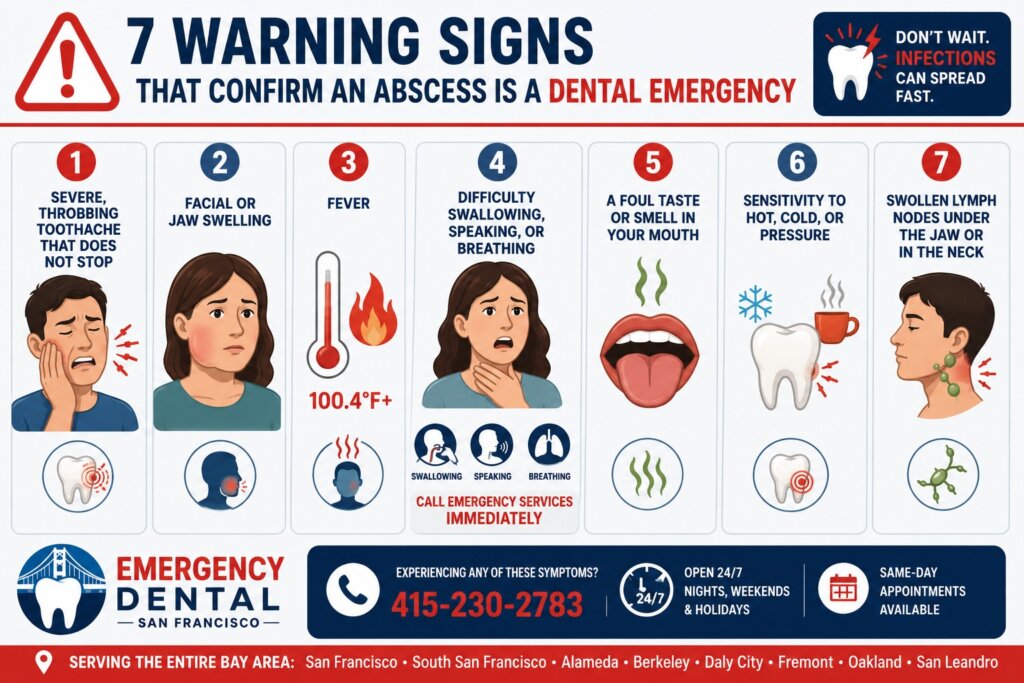
Some symptoms are uncomfortable but manageable. Others are signals that you need care within hours, not days. Knowing the difference can protect your health and, in rare cases, your life. Here are the key warning signs to watch for:
1. Severe, Throbbing Toothache That Does Not Stop
An abscess-related toothache is often described as a constant, pulsing pain that radiates to the jaw, ear, or neck. Over-the-counter pain relief may dull it temporarily, but it will return — and often intensifies overnight.
2. Facial or Jaw Swelling
Visible swelling on one side of your face, jaw, or cheek is a sign the infection is spreading into surrounding tissue. This symptom alone warrants a same-day dental appointment.
3. Fever
A fever signals that your body is fighting a systemic infection. Combined with dental pain or swelling, a fever is a clear indicator that the abscess needs immediate professional attention. The Mayo Clinic specifically flags this combination as a reason to seek urgent help.
4. Difficulty Swallowing, Speaking, or Breathing
The NHS identifies these as signs of a severe emergency. If the infection has spread to the throat or is affecting your airway, call emergency services immediately — this goes beyond what a dental clinic can manage alone.
5. A Foul Taste or Smell in Your Mouth
A sudden salty or bitter taste, especially after feeling pressure in the gum, may mean the abscess has ruptured. This does not mean the infection is gone — it means pus has drained into your mouth and the source still needs treatment.
6. Sensitivity to Hot, Cold, or Pressure
Sharp sensitivity when biting down or drinking something warm or cold can indicate nerve involvement. This is a common early symptom that often precedes more serious swelling.
7. Swollen Lymph Nodes Under the Jaw or in the Neck
Tender, swollen lymph nodes in the neck or under the chin are a sign your immune system is actively responding to infection spreading beyond the tooth itself.
If you are experiencing any combination of these symptoms, this is the moment to contact Emergency Dental San Francisco at 415-230-2783. Our team handles abscess emergencies every day — including nights, weekends, and holidays — with same-day appointments available across the Bay Area.
Is an Abscess a Dental Emergency When You Have MetLife Dental Login or Insurance Coverage?
One of the most common reasons people delay care is cost uncertainty. You might be wondering whether your insurance covers an emergency abscess visit — and the answer, in most cases, is yes. Emergency Dental San Francisco accepts most dental insurance plans, including those accessible through the MetLife dental provider login portal and similar networks.
For patients without coverage, we accept cash and all major credit cards. Financing options are also available for those who qualify, so cost does not have to be a reason to delay treatment that genuinely cannot wait.
If you use a Brident Dental plan or another network plan, it is worth calling ahead to confirm in-network status. Our front desk team can help you sort that out quickly — even if you are calling at 11 p.m. on a Saturday.
| Symptom | Urgency Level | Recommended Action |
|---|---|---|
| Throbbing toothache, no swelling | Urgent — same day | Call for a same-day appointment |
| Swelling with or without fever | High — within hours | Call 415-230-2783 immediately |
| Difficulty swallowing or breathing | Critical — airway risk | Call 911 or go to the ER |
| Foul taste after pressure relief | Urgent — infection active | See a dentist same day |
| Swollen lymph nodes, no fever | Moderate to high | Schedule urgent dental visit |
What Happens When You Come In: Treatment for Abscesses at an Urgent Dental Clinic Near Me
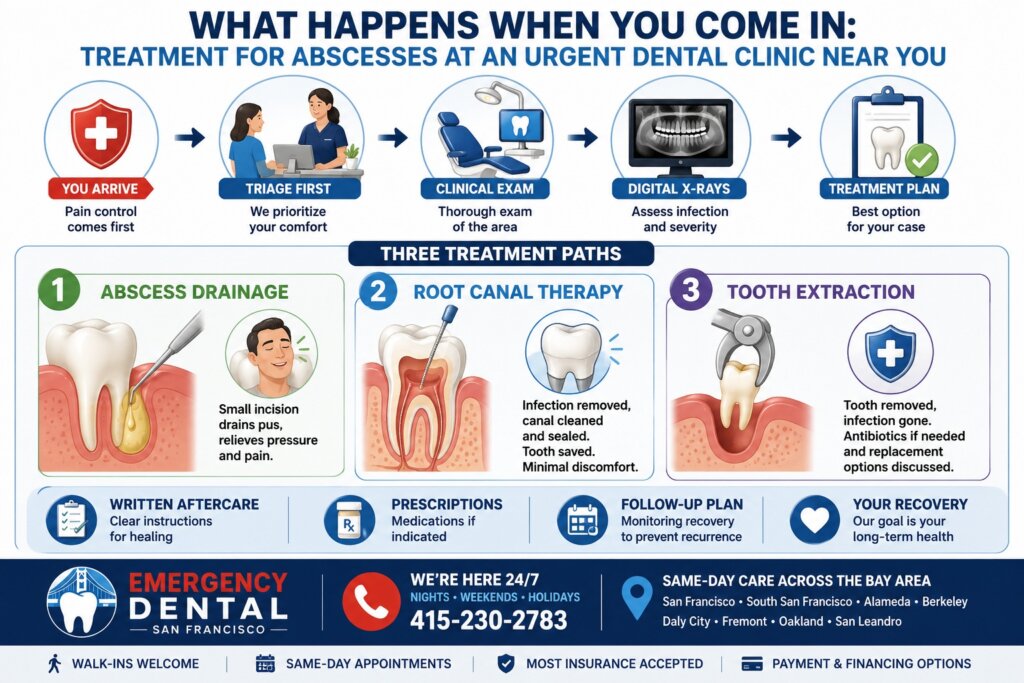
When you arrive at our clinic, the first priority is pain control. We do not make you fill out paperwork while you are in agony. Triage comes first, then a clinical exam and digital X-rays to assess the extent of the infection and determine the best course of treatment.
From there, treatment typically follows one of three paths depending on the severity and location of the abscess.
1. Abscess Drainage
If the abscess is accessible, a clinician will make a small incision to drain the pus and relieve pressure. This often provides immediate pain relief and allows the area to begin healing.
2. Root Canal Therapy
When the infection originates inside the tooth — at the root — a root canal is often the recommended treatment. The infected pulp is removed, the canal is cleaned and sealed, and the tooth is preserved. This is not the painful procedure it is sometimes portrayed as; with modern anesthesia, most patients report feeling pressure but not pain.
3. Tooth Extraction
In cases where the tooth cannot be saved, extraction removes the source of infection entirely. This is followed by a prescription for antibiotics if needed, and a clear plan for tooth replacement options once healing is complete.
Every patient leaves with written aftercare instructions, prescriptions if indicated, and a follow-up plan. That last part matters more than people realize — treating the abscess is step one, but monitoring recovery is how you avoid a recurrence.
What to Do Before You Arrive: Steps to Manage Abscess Pain at Home
These steps will not treat the infection, but they can help reduce discomfort while you arrange to be seen. Think of them as temporary measures, not solutions.
- Rinse gently with warm salt water to reduce bacteria in the mouth and soothe inflamed tissue.
- Apply a cold compress to the outside of your cheek for 10 to 15 minutes at a time to reduce swelling.
- Take over-the-counter pain relievers such as ibuprofen as directed — do not place aspirin directly on gum tissue.
- Avoid hot foods and drinks, which can increase pain and inflammation.
- Do not try to pop or drain the abscess yourself — this can push bacteria deeper into the tissue.
- Gather your insurance card, a list of current medications and allergies, and any recent dental X-rays to bring to your appointment.
These steps are not a substitute for care. They are a bridge to get you from right now to your appointment with us.
Is an Abscess a Dental Emergency Even Without Pain? What Dental Assistant Jobs Training Teaches
This is a question that comes up more than you might expect. Some abscesses — particularly chronic ones — present with little to no pain. The infection is still active. The damage is still occurring. Pain is not always a reliable indicator of severity.
Clinicians trained in dental assistant jobs and emergency dentistry know that a painless abscess can be just as dangerous as a painful one. If you notice swelling, a visible bump on the gum, or a persistent bad taste without significant pain, that is still worth a same-day evaluation.
Do not use the absence of pain as a reason to delay. Use it as an opportunity to catch the problem before it escalates.
Serving the Bay Area: Same-Day Abscess Care From Oakland to Daly City
Emergency Dental San Francisco serves patients across a wide area — not just within San Francisco proper. Whether you are in Oakland, Berkeley, Alameda, Fremont, San Leandro, Daly City, or South San Francisco, same-day and after-hours care is within reach.
Walk-ins are welcome. Online booking is available. And if you are in too much pain to navigate a website, a phone call to 415-230-2783 connects you directly with our team, 24 hours a day, every day of the year. Our clinicians follow CDC and OSHA infection-control standards, use modern diagnostic equipment, and work in a clean, fully sterilized clinical environment — so you are not trading safety for speed.
If you have been searching for a dental clinic near me that handles true emergencies — not just routine cleanings — this is it. Abscess treatment is one of the most common reasons patients come through our doors, and it is something our team handles with both urgency and care.
Conclusion
A dental abscess is a genuine emergency that requires professional treatment — not home remedies or delayed appointments. Swelling, fever, and spreading pain are signals your body is giving you, and they deserve a fast, clear response. Emergency Dental San Francisco is available same-day, after hours, and on weekends to provide the abscess treatment you need. Call 415-230-2783 or book online now — do not wait for the pain to get worse.
Emergency Dental San Francisco specializes in same-day abscess treatment to stop pain fast. We serve the Bay Area daily, including weekends and holidays. Call 415-230-2783 or book online—get started today.
FAQs
Is a Dental Abscess an Emergency?
Yes. A dental abscess is a dental emergency because it’s an active infection that can worsen quickly and spread. Call 415-230-2783 or book online for same-day evaluation and safe, professional treatment.
How Long Can You Wait to Treat a Dental Abscess?
Ideally, you shouldn’t wait—get seen the same day or within 24 hours. Waiting increases the risk of swelling, severe pain, and infection spread, and it can make treatment more complex.
When Should You Go to the ER for a Dental Abscess?
Go to the ER (or call 911) if you have trouble breathing or swallowing, facial/neck swelling, fever with worsening symptoms, confusion, or you feel very ill. Otherwise, an urgent dental clinic is usually the best place for definitive dental care and next steps.
What Happens if a Dental Abscess Is Left Untreated?
An untreated abscess can spread to the jaw, face, neck, or bloodstream and may become life-threatening. It can also damage nearby teeth and bone, leading to more extensive treatment.
Can a Dental Abscess Go Away on Its Own?
Not reliably. Symptoms may temporarily improve if it drains, but the infection source usually remains and can flare up again. A licensed dental exam and treatment are needed to resolve it safely.

Emergency Dental San Francisco is a dental office focused on providing same-day dental appointments to patients in San Francisco and the surrounding area. We provide urgent dental care services during weekends, evenings and holidays.
We accept several forms of payment and have financing options available to those who qualify. We accept most dental insurance.