
07 Aug Dental Emergency & Denture Care: What to Do When Problems Happen
A dental emergency can happen at any moment—Sunday afternoon, a holiday evening, or right before an important meeting. Whether you are dealing with a cracked tooth, a severe toothache, or a broken denture, knowing what to do in the first few minutes can make a real difference in your outcome. According to data from 2020 to 2022, tooth disorders accounted for an annual average of nearly 1.9 million emergency department visits in the United States, which shows just how often people are caught off guard without a clear plan.
This article walks you through the most common dental emergency and denture care situations, what steps to take right away, and when to call a dentist versus head to the ER. You will also find a quick guide on what to bring to your visit and how Emergency Dental San Francisco can connect you with same-day, after-hours care across the Bay Area.
Key Takeaways
- A dental emergency includes uncontrolled bleeding, severe pain, swelling with fever, or a knocked-out tooth that needs immediate attention.
- The American Dental Association defines dental emergencies as potentially life-threatening conditions requiring prompt treatment to stop bleeding, relieve pain, or address infection.
- Denture problems like cracks, breaks, or poor fit can often be addressed same-day with the right urgent dental care dentist.
- For a knocked-out permanent tooth, keep it moist and get to a dentist ideally within 30 minutes.
- Emergency Dental San Francisco offers same-day appointments, walk-ins, and 24/7 phone access for patients across San Francisco and the greater Bay Area.
- Knowing the difference between a true emergency and an urgent but non-life-threatening issue helps you act faster and smarter.
Understanding what qualifies as a dental emergency—and what to do before you even get to a dentist office near me—is the first step toward faster relief and better outcomes.
What Counts as a Dental Emergency and Denture Care Crisis
Not every dental problem needs a midnight call, but some absolutely do. The ADA defines a dental emergency as any situation that is potentially life-threatening and requires immediate care to stop bleeding, relieve severe pain, or control infection. If you are unsure whether your situation qualifies, the safest move is to call a dentist and describe your symptoms.
Denture problems sit in a slightly different category. A cracked or broken denture is not life-threatening, but it can affect your ability to eat, speak, and function normally—and leaving it unaddressed can cause mouth sores or bite problems over time.
Here is a quick breakdown of what typically qualifies as a dental emergency versus an urgent but non-critical issue:
| Situation | Emergency Level | Recommended Action |
|---|---|---|
| Uncontrolled bleeding | Immediate / Life-threatening | Call 911 or go to the ER |
| Swelling with fever or difficulty swallowing | Immediate / Life-threatening | Go to ER or call 415-230-2783 |
| Knocked-out permanent tooth | Urgent (30-minute window) | Call emergency dental care dentist now |
| Severe toothache not relieved by medication | Urgent | Call a dentist same-day |
| Broken or cracked tooth with pain | Urgent | Same-day dental visit |
| Broken denture | Non-critical but urgent | Same-day denture repair appointment |
| Lost crown or filling | Non-critical but time-sensitive | Schedule within 24–48 hours |
If your situation involves swelling that is spreading toward your jaw or neck, or you are having trouble breathing or swallowing, go to the nearest emergency room. For everything else on that list, an emergency dental care dentist is the right first call.
Dental Emergency and Denture Care: Step-by-Step First Response
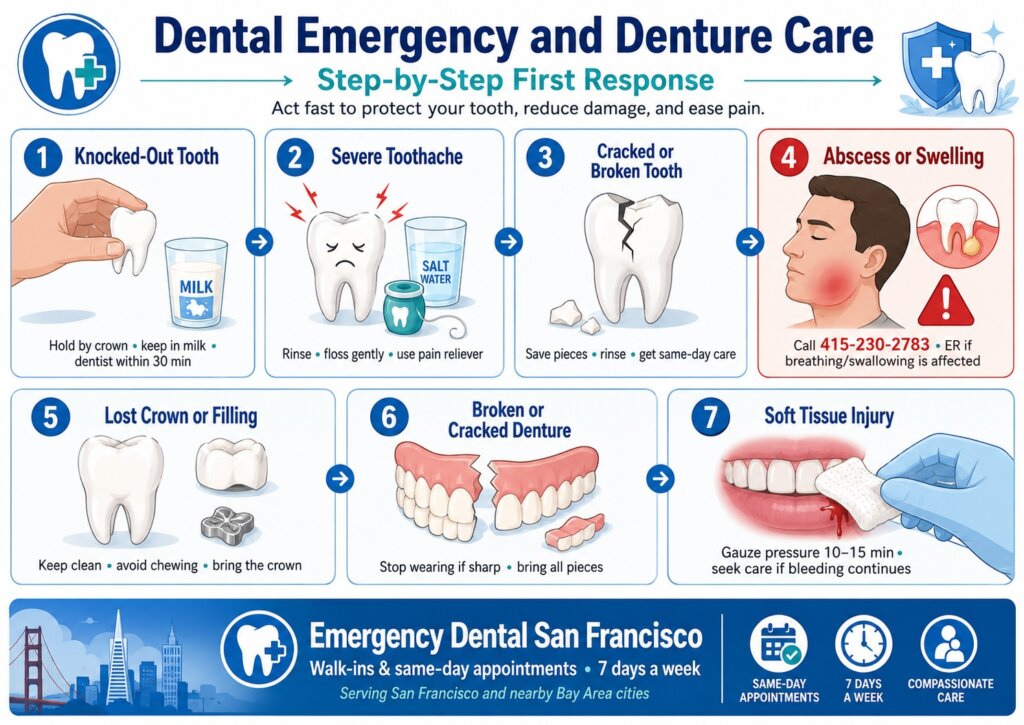
The minutes right after a dental problem starts matter. Acting quickly—and correctly—can protect your tooth, limit damage, and reduce pain before you reach a dentist office near me. Here is what to do for the most common urgent situations.
1. Knocked-Out Permanent Tooth
Pick up the tooth by the crown, not the root. Gently rinse it with clean water, try to reinsert it into the socket if possible, or keep it moist in milk or between your cheek and gum—and get to a dentist within 30 minutes.
2. Severe Toothache
Rinse your mouth with warm salt water and gently floss around the tooth to check for trapped food. Do not place aspirin directly on your gums, as this can cause tissue damage—take an over-the-counter pain reliever as directed and call a dentist if pain does not ease.
3. Cracked or Broken Tooth
Save any tooth fragments and rinse your mouth with warm water. Avoid hard or sticky foods and contact an emergency dental care dentist the same day, especially if you feel sharp pain or the break is near the gumline.
4. Dental Abscess or Swelling
A swollen jaw or gum with fever is a sign of infection that can spread quickly. Do not wait—call Emergency Dental San Francisco at 415-230-2783 or head to the ER if swelling is affecting your ability to breathe or swallow.
5. Lost Crown or Filling
Keep the area clean and avoid chewing on that side. If you still have the crown, bring it to your appointment—our team can often recemented or replace it same-day.
6. Broken or Cracked Denture
Stop wearing the denture if it has a sharp edge that is cutting your gum. Bring all the pieces to your appointment, as same-day denture repair through our lab network may be possible depending on the type of damage.
7. Soft Tissue Injury or Bleeding Gums
Apply gentle pressure with clean gauze for 10 to 15 minutes. If bleeding does not slow or stop, or if the cut is deep, seek emergency dental care or go to an urgent care facility.
Once you have taken those first steps, the next priority is getting to a dentist as soon as possible. Emergency Dental San Francisco accepts walk-ins and same-day appointments seven days a week, including weekends and holidays, across San Francisco and nearby Bay Area cities like Oakland, Berkeley, Daly City, and Fremont.
Dental Emergency and Denture Care: What to Expect at Your Visit
Walking into an emergency dentist office near me when you are in pain can feel stressful, especially if you have never been there before. Knowing what to expect can help you feel more prepared and less anxious when you arrive. Our clinic follows a straightforward visit flow designed to get you to pain relief as quickly as possible.
Here is what typically happens during an emergency dental visit:
- Triage and Pain Control: The team assesses your symptoms right away and begins pain management before anything else. Your comfort is the first priority.
- Exam and X-Rays: A licensed clinician performs a focused exam and takes digital X-rays to understand what is happening beneath the surface. This step usually takes 15 to 20 minutes.
- Clear Options with an Estimate: You receive a plain-language explanation of your options—whether that is an extraction, root canal, repair, or temporary relief—along with an up-front cost estimate before any work begins.
- Immediate Treatment: When same-day treatment is indicated, the clinician proceeds with your consent. Most urgent procedures, including extractions, abscess drainage, and crown recementing, can be completed in a single visit.
- Aftercare Instructions and Follow-Up Plan: You leave with written aftercare instructions, any necessary prescriptions, and a realistic plan for follow-up care so nothing falls through the cracks.
You might be wondering whether your insurance will cover an emergency visit. We accept most dental insurance plans and also offer financing options for patients who qualify. For those without insurance, we accept cash and all major credit cards. Our goal is to keep urgent care accessible regardless of your coverage situation.
To make your visit go smoothly, bring a government-issued ID, your insurance card if you have one, a list of your current medications and allergies, and any recent dental records or X-rays. Arriving about 15 minutes early helps the team prepare before you are seen.
Denture Emergencies: Dental Emergency and Denture Care for Denture Wearers
Denture problems deserve their own section because they affect a specific group of patients—often older adults—who may not realize that same-day help is available. A broken, cracked, or ill-fitting denture is more than an inconvenience. It can make eating painful, affect speech, and cause sores or infections if sharp edges press against soft tissue.
Common denture emergencies include:
- A full or partial denture that has cracked or snapped in two
- A denture tooth that has broken off
- A denture that no longer fits properly after weight loss, illness, or bone changes
- Sore spots or bleeding gums caused by an ill-fitting appliance
- A denture lost or damaged during travel or a fall
Same-day denture repair is available through our lab network for many types of breaks and cracks. The repair process depends on the extent of the damage, but minor fractures can often be addressed within a few hours. If your denture cannot be repaired the same day, our team can provide a temporary solution and walk you through realistic next steps.
Do not try to repair a broken denture at home with super glue or over-the-counter adhesive kits. These products are not designed for oral use and can warp the denture base, making a professional repair harder and more expensive. Bring the pieces to our clinic and let a licensed clinician assess the damage properly.
If you are a denture wearer in San Francisco or the surrounding Bay Area and you need urgent help, call us at 415-230-2783 or book an appointment online. We serve patients in South San Francisco, Alameda, Berkeley, Daly City, Fremont, Oakland, and San Leandro—same-day, weekends, and holidays included.
When to Go to the ER Instead of a Dentist Office Near Me
Most dental emergencies are best handled by an emergency dental care dentist, not a hospital emergency room. ERs are not equipped to perform dental procedures like extractions or root canals, and wait times can stretch for hours. That said, there are specific situations where the ER is the right call.
Go to the emergency room if you experience:
- Swelling in your jaw, neck, or throat that is spreading or affecting your breathing
- Uncontrolled bleeding that does not slow after 15 minutes of firm pressure
- Suspected broken facial bones from trauma
- A high fever combined with severe facial swelling
- Loss of consciousness or difficulty staying awake after dental trauma
For everything else—severe toothaches, abscesses without airway involvement, cracked teeth, knocked-out teeth, lost crowns, and denture problems—an emergency dentist is the faster and more effective option. The ER can prescribe antibiotics and pain relief, but they cannot fix the underlying dental problem. You will still need to follow up with a dentist, so starting there saves time.
Emergency Dental San Francisco is open 24 hours a day, every day of the year. If you are not sure whether to call us or go to the ER, call 415-230-2783 and describe your symptoms. Our team can help you triage over the phone and direct you to the right level of care immediately.
Conclusion
Dental emergencies and denture problems are stressful, but knowing what to do first makes a real difference. Act quickly, stay calm, and get to the right care as soon as possible. Emergency Dental San Francisco is here for same-day, after-hours, and weekend care across the Bay Area—call 415-230-2783 or book an appointment online now.
Emergency Dental San Francisco specializes in same-day urgent dental relief for broken dentures and dental emergencies. We serve the Bay Area daily, including weekends and holidays. Call 415-230-2783 or get started today.
FAQs
What Counts as a Dental Emergency?
A dental emergency is any problem causing severe pain, swelling, bleeding that won’t stop, signs of infection (like an abscess, fever, or facial swelling), or a damaged/knocked-out tooth. If you’re unsure, call Emergency Dental San Francisco at 415-230-2783 for guidance and same-day care.
What Should I Do If My Denture Breaks or Cracks?
Stop wearing it if it’s sharp or unstable, rinse it gently, and save all pieces. Don’t use super glue or household adhesives—these can be toxic and make repair harder. Call us for a same-day denture repair or adjustment and to check for sore spots or injury.
Can I Go to the ER for a Dental Emergency?
You can go to the ER for trouble breathing or swallowing, uncontrolled bleeding, major facial trauma, or rapidly spreading swelling. For most dental emergencies (toothaches, abscesses, broken teeth, denture issues), an urgent-care dentist can treat the cause and provide definitive relief—often faster and more affordably.
How Can I Relieve Severe Tooth Pain Until I See a Dentist?
Rinse with warm salt water, use a cold compress on the cheek, and take over-the-counter pain medicine as directed on the label (avoid aspirin on the gums). Keep the area clean and avoid chewing on that side. If there’s swelling, fever, or worsening pain, call us immediately for urgent evaluation.
How Do I Care for My Dentures After an Extraction or Dental Emergency?
Follow your dentist’s instructions closely—often you’ll keep the denture in place for the first day to reduce swelling, then remove it to clean gently. Rinse your mouth with salt water as advised, clean dentures with a soft brush (no hot water), and soak them when out. If you develop sore spots, looseness, or bleeding, schedule an adjustment right away.

Emergency Dental San Francisco is a dental office focused on providing same-day dental appointments to patients in San Francisco and the surrounding area. We provide urgent dental care services during weekends, evenings and holidays.
We accept several forms of payment and have financing options available to those who qualify. We accept most dental insurance.