

15 Jun Emergency Dental Visit Costs: How Exams, X-Rays, and Procedures Affect the Final Bill
A dental emergency rarely happens at a convenient time. It might be a Sunday afternoon, a holiday weekend, or late at night when your regular dentist office near me is closed and the pain is getting worse. In those moments, most people have two immediate questions: where can I get help right now, and how much is this going to cost?
This article breaks down the cost of an emergency dental visit from start to finish—what you pay for at each stage, what drives those costs up or down, how insurance and financing factor in, and what you can realistically expect when you walk through the door. Whether you are dealing with a cracked tooth, a swollen abscess, or a knocked-out crown, understanding the financial side of urgent dental care helps you make faster, calmer decisions.
Key Takeaways
- The cost of an emergency dental visit depends on the type and severity of the problem, not just a flat fee.
- An initial exam and X-rays are almost always the first charges you will see at any dentist office near me.
- Procedures like extractions, root canals, and abscess drainage each carry separate costs beyond the exam.
- Dental insurance, including plans managed through MetLife Dental login portals, often covers a portion of emergency exams and some treatments.
- Going to a hospital emergency room for a dental issue typically costs significantly more than seeing an urgent care dentist directly.
- Financing options exist at many urgent dental practices, making same-day care accessible even without insurance.
- Acting quickly on a dental emergency usually reduces the total cost of treatment over time.
What the Cost of an Emergency Dental Visit Actually Covers at a Dentist
When people search for a dentist near me in a panic, they often expect a single flat price. The reality is that an emergency dental visit is made up of several components, each with its own cost. Understanding what you are paying for at each step removes a lot of the anxiety around the bill.
The visit typically starts with a clinical exam and one or more X-rays. This is the diagnostic phase. The dentist needs to see what is happening beneath the surface before recommending any treatment. After that, the treatment itself—whether it is a simple extraction, a root canal, an abscess drainage, or a temporary repair—is billed separately.
Here is a general breakdown of what each component may cost, based on national averages from the Agency for Healthcare Research and Quality (AHRQ) and American Dental Association (ADA) Health Policy Institute data:
| Service | Estimated Cost Range (No Insurance) | Notes |
|---|---|---|
| Emergency exam | $50 – $150 | Often required before any treatment |
| Dental X-rays (1–4 images) | $25 – $200 | Periapical or panoramic depending on case |
| Simple tooth extraction | $150 – $300 | Surgical extractions cost more |
| Root canal (anterior tooth) | $700 – $1,100 | Molar root canals typically higher |
| Abscess drainage | $150 – $400 | May include antibiotic prescription |
| Temporary crown or filling | $100 – $300 | Permanent restoration billed separately |
| Lost crown recementation | $75 – $200 | Depends on crown condition |
These ranges are estimates. Your actual cost will depend on the complexity of your case, the location of the practice, and whether you have insurance coverage.
Six Factors That Influence the Cost of an Emergency Dental Visit at Any Dentist Office Near Me
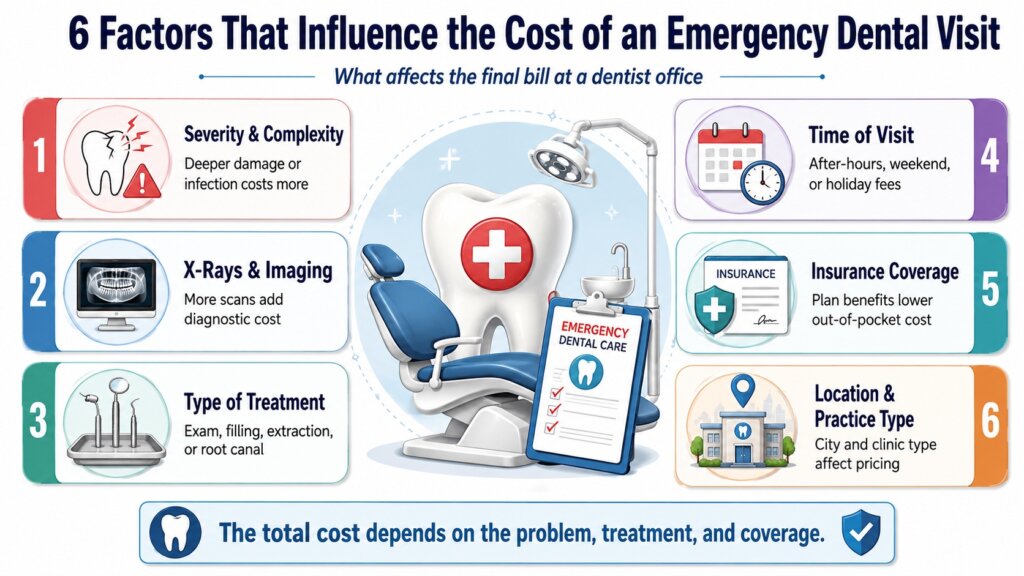
Not every emergency visit costs the same, even for similar problems. Several variables shape the final number on your bill, and knowing them ahead of time helps you ask the right questions when you arrive.
1. Severity and Complexity of the Problem
A simple lost filling is a very different situation from a deep infection spreading into the jaw. More complex cases require more time, more materials, and sometimes specialist involvement, all of which increase cost.
2. Number of X-Rays and Imaging Needed
Some cases need a single periapical X-ray. Others require a full-mouth series or a panoramic scan to assess the extent of damage or infection. Each additional image adds to the diagnostic cost.
3. Type of Treatment Required
An exam that ends with a prescription for antibiotics costs far less than one that leads directly to an emergency root canal. The treatment category—preventive, restorative, surgical, or endodontic—has the biggest impact on your total bill.
4. Time of Visit
After-hours, weekend, and holiday visits sometimes carry a small additional fee at certain practices. This reflects the operational cost of keeping a clinic staffed and open outside standard business hours. It is worth asking about this when you call.
5. Insurance Coverage and Plan Type
Patients with dental insurance—including PPO plans accessible through the MetLife Dental login or similar portals—often pay significantly less out of pocket. Most plans cover emergency exams and X-rays at 80 to 100 percent after the deductible, and they typically cover a portion of restorative procedures as well. Patients without insurance pay the full fee-for-service rate.
6. Geographic Location and Practice Type
Dental fees in San Francisco and the Bay Area tend to run higher than national averages, which is consistent with ADA Health Policy Institute data on regional cost variation. An urgent care dental practice may also price differently than a general dentist office near me that occasionally handles emergencies.
Why Skipping the Dentist and Going to the ER Costs More
You might be wondering whether the emergency room is a faster or cheaper option when dental pain strikes late at night. Research published in peer-reviewed literature, including data cited by the National Center for Biotechnology Information (NCBI), consistently shows that nontraumatic dental conditions account for a significant number of potentially avoidable emergency department visits—and those visits are substantially more expensive than seeing a dentist directly.
Hospital ERs are not equipped to perform dental procedures. They can prescribe pain medication and antibiotics, but they cannot drain an abscess, perform an extraction, or repair a cracked tooth. That means you pay a much higher facility fee for temporary relief and still need to see a dentist afterward. The AHRQ has documented that dental-related ER visits generate costs far above what the same problem would cost at a dental practice.
The only situations where the ER is genuinely the right first stop are suspected facial fractures, uncontrolled bleeding that will not stop, difficulty breathing or swallowing due to swelling, or significant trauma to the jaw. For everything else—toothaches, abscesses, broken teeth, lost crowns—an urgent care dentist is both faster and more cost-effective.
At Emergency Dental San Francisco, we see patients the same day for exactly these situations. Our team handles urgent exams, X-rays, extractions, root canals, abscess drainage, and temporary restorations in one visit whenever possible. Call 415-230-2783 or book an appointment online to get seen today without the ER markup.
How Dental Insurance Affects the Cost of an Emergency Dental Visit
If you have dental insurance, your plan likely covers at least part of an emergency visit. The ADA’s overview of dental benefits explains that most employer-sponsored PPO plans—including those managed through platforms like MetLife Dental login—cover diagnostic services like exams and X-rays at a high percentage, often 80 to 100 percent after your annual deductible is met.
Coverage for treatment varies more. Basic restorative procedures like fillings and simple extractions are typically covered at 70 to 80 percent. Major procedures like root canals, crowns, and surgical extractions may be covered at 50 percent, subject to annual maximums. Knowing your plan’s breakdown before you arrive helps you estimate your out-of-pocket responsibility.
A few practical tips for using insurance at an emergency dental visit:
- Bring your insurance card and member ID to the appointment.
- Ask the front desk to verify your benefits before treatment begins.
- Request an itemized estimate so you understand what each procedure will cost under your plan.
- Check whether the practice is in-network, as out-of-network visits may cost more depending on your plan structure.
- If you use MetLife Dental, log in to your MetLife Dental login portal before your visit to review your remaining annual maximum and deductible status.
We accept most dental insurance plans and will work with your carrier to process claims accurately. For patients without insurance, we accept cash and all major credit cards, and we offer financing options for those who qualify. Urgent care should not be delayed because of financial uncertainty—reach out and we will walk you through your options before treatment starts.
What to Expect During the Visit: From Triage to Treatment
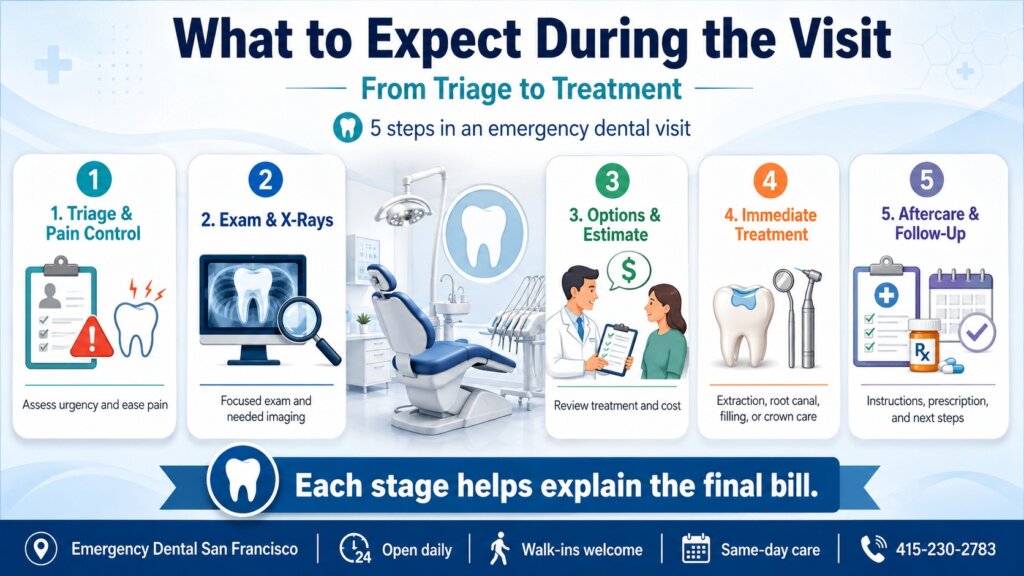
Understanding the flow of an emergency dental visit also helps you understand the billing. Each stage of care corresponds to a charge, and knowing the sequence makes the final statement easier to read.
1. Triage and Pain Control
When you arrive, the team assesses the urgency of your situation and addresses immediate pain. This is part of the emergency exam charge and is not billed as a separate line item in most cases.
2. Exam and X-Rays
The dentist performs a focused clinical exam and takes the necessary X-rays. This diagnostic phase is billed as the emergency exam fee plus imaging costs.
3. Treatment Options and Estimate
Before any procedure begins, you receive a clear explanation of the recommended treatment and an upfront cost estimate. You have the opportunity to ask questions and understand what your insurance will cover versus what you owe out of pocket.
4. Immediate Treatment
When you agree to proceed, treatment begins. Depending on the problem, this may be an extraction, a root canal, abscess drainage, a temporary filling, or recementation of a lost crown. Each procedure is billed separately from the exam.
5. Aftercare Instructions and Follow-Up Plan
Before you leave, you receive written aftercare instructions and, if needed, a prescription. Any recommended follow-up visits are outlined clearly. Follow-up procedures are scheduled and billed at future appointments.
If you are in the Bay Area and need same-day care, Emergency Dental San Francisco is open every day including weekends and holidays. We serve patients across San Francisco, Oakland, Berkeley, Alameda, Daly City, Fremont, South San Francisco, and San Leandro. Walk-ins are welcome, and same-day appointments are available around the clock. Call 415-230-2783 or visit our locations page to find the nearest option.
Does Seeing a Pediatric Dentist Near Me Change the Cost for Children
Parents dealing with a child’s dental emergency often search specifically for a pediatric dentist near me, and that is a reasonable instinct. Pediatric dental emergencies—knocked-out baby teeth, sports injuries, severe toothaches, broken braces—require a clinician who understands child-specific anatomy and behavior management.
The cost structure for pediatric emergency visits is similar to adult visits: exam, X-rays, and treatment are billed separately. Some pediatric-specific procedures, like space maintainers after a premature tooth loss, may add to the total. Insurance coverage for children’s dental care is often more comprehensive under the Affordable Care Act, which mandates pediatric dental benefits in most marketplace and employer plans.
Our clinic provides gentle urgent care for pediatric patients as well. If your child is in pain and you cannot reach your regular pediatric dentist near me, we can help with a same-day evaluation and treatment plan.
Conclusion
The cost of an emergency dental visit ranges widely depending on what is wrong, what treatment is needed, and whether you have insurance—but acting quickly almost always costs less than waiting. Skipping the ER and going directly to an urgent care dentist saves both time and money. If you are in San Francisco or the surrounding Bay Area and need immediate help, call Emergency Dental San Francisco at 415-230-2783 or book a same-day appointment online—we are here every day, including nights, weekends, and holidays.
Emergency Dental San Francisco offers transparent, affordable emergency care with flexible payment and most insurance accepted. Same-day appointments are available now. Call 415-230-2783 or get started today.
FAQs
How Much Does an Emergency Dental Visit Cost Without Insurance?
In the Bay Area, an emergency dental visit without insurance typically ranges from about $150–$350 for an exam, with X-rays commonly adding $50–$250; total cost depends on what treatment is needed that day. At Emergency Dental San Francisco, we explain pricing up front and offer payment options to keep urgent care accessible.
How Much Does It Cost to See an Emergency Dentist for a Toothache?
For a toothache, most patients pay around $200–$600 for the emergency exam and diagnostics, but the total varies based on whether you need a filling, infection treatment, root canal, or extraction. Our clinicians focus on fast pain relief first, then provide clear next steps and a written estimate before treatment.
How Much Does An Emergency Tooth Extraction Cost?
An emergency tooth extraction often ranges from about $300–$900 for a simple extraction, while surgical extractions can be roughly $600–$1,800+ depending on complexity; sedation, if needed, may add cost. We evaluate quickly, discuss options, and prioritize safe, comfortable removal when extraction is the best choice.
How Much Does An Emergency Root Canal Cost?
An emergency root canal commonly costs about $900–$2,500+ depending on the tooth (front vs. molar) and complexity, and a crown is often an additional cost if recommended after. We use modern imaging and clear communication to confirm the diagnosis and relieve pain as efficiently as possible.
Can I Go To The ER For A Dental Emergency And How Much Will It Cost?
You can go to the ER for dental emergencies involving severe swelling, fever, trouble breathing/swallowing, or uncontrolled bleeding, but ERs usually can’t provide definitive dental treatment (like extractions or root canals) and may only offer pain meds or antibiotics. ER visits can cost hundreds to thousands of dollars depending on insurance and tests, while an urgent dental office can typically diagnose and treat the source of the problem the same day.

Emergency Dental San Francisco is a dental office focused on providing same-day dental appointments to patients in San Francisco and the surrounding area. We provide urgent dental care services during weekends, evenings and holidays.
We accept several forms of payment and have financing options available to those who qualify. We accept most dental insurance.