

05 Oct What Emergency Dentists Wish Patients Knew Before Seeking Urgent Treatment
A dental emergency can happen at the worst possible time—Sunday afternoon, late Friday night, or right in the middle of a holiday weekend. The pain is real, the panic is real, and most people have no idea what to do first. That uncertainty can cost you time, and in some cases, a tooth.
This article answers the 10 most common emergency dental questions we hear from patients across San Francisco and the greater Bay Area. Whether you’re dealing with a knocked-out tooth, a throbbing abscess, or a cracked crown, you’ll find clear, practical guidance here—plus honest information about when to come in, what to bring, and what to expect.
Key Takeaways
- Not every dental problem is a true emergency, but some conditions require care within the hour.
- A knocked-out permanent tooth has the best chance of survival if you act within 30 minutes.
- Swelling with fever is a warning sign of infection and should never be left untreated overnight.
- The emergency room is not the right first stop for most dental problems—an urgent care dentist is.
- Emergency Dental San Francisco offers same-day, after-hours, and weekend appointments across the Bay Area.
- Most dental insurance plans cover emergency exams, and financing is available for patients without coverage.
Let’s get into the questions that matter most when you’re in pain and need answers fast.
Emergency Dental Questions: What Actually Counts as a Dental Emergency?
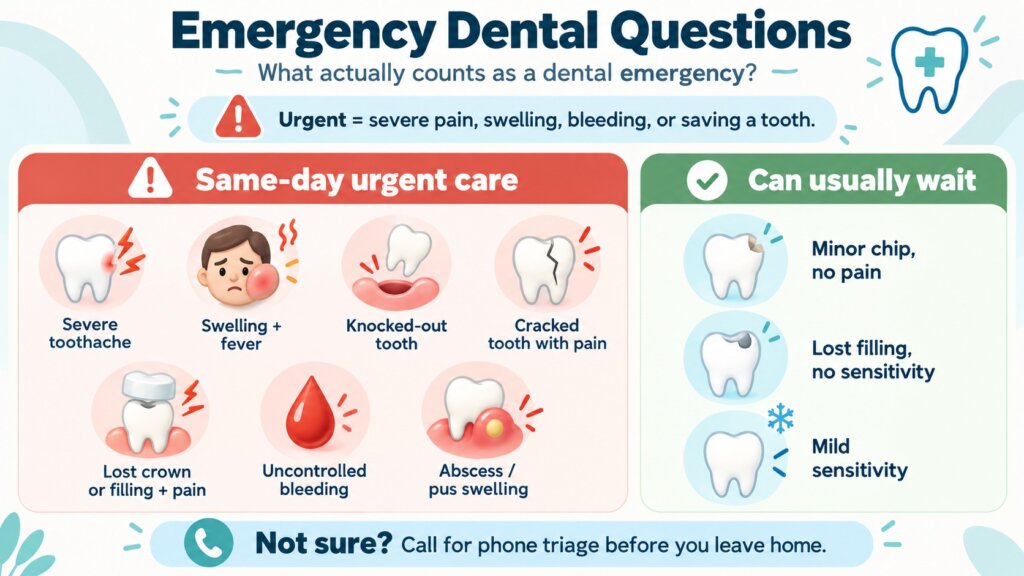
This is the first question almost everyone asks, and it’s a fair one. Not every toothache or chipped tooth requires immediate professional care, but some situations absolutely do. Knowing the difference can protect your health and your wallet.
According to the NIH National Library of Medicine, dental emergencies generally fall into two categories: those that are life-threatening and those that require urgent care to save a tooth or stop severe pain. Here’s how to tell them apart.
Conditions that need same-day urgent dental care:
- Severe or throbbing toothache that doesn’t respond to over-the-counter pain relief
- Swelling in the gum, jaw, or face—especially with fever
- A knocked-out permanent tooth
- A cracked or fractured tooth with pain or sharp edges
- A lost crown or filling causing sensitivity or pain
- Uncontrolled bleeding from the mouth after an injury
- A dental abscess with visible swelling or pus
Conditions that can wait for a next-day or scheduled appointment:
- A minor chip with no pain
- A lost filling with no sensitivity
- Mild, intermittent tooth sensitivity
If you’re unsure, call us. Our team can help you triage over the phone before you even leave home.
Common Emergency Dental Questions About Knocked-Out Teeth and What to Do
A knocked-out tooth is one of the most time-sensitive dental emergencies there is. Every minute matters, and what you do in the first few minutes can determine whether the tooth can be saved.
The Indian Health Service First Aid for Dental Emergencies guide outlines clear steps for handling an avulsed (knocked-out) tooth. Follow these in order:
- Pick up the tooth by the crown, not the root. Touching the root can damage the cells needed for reattachment.
- Rinse it gently with clean water. Do not scrub or use soap. A light rinse is enough to remove visible debris.
- Try to reinsert it into the socket. If you can, gently push the tooth back into place and bite down softly on a clean cloth to hold it.
- If reinsertion isn’t possible, keep it moist. Place the tooth in a cup of milk, or tuck it between your cheek and gum. Do not wrap it in a dry tissue.
- Get to a dentist within 30 minutes. The survival rate for knocked-out teeth drops significantly after the first half hour.
Emergency Dental San Francisco sees knocked-out tooth cases the same day, including evenings and weekends. Call 415-230-2783 the moment it happens.
Top Emergency Dental Questions About Toothaches: When Is It Serious?
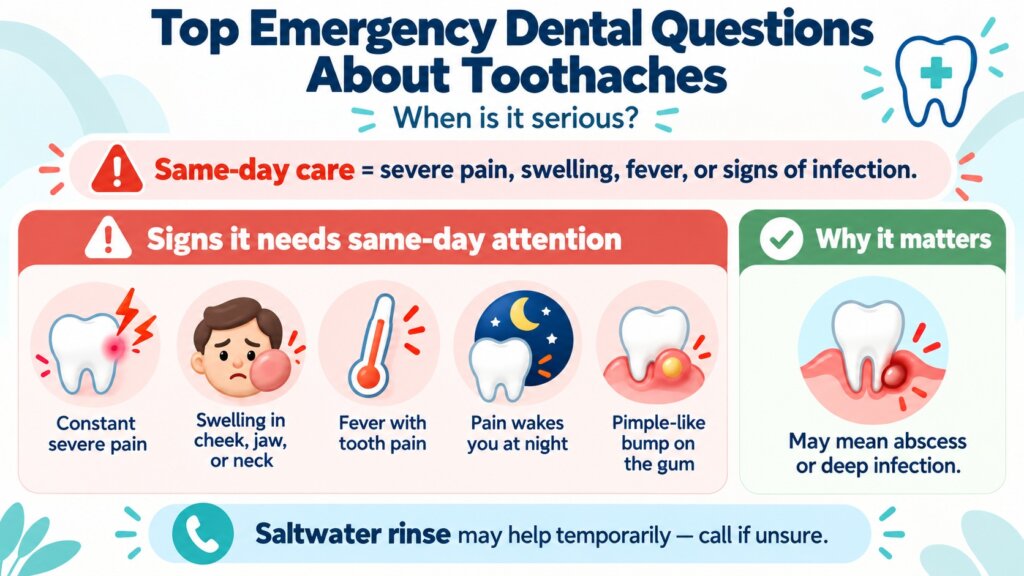
Toothaches range from mildly annoying to completely debilitating. The severity and type of pain often tells you how urgent the situation is. A dull ache after eating something cold is different from a throbbing pain that keeps you up at night.
You might be wondering whether you can just take ibuprofen and wait it out. Sometimes that’s fine for a day. But certain types of toothache pain signal something more serious that won’t resolve on its own.
Signs your toothache needs same-day attention:
- The pain is constant and severe, not coming and going
- You notice swelling in your cheek, jaw, or neck
- You have a fever alongside the tooth pain
- The pain wakes you up from sleep
- You see a pimple-like bump on your gum near the tooth
These signs often point to an abscess or deep infection. Left untreated, a dental infection can spread to the jaw, neck, or airway—a situation that becomes a medical emergency. A warm saltwater rinse may offer temporary relief, but it is not a substitute for professional care.
Emergency Dental Questions About Abscesses: Is It Dangerous?
A dental abscess is a pocket of infection, usually caused by bacteria entering through a cavity, crack, or gum disease. It can develop quickly and cause intense, localized pain. The MedlinePlus resource on tooth abscesses notes that symptoms include throbbing pain, swelling, fever, and a bad taste in the mouth from draining pus.
An abscess will not go away on its own. It requires professional drainage and, in most cases, antibiotics. Delaying treatment allows the infection to spread.
Our clinic handles abscesses the same day. We drain the infection, manage your pain, and prescribe antibiotics when needed. If you’re searching for a dentist office near me that can treat an abscess after hours or on a weekend, we’re available. Walk-ins are welcome, and same-day appointments are open seven days a week.
Emergency Dental Questions for Parents: What About Kids and Dental Injuries?
Children are active, and dental injuries happen—sports, falls, playground accidents. The Head Start Treating Oral Injuries resource and the UNC Pediatric Dental Emergency Clinical Pathway both emphasize that a child’s response to dental trauma depends on whether the injured tooth is a baby tooth or a permanent one.
For baby teeth, reinsertion is generally not recommended—it can damage the developing permanent tooth underneath. For permanent teeth, the same 30-minute rule applies. Keep the tooth moist and get to a pediatric dentist near me or an urgent care dental office immediately.
Common pediatric dental emergencies we treat:
- Knocked-out or loosened teeth from falls or sports
- Broken or chipped teeth with sharp edges
- Soft tissue injuries to the lips, tongue, or cheeks
- Severe toothaches from untreated cavities
- Broken braces or orthodontic wires causing irritation
We provide gentle, child-friendly urgent dental care. If your child is in pain or has experienced trauma, call us before heading to the ER—we can often see them faster and provide more targeted care.
Frequently Asked Emergency Dental Questions: Should I Go to the ER or a Dentist?
This is one of the most common emergency dental questions we hear, and the answer depends on the specific situation. Most dental emergencies—even severe ones—are better handled by an emergency dentist than a hospital emergency room.
| Situation | Go to Emergency Dentist | Go to ER |
|---|---|---|
| Severe toothache | Yes | No |
| Dental abscess (no breathing issues) | Yes | No |
| Knocked-out tooth | Yes | No |
| Cracked or broken tooth | Yes | No |
| Jaw fracture or suspected break | No | Yes |
| Uncontrolled bleeding after injury | No | Yes |
| Swelling affecting breathing or swallowing | No | Yes |
ERs can manage pain and prescribe antibiotics, but they typically cannot perform dental procedures. You’ll still need to follow up with a dentist afterward. Going directly to an urgent care dental office saves time and gets you the right treatment sooner.
Emergency Dental Questions About Broken Teeth: Can a Cracked Tooth Be Saved?
A cracked or fractured tooth is not always a lost cause. Whether it can be saved depends on the location and severity of the crack. A small crack limited to the enamel is very different from one that extends into the root.
If you crack a tooth, save any fragments. Avoid chewing on that side, and stay away from hard, sticky, or very hot or cold foods. Rinse gently with warm water and call your dentist right away.
At our clinic, we take same-day X-rays to assess the damage and walk you through your options—whether that’s bonding, a crown, or in more serious cases, extraction. We explain everything in plain language and give you a cost estimate before any procedure begins. Patients with MetLife dental login access or other insurance can verify coverage on the spot.
Common Emergency Dental Questions About Lost Crowns and Fillings
Losing a crown or filling is uncomfortable and can leave your tooth exposed to sensitivity and further damage. It’s not always a same-hour emergency, but it does need attention within a day or two—sooner if you’re in pain.
In the meantime, keep the area clean. If you still have the crown and it’s intact, bring it with you. Do not try to glue it back yourself with household adhesives. Some pharmacies sell temporary dental cement that can hold a crown in place briefly, but this is a short-term fix only.
We recement and replace crowns and fillings the same day whenever possible. If you’re looking for a dentist near me who handles lost restorations quickly and without a long wait, our team is ready to help.
Emergency Dental Questions About Insurance and Payment: What Will This Cost?
Cost is a real concern, especially when a dental emergency happens unexpectedly. You shouldn’t have to choose between your health and your budget.
Emergency Dental San Francisco accepts most major dental insurance plans. If you have MetLife dental login access or coverage through another provider, our front desk staff can help verify your benefits before treatment starts. For patients without insurance, we accept cash and all major credit cards, and financing options are available for those who qualify.
We provide upfront cost estimates whenever possible. No surprises. No pressure. Just clear information so you can make the right decision for your situation.
Emergency Dental Questions About What to Expect During Your Visit at a Dentist Office Near Me
Walking into an urgent care dental office when you’re in pain can feel overwhelming. Knowing what to expect helps. Our visit process is straightforward and designed to get you comfortable as quickly as possible.
Here’s what typically happens when you come in:
- Triage and pain control. We assess your situation immediately and prioritize stopping your pain first.
- Exam and X-rays. We take digital X-rays to get a clear picture of what’s happening beneath the surface.
- Treatment options and estimate. We explain your options—extraction, root canal, repair, or temporary relief—and give you a cost breakdown before anything starts.
- Immediate treatment. When indicated, we treat the problem the same day.
- Written aftercare instructions. You leave with clear instructions, any necessary prescriptions, and a follow-up plan.
Arrive about 15 minutes early if you can. Bring a government-issued ID, your insurance card, a list of current medications and allergies, and any recent dental records or X-rays you have on hand. That’s it.
Final Thoughts on the Most Common Emergency Dental Questions
Dental emergencies are stressful, but they don’t have to be confusing. Knowing what to do—and where to go—makes all the difference. Emergency Dental San Francisco is here for San Francisco residents and patients across the Bay Area, including Oakland, Berkeley, Alameda, Daly City, Fremont, and San Leandro, every day of the year. Call 415-230-2783 now, walk in, or book your same-day appointment online—relief is closer than you think.
Emergency Dental San Francisco specializes in same-day urgent dental care for fast, compassionate pain relief. We serve the Bay Area seven days a week, including holidays. Call 415-230-2783 or book online—learn more today.
FAQs
What Is Considered a Dental Emergency?
A dental emergency is any mouth or tooth problem that needs prompt care to stop severe pain, bleeding, infection, or prevent permanent damage—such as intense toothache, swelling/abscess, knocked-out or broken teeth, uncontrolled bleeding, or facial swelling with fever. If you’re unsure, call Emergency Dental San Francisco at 415-230-2783 for guidance and same-day options.
What Should I Do If I Have a Toothache That Won’t Go Away?
Call for a same-day dental exam—persistent tooth pain often signals decay, infection, or a cracked tooth that won’t resolve on its own. Until you’re seen, use a cold compress, take OTC pain medicine as directed (if safe for you), and avoid chewing on that side; don’t place aspirin on the gums.
How Do I Know If I Need to Go to the ER for a Dental Problem?
Go to the ER (or call 911) for trouble breathing or swallowing, rapidly spreading facial/neck swelling, high fever, uncontrolled bleeding, or signs of a serious infection. Otherwise, most urgent dental issues—like severe toothaches, abscesses, and broken teeth—are best treated by an emergency dentist who can diagnose and fix the source.
What Should I Do If I Knock Out a Tooth?
Act fast: pick up the tooth by the crown (not the root), gently rinse if dirty, and try to place it back in the socket. If you can’t, store it in milk or saliva and get to an emergency dentist immediately—ideally within 30–60 minutes—for the best chance of saving it.
Can I Go to Urgent Care for a Dental Emergency?
Medical urgent care can help with pain control or antibiotics in limited cases, but they usually can’t provide dental X-rays or definitive treatment like drainage, root canal therapy, or dental repair. For faster relief and a clear next step, an urgent-care dental practice like Emergency Dental San Francisco can evaluate and treat the problem directly—often same-day, after-hours, weekends, and holidays.

Emergency Dental San Francisco is a dental office focused on providing same-day dental appointments to patients in San Francisco and the surrounding area. We provide urgent dental care services during weekends, evenings and holidays.
We accept several forms of payment and have financing options available to those who qualify. We accept most dental insurance.