
06 Nov Emergency Dental Oral Surgeon: When Should You See a Specialist Instead of a Dentist?
You’re in pain. Something feels wrong with your jaw, your tooth, or your gums—and you don’t know if you need a regular dentist or someone with more specialized training. That question matters more than most people realize, and getting it wrong can delay the care you actually need. An emergency dental oral surgeon handles cases that go beyond what a general dentist is equipped to manage, and knowing the difference can save your tooth, your health, and your time.
This article breaks down exactly when a specialist is the right call, what conditions require oral surgery versus routine dental care, how pediatric dental trauma fits into the picture, and what to expect when you walk into an urgent dental office near you. We’ll also cover how Emergency Dental San Francisco can help you get the right level of care, fast.
Key Takeaways
- Oral and maxillofacial surgeons manage complex dental and facial surgical conditions, while general dentists can treat many dental emergencies and refer patients when specialized care is needed.
- Infections spreading to the jaw or neck, impacted wisdom teeth, and facial trauma often require surgical intervention.
- A general emergency dentist handles most urgent cases—pain, broken teeth, lost crowns, and abscesses—same day.
- Pediatric dental trauma is common and time-sensitive; children need prompt evaluation from a qualified dental provider.
- Emergency Dental San Francisco offers same-day urgent care across the Bay Area, with referrals to oral surgeons when needed.
- Knowing which provider to call first reduces delays and improves outcomes.
Emergency Dental Oral Surgeon vs. Dentist: What Is the Actual Difference?
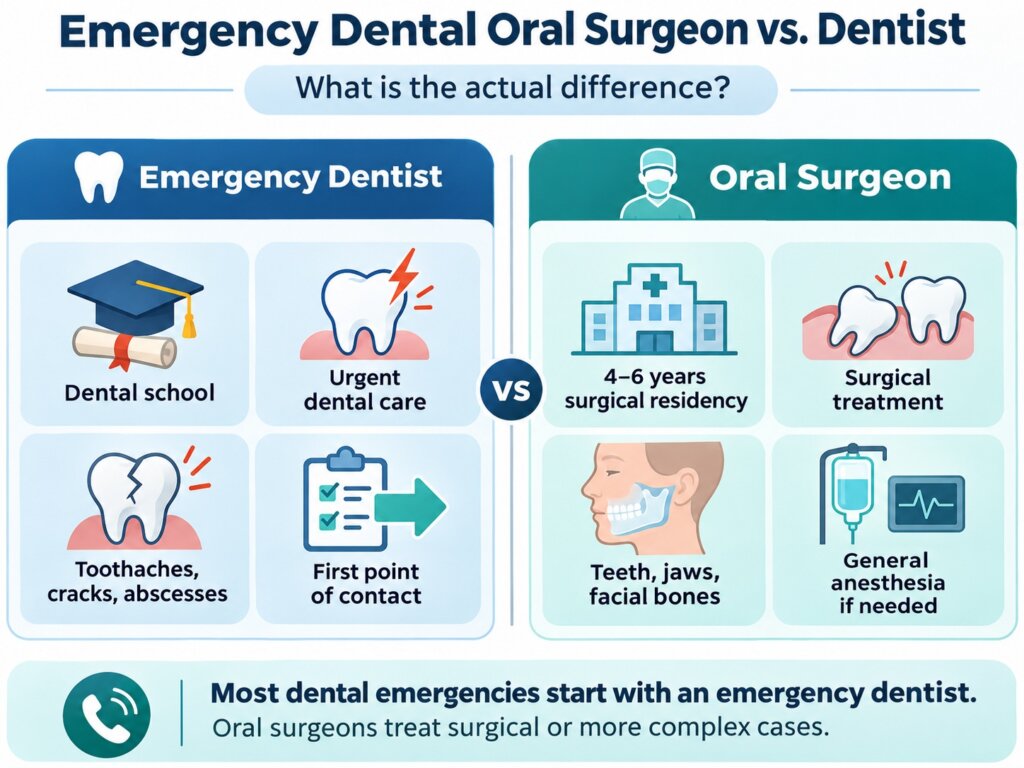
A general dentist and an oral surgeon both treat dental problems, but their training, tools, and scope of practice are not the same. A general dentist completes four years of dental school and is trained to handle most everyday and urgent dental issues. An oral and maxillofacial surgeon completes an additional four to six years of hospital-based surgical residency, giving them the skills to operate on teeth, jaws, facial bones, and soft tissue under general anesthesia if needed.
Think of it this way: a general emergency dentist is like a primary care physician who can handle most urgent situations. An oral surgeon is the specialist you get referred to when the problem is surgical in nature or involves structures beyond the teeth themselves.
You might be wondering—does that mean you should go straight to an oral surgeon when something hurts badly? Not necessarily. Most dental emergencies, including severe toothaches, cracked molars, knocked-out teeth, and abscesses, are handled effectively by an emergency dentist. The oral surgeon comes into play for a specific set of conditions.
When Does an Emergency Dental Oral Surgeon Become Necessary for a Dentist Office?
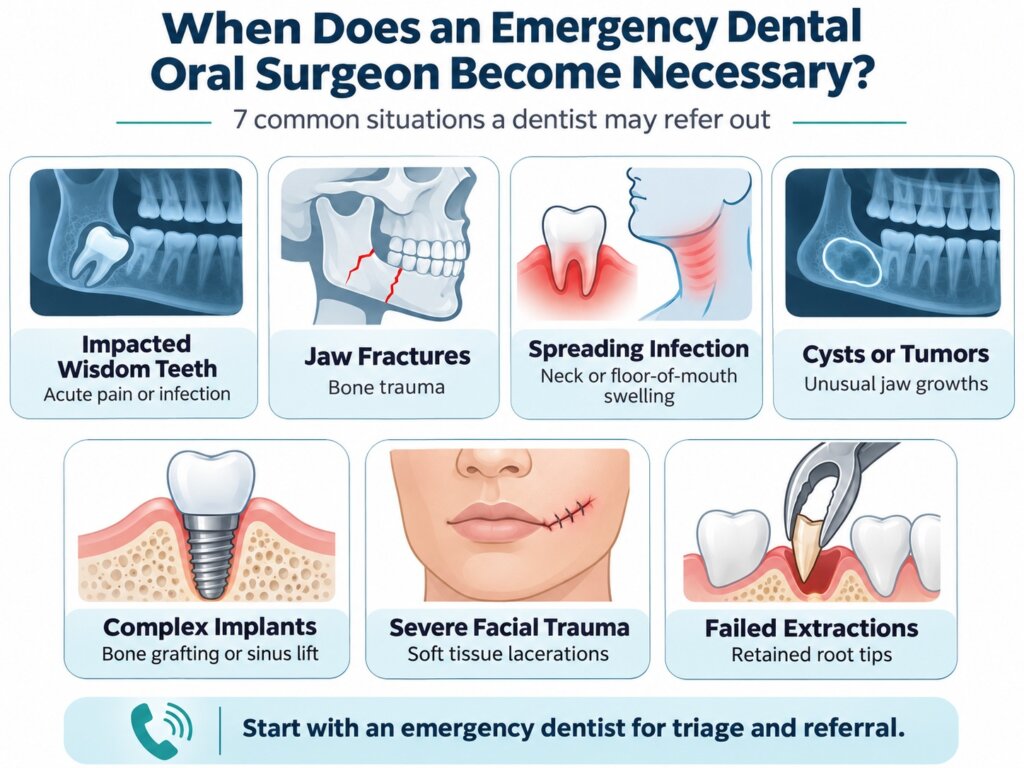
There are clear clinical situations where a general emergency dentist will refer you to an oral surgeon. These are not edge cases. They come up regularly, and recognizing them early helps you move faster toward the right care.
1. Impacted Wisdom Teeth Causing Acute Pain or Infection
Impacted wisdom teeth may cause pain, inflammation, or infection when they cannot erupt normally. A general dentist can evaluate the condition and determine whether extraction or specialist referral is appropriate. Deeply impacted teeth, complex root structures, or teeth positioned close to important nerves may require treatment by an oral and maxillofacial surgeon.
2. Jaw Fractures or Facial Bone Trauma
A cracked or fractured jaw following a fall, sports injury, or accident is beyond the scope of routine dental care. This requires imaging, stabilization, and sometimes surgical fixation. If you suspect a jaw fracture, an emergency room evaluation followed by oral surgery consultation is the appropriate path.
3. Spreading Dental Infections With Swelling in the Neck or Floor of the Mouth
A localized dental abscess typically requires prompt dental treatment, such as drainage, root canal therapy, or extraction when appropriate. Antibiotics are not routinely necessary for every localized abscess. However, rapidly spreading swelling, difficulty breathing or swallowing, or infection affecting the floor of the mouth or neck can indicate a medical emergency requiring immediate hospital assessment and potentially surgical intervention.
4. Cysts, Tumors, or Unusual Growths in the Jaw
If X-rays or a clinical exam reveal an abnormal growth, lesion, or cyst in the jawbone or soft tissue, an oral surgeon is the right specialist. Biopsy, excision, and pathology review fall within their scope, not a general dentist’s.
5. Dental Implant Placement
Placing implants requires surgical insertion into the jawbone. While some general dentists are trained in basic implant placement, complex cases involving bone grafting, sinus lifts, or multiple implants are typically referred to an oral surgeon.
6. Severe Facial Trauma With Soft Tissue Lacerations
Deep cuts around the mouth, lips, or cheeks following trauma may need surgical repair to minimize scarring and restore function. An oral surgeon’s training in facial anatomy makes them the appropriate provider for these injuries.
7. Failed Extractions or Retained Root Tips
When a tooth breaks during extraction and a root tip remains embedded in the bone, retrieval can require surgical access. A general dentist may refer these cases to an oral surgeon to avoid nerve or sinus complications.
Understanding these seven scenarios helps you make faster, better decisions when something goes wrong. Most of the time, though, your first call should still be to an emergency dental provider who can triage your situation and refer you if needed.
What an Emergency Dentist Near Me Can Handle Without a Specialist
It’s worth being clear about how much an emergency dentist can manage, because many patients assume they need a surgeon when they don’t. The list of conditions treated effectively at an urgent dental office is long.
| Condition | Current wording | Recommended wording |
|---|---|---|
| Impacted wisdom tooth | Oral surgeon performs surgical extraction | Oral surgeon for complex cases |
| Spreading neck infection | Oral surgeon for hospital-based care | Immediate hospital assessment; surgical care when indicated |
| Jaw fracture | Dentist stabilizes and refers | Emergency medical evaluation and specialist referral |
| Dental implant placement | General dentist handles simple cases only | Trained general dentists or specialists, depending on case complexity |
Emergency Dental San Francisco handles the full left column of that table. Our team performs same-day exams, digital X-rays, extractions, root canal therapy, abscess drainage, crown recementation, and soft tissue management. If your case requires surgical escalation, we’ll tell you clearly and help coordinate the next step. Call us at 415-230-2783 or book a same-day appointment online.
Pediatric Dental Emergencies: What the Research Says About a Pediatric Dentist
Children experience dental trauma at surprisingly high rates. Studies show that dental injuries affect between 20 and 30 percent of children in the primary dentition and a similar proportion in the permanent dentition, with falls and collisions being the most common causes (Andersson et al., 2012, Dental Traumatology; PMC6138820). Boys tend to experience trauma more frequently than girls, and the peak age for primary tooth injuries falls between one and three years old.
A cross-sectional analysis of pediatric emergency dental patients found that toothaches and dental trauma account for the majority of urgent visits in children, with a notable portion involving avulsed (knocked-out) or luxated (displaced) teeth. These injuries are time-sensitive. The window for reimplanting a permanent tooth is ideally within 30 to 60 minutes of the injury occurring.
So when should a child see an emergency dental oral surgeon rather than a general or pediatric dentist? The same general rules apply. Jaw fractures, spreading infections, and retained root fragments in children require surgical expertise. Most other pediatric dental emergencies—knocked-out teeth, fractured crowns, soft tissue injuries, and severe pain—can and should be evaluated first at an emergency dental office.
Our clinic provides urgent dental evaluations for children experiencing tooth injuries, severe pain, or other dental emergencies. If a permanent tooth is knocked out, seek immediate dental care and keep the tooth moist in milk or a tooth-preservation solution if it cannot be safely reinserted. Never reimplant a knocked-out baby tooth. Call our team promptly for guidance and appropriate care.
How to Decide: A Simple Triage Guide for Any Dentist
When something goes wrong with your teeth or jaw, use this quick decision framework before you search for a dentist near me or head to the ER.
Step 1: Identify the Symptoms
Is there severe pain, visible swelling, bleeding, a broken tooth, or a loose tooth? These are urgent but typically manageable at an emergency dental office.
Step 2: Check for Red-Flag Signs
Swelling that extends to your neck, throat, or eye; difficulty breathing or swallowing; uncontrolled bleeding; or a suspected jaw fracture—these require an ER visit or immediate surgical consultation, not a standard dental appointment.
Step 3: Call an Emergency Dental Provider First
For dental emergencies without life-threatening symptoms, contact an emergency dentist for an evaluation and appropriate treatment. The dentist can assess whether specialist referral is needed. However, difficulty breathing or swallowing, rapidly spreading swelling, uncontrolled bleeding, or significant facial trauma requires immediate hospital emergency care rather than waiting for a dental appointment.
Step 4: Bring the Right Information
When you arrive, bring a government-issued ID, your insurance card, a list of current medications and allergies, and any recent X-rays or dental records. This allows the clinical team to act faster.
Step 5: Follow the Referral Path If Needed
If an oral surgeon referral is indicated, your emergency dentist should provide a clear explanation of why, what the surgical consultation will involve, and what to expect next. You should leave with a written plan, not just a verbal suggestion.
Emergency Dental San Francisco follows this exact process. We triage, treat, and coordinate. If you need a specialist, we’ll tell you directly and help you get there. Walk-ins are welcome, and we’re open 24 hours a day, every day of the year—including weekends and holidays. Patients using MetLife dental or other major insurance plans can verify coverage when they call or arrive. We also offer financing for qualified patients and accept all major credit cards.
Insurance, Access, and What to Expect at Our Dentist Office
Unexpected dental emergencies can create financial uncertainty, especially when specialized surgical care is necessary. Emergency Dental San Francisco can help patients review accepted insurance plans, available payment options, and estimated costs before treatment. Insurance coverage for oral surgery and specialist consultations varies by provider and policy.
For patients without insurance, we accept cash and all major credit cards. Financing is available for those who qualify. Our goal is to make urgent dental care accessible, not to add financial stress to an already difficult moment.
We serve San Francisco and the surrounding Bay Area, including Oakland, Berkeley, Alameda, Daly City, Fremont, South San Francisco, and San Leandro. Whether you’re searching for a dentist office near me at 2 a.m. on a Saturday or need a same-day appointment after a sports injury on a holiday, we’re here. Call 415-230-2783 or book online now.
Conclusion
Knowing when to visit an emergency dentist or oral surgeon helps patients seek appropriate care for injuries, infections, and severe dental pain. General dentists can treat many urgent conditions, while complex surgical problems may require specialist referral. Life-threatening symptoms, including breathing difficulties and rapidly spreading infections, require immediate hospital care.
Emergency Dental San Francisco offers urgent dental evaluations and guidance on appropriate treatment options. Call 415-230-2783 to discuss your symptoms and arrange an appointment.
FAQs
What Is Considered a Dental Emergency That Needs an Oral Surgeon?
Emergencies that may need an oral surgeon include severe facial swelling or spreading infection, uncontrolled bleeding, jaw fracture or dislocation, complex or surgical extractions (including impacted teeth), and significant trauma to teeth, bone, or gums. Our emergency team can evaluate you quickly, relieve pain, and coordinate same-day referral if a specialist is needed.
Can an Oral Surgeon See You the Same Day for an Emergency?
Often, yes—many oral surgeons reserve time for urgent cases, but availability varies. We offer same-day, after-hours, weekend, and holiday emergency visits in San Francisco and can help triage your symptoms, start treatment immediately, and arrange a fast specialist referral when appropriate.
How Much Does an Emergency Oral Surgery Visit Cost?
Costs vary based on the exam, X-rays/CBCT imaging, anesthesia or sedation, and the procedure needed (such as surgical extraction or incision and drainage). We accept most dental insurance plans, offer financing for those who qualify, and provide clear, upfront estimates so you understand your options before treatment.
Should I Go To The ER Or An Emergency Dentist For Severe Tooth Pain Or Swelling?
Go to the ER for trouble breathing or swallowing, rapidly spreading facial/neck swelling, high fever with severe swelling, uncontrolled bleeding, or major trauma. For most severe tooth pain, abscesses, and dental swelling, an emergency dentist is usually the fastest way to get definitive relief (like drainage, antibiotics when appropriate, or treatment of the tooth) and a clear next-step plan.
Do Oral Surgeons Handle Emergency Tooth Extractions And Impacted Wisdom Teeth?
Yes—oral surgeons commonly handle emergency extractions, surgical extractions, and impacted wisdom teeth, especially when roots are complex or infection is significant. We can assess you the same day, manage pain and infection safely, and either treat in-office when appropriate or refer promptly for oral surgery.

Emergency Dental San Francisco is a dental office focused on providing same-day dental appointments to patients in San Francisco and the surrounding area. We provide urgent dental care services during weekends, evenings and holidays.
We accept several forms of payment and have financing options available to those who qualify. We accept most dental insurance.