

22 Sep Why Urgent Care May Relieve Dental Pain Without Treating the Underlying Problem
A sudden toothache at midnight or a cracked tooth on a Sunday afternoon puts you in a tough spot. You need relief fast, but you’re not sure where to go. Can you go to urgent care for a dental emergency, or do you need a dentist office near you that handles these situations directly?
This article breaks down exactly what urgent care centers can and cannot do for dental problems, when the emergency room makes sense, and when seeing an emergency dental care dentist is your best move. You’ll also find a clear comparison table, a triage guide, and practical steps to take before you arrive anywhere.
Key Takeaways
- Urgent care centers can offer temporary pain relief for dental emergencies but cannot perform definitive dental treatments like extractions or root canals.
- The American Dental Association classifies dental emergencies into life-threatening conditions and urgent conditions that still require prompt professional care.
- For most dental pain, swelling, infections, and tooth injuries, seeing an emergency dental care dentist is faster, more effective, and more appropriate than an urgent care visit.
- Hospital emergency departments are best reserved for uncontrolled bleeding, airway-threatening swelling, or significant facial trauma.
- Emergency Dental San Francisco provides same-day, after-hours, and weekend dental care across the Bay Area, including walk-in appointments and 24/7 phone access.
- Knowing the difference between a dental emergency and an urgent dental condition helps you choose the right care setting the first time.
Understanding where to go starts with understanding what kind of dental problem you actually have. Not all tooth pain is the same, and the right care setting depends on what’s happening in your mouth right now.
Can You Go to Urgent Care for a Dental Emergency? Here’s the Direct Answer
Yes, you can go to urgent care for a dental emergency, but only in a limited way. According to guidance from University of Utah Health, urgent care centers can prescribe pain medication and sometimes perform dental nerve blocks when a dentist is not immediately available. What they cannot do is provide the actual dental treatment you need, such as a filling, root canal, tooth extraction, or abscess drainage.
Think of urgent care as a bridge, not a destination. It may reduce your pain temporarily, but you will still need to follow up with a dentist or a dentist office near you to fix the underlying problem.
So if you’re asking whether urgent care solves a dental emergency, the honest answer is no. It manages symptoms. The fix comes from a dentist.
What the American Dental Association Says About Dental Emergencies
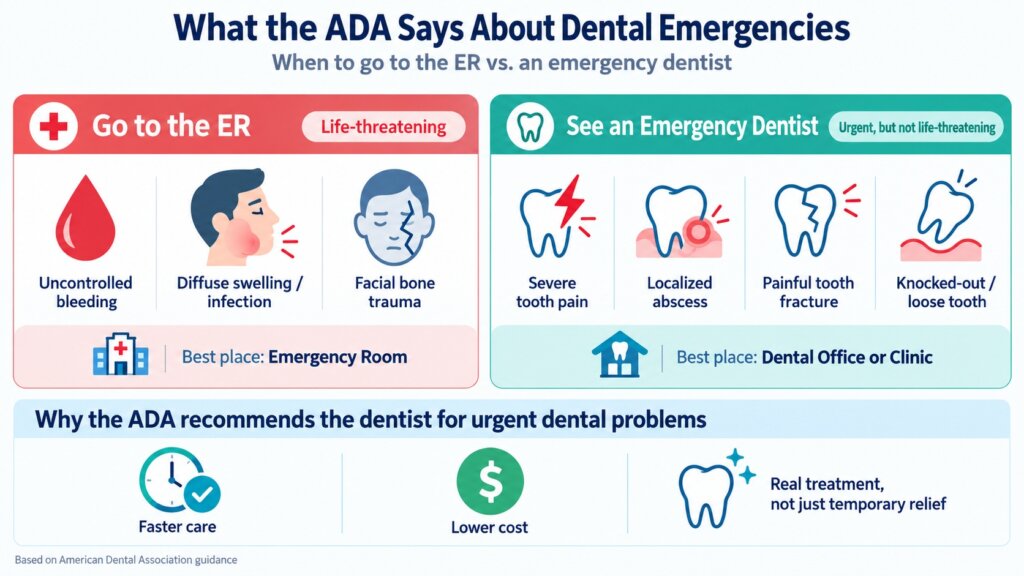
The American Dental Association draws a clear line between two categories of dental problems. Life-threatening dental emergencies include uncontrolled bleeding, diffuse infection with swelling that may compromise the airway, and facial bone trauma. These situations require an emergency room, not a dentist office.
Urgent dental conditions are a separate category. These include severe tooth pain, localized abscesses, tooth fractures causing pain or soft-tissue trauma, and knocked-out or displaced teeth. These are serious but not immediately life-threatening, and they are best handled by an emergency dental care dentist, not a hospital.
The ADA also notes that a large number of dental problems seen in hospital emergency departments could be managed more effectively in a dental office or clinic. Seeing a dentist for these situations saves time, reduces costs, and gives you access to real treatment rather than temporary medication.
Urgent Care vs. Emergency Dentist: A Side-by-Side Comparison
Choosing between urgent care and an emergency dentist office near you comes down to what each setting can actually do. The table below gives you a clear picture.
| Situation | Urgent Care Center | Emergency Dentist Near You |
|---|---|---|
| Severe toothache | Pain medication, nerve block (temporary) | Exam, X-ray, root canal or extraction |
| Dental abscess (localized) | Antibiotics only | Drainage, infection control, root canal or extraction |
| Knocked-out tooth | Cannot reimplant or stabilize | Reimplantation possible within 30 minutes |
| Cracked or fractured tooth | Pain management only | Repair, bonding, crown, or extraction |
| Lost crown or filling | Cannot replace or recement | Same-day recementation or temporary restoration |
| Swelling threatening the airway | Refer to ER | Refer to ER |
| Uncontrolled bleeding | Basic pressure, refer to ER | Refer to ER if beyond dental cause |
The pattern here is consistent. Urgent care buys time. An emergency dental care dentist solves the problem. If you’re in the Bay Area and need real treatment today, Emergency Dental San Francisco offers same-day urgent exams, X-rays, extractions, root canal therapy, abscess drainage, and crown repair, available every day of the week, including holidays. Call 415-230-2783 or book an appointment online.
When Can You Go to Urgent Care for a Dental Emergency and When Should You Skip It?
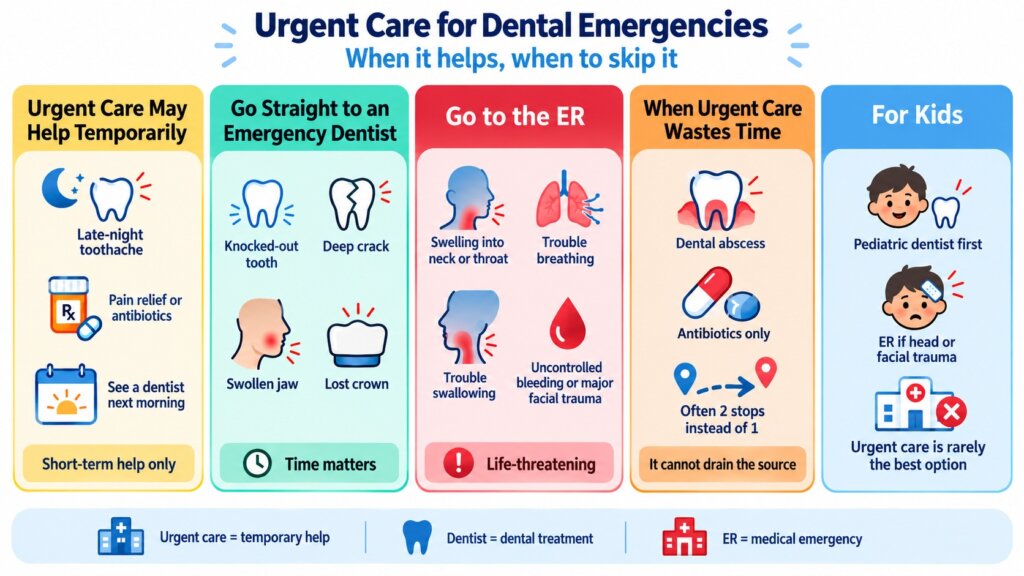
There are specific situations where stopping at urgent care first makes sense, and others where it simply delays the care you actually need. Knowing the difference saves you time and money.
1. When Urgent Care May Help Temporarily
If it’s 2 a.m., you have a severe toothache, and no emergency dentist near you is available, urgent care can prescribe pain relief or antibiotics to get you through the night. This is a reasonable short-term step as long as you follow up with a dentist the next morning.
2. When You Should Go Directly to an Emergency Dentist
If you have a knocked-out tooth, a deep crack, a swollen jaw, or a lost crown, skip urgent care and go straight to a dentist office near you that handles emergencies. Time matters for these conditions, especially for knocked-out teeth, where reimplantation success drops significantly after 30 minutes.
3. When the ER Is the Right Call
Go to the emergency room if you have swelling that is spreading into your neck or throat, difficulty breathing or swallowing, uncontrolled bleeding that won’t stop, or significant facial or jaw trauma. These are the life-threatening emergencies the ADA describes, and they require medical intervention, not dental treatment alone.
4. When Urgent Care Wastes Valuable Time
For dental abscesses, urgent care can prescribe antibiotics, but it cannot drain the infection. The abscess will remain until a dentist treats the source. Going to urgent care first in this situation often means two stops instead of one.
5. When a Pediatric Dentist Near Me Is the Better Option for Kids
Nationwide Children’s Hospital advises that for most pediatric dental emergencies, parents should take the child to a dentist or pediatric dentist near them as soon as possible. The ER is appropriate only if the child’s dentist is unavailable or if there are signs of head or facial trauma. Urgent care is rarely the best option for children with dental injuries.
What to Do Before You Arrive at a Dentist Office
Taking a few quick steps before your visit can protect the tooth, reduce pain, and help your dentist work faster. These steps apply whether you’re heading to an emergency dental care dentist or waiting for a morning appointment.
- Knocked-out tooth: Handle it by the crown only. Gently rinse it without scrubbing. Try to reinsert it into the socket. If that’s not possible, keep it moist in milk or between your cheek and gum. Get to a dentist within 30 minutes if you can.
- Severe toothache or swelling: Rinse with warm salt water. Apply a cold compress to the outside of your cheek. Do not place aspirin directly on your gum tissue.
- Broken or chipped tooth: Save any fragments. Avoid hard or sticky foods. Rinse gently with water.
- Lost crown or filling: Keep the area clean. Bring the crown or any intact restoration with you to the appointment.
- What to bring: A government-issued ID, your insurance card, a list of current medications and allergies, and any recent dental X-rays or records.
Arriving prepared helps the team move quickly from triage to treatment. You spend less time waiting and more time getting relief.
How Emergency Dental San Francisco Handles Urgent Dental Care Differently
You might be wondering what sets an emergency dental care dentist apart from a general dentist office near you that happens to have an opening. The difference is in how the visit is structured from the moment you walk in.
At Emergency Dental San Francisco, the visit follows a clear sequence: triage and immediate pain control come first, then an exam and X-rays, followed by a plain-language explanation of your options with an upfront cost estimate. Treatment happens the same day when it’s clinically appropriate. You leave with written aftercare instructions, prescriptions if needed, and a follow-up plan.
We serve patients across San Francisco, Oakland, Berkeley, Alameda, Daly City, Fremont, South San Francisco, and San Leandro. Walk-ins are welcome. Same-day appointments are available. We accept most dental insurance plans, offer financing for qualified patients, and accept cash and all major credit cards for those without insurance. Our clinic follows CDC and OSHA infection-control standards with strict sterilization protocols and licensed clinical staff. If you’re searching for an emergency dentist near you in the Bay Area, call 415-230-2783 or book your same-day appointment online.
Common Dental Emergencies and What Actually Fixes Them
People often arrive at urgent care or even the ER not knowing that a dentist could have resolved their issue faster and more completely. Here is what real treatment looks like for the most common urgent dental conditions.
1. Severe Toothache
A toothache severe enough to wake you up at night usually signals pulp inflammation or infection. A dentist will take an X-ray to identify the cause and may recommend root canal therapy or extraction depending on the condition of the tooth.
2. Dental Abscess
A localized abscess needs drainage and treatment of the source, either through root canal therapy or extraction. Antibiotics from urgent care slow the infection but do not eliminate it. The abscess will return without dental intervention.
3. Knocked-Out Tooth
This is one of the most time-sensitive dental emergencies. A dentist may be able to reimplant the tooth if you arrive quickly enough, ideally within 30 minutes. Urgent care cannot perform this procedure.
4. Cracked or Fractured Tooth
Depending on the depth of the crack, treatment may involve bonding, a crown, or extraction. A dentist will assess this with an exam and X-ray. Pain medication from urgent care does not address the structural damage.
5. Lost Crown or Filling
A dentist can recement a crown the same day in many cases. If the crown is lost or damaged, a temporary restoration may be placed while a permanent one is made. Urgent care has no tools or materials to help with this.
6. Soft-Tissue Injury or Gum Abscess
Lacerations inside the mouth or infected gum tissue require clinical evaluation. A dentist can drain a gum abscess, manage soft-tissue injuries, and prescribe appropriate treatment. Urgent care may clean a wound but cannot treat the dental source.
7. Broken Denture or Dental Appliance
Urgent care has no capacity to repair dentures. An emergency dental practice with same-day lab access can often provide a repair or temporary solution the same day, which is especially important for patients who rely on their dentures to eat or speak.
A Quick Triage Guide: Where Should You Go Right Now?
Still not sure where to go? Use this quick guide to make your decision.
| Your Symptom | Where to Go |
|---|---|
| Severe toothache, no swelling | Emergency dentist near you |
| Swollen jaw or face, no breathing difficulty | Emergency dentist near you |
| Swelling spreading to neck or throat | Emergency room immediately |
| Knocked-out tooth | Emergency dentist near you, within 30 minutes |
| Cracked or broken tooth with pain | Emergency dentist near you |
| Lost crown or filling | Emergency dentist near you |
| Uncontrolled bleeding | Emergency room |
| Facial or jaw trauma | Emergency room |
| No dentist available, severe pain at night | Urgent care for temporary relief, then dentist next day |
Conclusion
Urgent care can offer temporary relief for dental pain, but it cannot treat the underlying problem the way a dentist can. For most dental emergencies, including abscesses, knocked-out teeth, fractures, and severe toothaches, an emergency dental care dentist is the right first call. Emergency Dental San Francisco is available same-day, after hours, on weekends, and on holidays across the Bay Area. Call 415-230-2783 or book an appointment now for fast, professional care when you need it most.
Emergency Dental San Francisco offers same-day emergency dental care when urgent care clinics can’t help. We treat toothaches, abscesses, and cracked teeth fast—same day, evenings, and weekends. Call 415-230-2783 or book online. Get started today.
FAQs
Can Urgent Care Treat a Dental Emergency?
Most medical urgent care clinics can help with pain control and basic infection management, but they typically can’t treat the source of the problem (like an abscessed tooth, cracked tooth, or lost filling). A dedicated emergency dentist can diagnose the cause with dental X-rays and provide same-day treatment to relieve pain safely and prevent complications.
Will Urgent Care Pull A Tooth?
Medical urgent care centers generally do not perform tooth extractions. Emergency dental clinics can evaluate the tooth and, if needed, perform an extraction or offer other same-day options to stabilize the issue and relieve pain.
Can Urgent Care Prescribe Antibiotics For A Tooth Infection?
Yes, many urgent care providers can prescribe antibiotics when appropriate, but antibiotics alone usually don’t fix the underlying dental source. An emergency dentist can confirm the cause, drain or treat the infection when needed, and give clear next steps to prevent it from returning.
Should I Go To The ER Or Urgent Care For A Toothache?
Go to the ER for trouble breathing or swallowing, rapid facial/neck swelling, uncontrolled bleeding, high fever, or trauma with suspected fracture. For most toothaches, an emergency dentist is the fastest route to definitive relief because we can diagnose the tooth and treat the cause the same day.
How Much Does Urgent Care Cost For A Dental Emergency?
Costs vary by clinic, location, and services, and medical urgent care may add fees for exams, prescriptions, or imaging that still won’t resolve the dental problem. Emergency dental visits are typically more cost-effective for dental issues because you’re paying for dental diagnostics and treatment; we accept most insurance, offer financing for those who qualify, and provide clear pricing before care.

Emergency Dental San Francisco is a dental office focused on providing same-day dental appointments to patients in San Francisco and the surrounding area. We provide urgent dental care services during weekends, evenings and holidays.
We accept several forms of payment and have financing options available to those who qualify. We accept most dental insurance.