14 May How to Avoid Needing Emergency Dental Services: Which Preventive Habits Reduce Urgent Dental Problems?
Nearly 2 million Americans visit hospital emergency departments each year for tooth-related problems—and the average cost of one of those visits hit $2,437 in 2022, according to the CDC and UCSF research. That number is striking. And it does not include follow-up care, time off work, or the stress of sitting in an ER waiting room for a problem a dentist could have handled in an hour. Most of these visits are preventable.
This article walks you through exactly what you can do to reduce your risk of needing urgent dental care. You will find practical habits, early warning signs to watch for, and a clear comparison of what preventive care costs versus emergency treatment. And if prevention is not enough—because sometimes it is not—you will also know where to turn.
Key Takeaways
- Routine dental visits catch problems before they become emergencies that require same-day urgent care.
- Brushing and flossing daily are the most direct ways to prevent infection, decay, and gum disease.
- Ignoring tooth pain almost always makes the underlying problem worse and more expensive to treat.
- Diet, hydration, and lifestyle choices directly affect your long-term oral health and emergency risk.
- When prevention fails, having a trusted emergency dental care dentist you can call matters more than most people realize.
- Emergency department visits for dental issues cost three times more than seeing a dentist office near me, according to the ADA.
Prevention is not complicated. It mostly comes down to consistency. But even the most diligent patients sometimes face a cracked tooth, a sudden abscess, or an injury—and knowing what to do next is just as important as knowing how to avoid it.
How to Avoid Needing a Dental Emergency Service: The Core Habits That Actually Work
The most effective way to avoid a dental emergency service is to treat your teeth before they give you a reason to panic. That sounds obvious, but most people only think about their teeth when something hurts. Pain is usually the last signal, not the first. By the time you feel it, the problem has often been building for months.
Here is what consistent prevention actually looks like in practice.
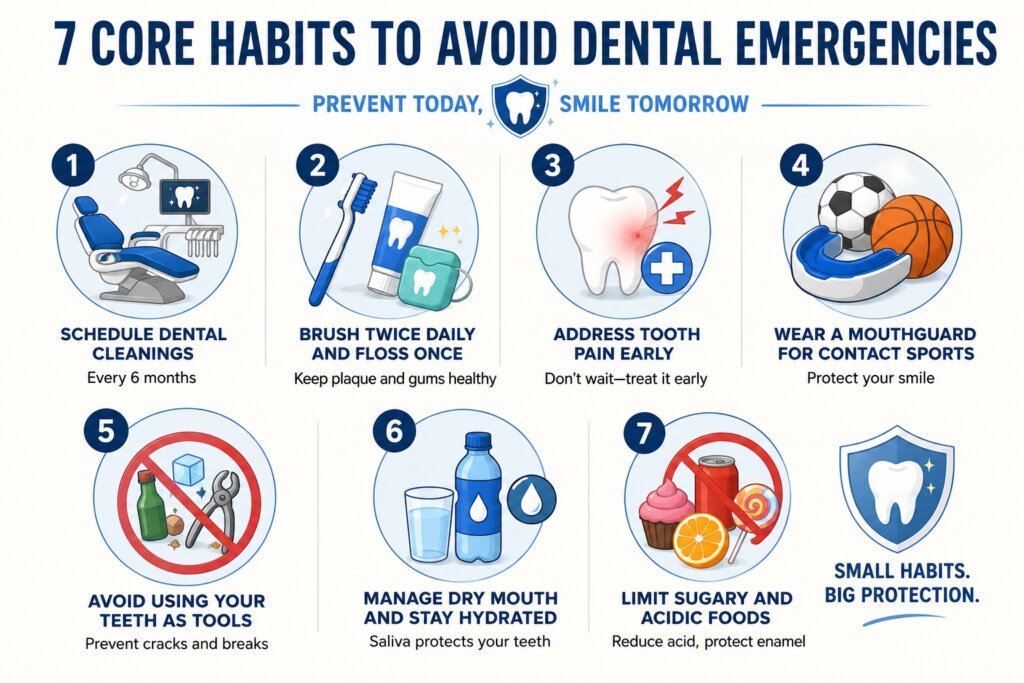
1. Schedule Dental Cleanings Every Six Months
Routine visits to a dentist office near me are the single most reliable way to catch decay, gum disease, and structural problems before they become urgent. A dentist can spot a hairline crack, a failing filling, or early-stage gum infection that you would never notice on your own. Missing even one or two annual appointments can allow small issues to progress into conditions that require emergency dental care.
2. Brush Twice Daily and Floss Once
This is not new advice, but it works. Brushing removes plaque from tooth surfaces, and flossing removes what your brush cannot reach between teeth and along the gumline. Skipping floss regularly is one of the most common reasons people develop gum infections that eventually require drainage or antibiotics. Use a soft-bristle brush and fluoride toothpaste. That combination is enough for most adults.
3. Address Tooth Pain Early—Do Not Wait
You might be wondering whether that dull ache will just go away on its own. Occasionally it does. More often, it does not. A toothache that persists beyond a day or two usually signals decay, infection, or a cracked tooth—all of which worsen without treatment. Waiting a week to see if it resolves can turn a manageable filling into a root canal, or a treatable infection into an abscess requiring drainage. Call a dentist when pain starts, not when it becomes unbearable.
4. Wear a Mouthguard for Contact Sports
Cracked and knocked-out teeth from sports injuries are among the most common reasons people search for an emergency dental care dentist on a weekend. A custom mouthguard from your dentist fits better and offers more protection than over-the-counter options. If you play any contact sport—or even recreational activities like cycling or skateboarding—this is one of the cheapest forms of dental insurance available.
5. Avoid Using Your Teeth as Tools
Opening packages, biting nails, chewing ice, or cracking nuts with your teeth creates stress fractures over time. These fractures are often invisible until the tooth breaks under normal chewing pressure. It is a small habit change with a disproportionate payoff. Teeth are not designed for these tasks, and the repair costs make the convenience not worth it.
6. Manage Dry Mouth and Stay Hydrated
Saliva neutralizes acids and helps remineralize enamel. When you are chronically dehydrated or taking medications that cause dry mouth, your teeth become more vulnerable to decay. Drinking water throughout the day—especially fluoridated tap water—is a simple and underrated protective habit. If dry mouth is a persistent issue, ask your dentist about prescription-strength fluoride or saliva substitutes.
7. Limit Sugary and Acidic Foods
Sugar feeds the bacteria that produce acid, which erodes enamel. Acidic drinks like soda and citrus juice compound the problem. You do not need to eliminate these entirely, but frequency matters more than quantity. Sipping soda slowly over an hour is harder on your enamel than drinking it quickly with a meal. Rinsing with water afterward helps reduce acid exposure.
These habits are not difficult individually. The challenge is maintaining them consistently over years. That is where most people fall short—and where the risk of eventually needing an emergency dental service increases.
Warning Signs That Signal You Need an Emergency Dental Care Dentist Soon

Even with good habits, dental problems can still develop. Knowing the early warning signs gives you time to see a dentist before the situation escalates into a true emergency. Most people wait too long because the signs are easy to rationalize away.
Watch for these signals and act on them promptly.
- Persistent tooth sensitivity that lasts more than a few seconds after eating or drinking hot or cold foods may indicate enamel erosion or an exposed nerve.
- Swelling in the gum or jaw is one of the clearest signs of infection. If it is accompanied by fever, that is a dental emergency—call a dentist immediately.
- A tooth that feels loose in an adult is not normal. It often points to advanced gum disease or bone loss that needs prompt evaluation.
- Bleeding gums that do not improve after a week of consistent flossing may signal gum disease that requires professional treatment.
- A cracked or chipped tooth that causes pain when biting down needs to be examined before the crack deepens into the nerve.
- A lost filling or crown exposes the underlying tooth to bacteria and temperature sensitivity. It should be addressed within a few days, not weeks.
If any of these apply to you right now, this is a good time to call our clinic at 415-230-2783 or book a same-day appointment online. Emergency Dental San Francisco offers urgent exams and X-rays, same-day treatment, and clear cost estimates before any procedure begins—so you are never left guessing.
The Real Cost of Skipping Preventive Care at a Dentist Office Near Me
People often skip routine dental visits because of cost. That logic, while understandable, tends to backfire. The ADA reports that emergency department visits for dental problems cost three times more than a standard dentist visit—averaging $749 per ER visit even without hospitalization, adding up to $1.6 billion annually nationwide. That does not include what happens after the ER, which typically cannot treat the underlying dental cause at all.
Here is a straightforward comparison of what preventive care costs versus delayed emergency care.
| Situation | Preventive Action | Estimated Cost | Delayed Emergency Cost |
|---|---|---|---|
| Early-stage decay | Filling at routine visit | $150–$300 | Root canal + crown: $1,500–$3,000 |
| Gum inflammation | Cleaning + scaling | $200–$400 | Surgical treatment or extraction: $1,000–$3,500 |
| Cracked tooth (minor) | Bonding or crown | $300–$1,200 | Extraction + implant: $3,000–$5,000 |
| Dental abscess (early) | Root canal therapy | $700–$1,500 | ER visit + hospitalization risk: $2,437+ |
| Sports injury prevention | Custom mouthguard | $300–$500 | Knocked-out tooth reimplantation or implant: $3,000–$5,000 |
The numbers are not close. Preventive care wins on cost every time. And that does not account for the pain, the time lost, or the stress of managing a dental crisis on a weekend or holiday.
What to Do When You Cannot Avoid a Dental Emergency Service Visit
Prevention works most of the time. Not all of the time. A fall, a sudden abscess, a crown that comes off on a Friday night—these things happen regardless of how well you take care of your teeth. When they do, how you respond in the first hour matters.
Here are immediate steps for the most common urgent situations.
1. Knocked-Out Tooth
Handle the tooth by the crown, not the root. Rinse it gently with water—do not scrub it. Reinsert it into the socket if you can, or keep it moist in milk or between your cheek and gum. Come in within 30 minutes for the best chance of saving it.
2. Severe Toothache or Swelling
Use a warm salt-water rinse to reduce irritation. Apply a cold compress to the outside of your cheek in 10-minute intervals. Do not place aspirin directly on your gums—it can cause tissue damage. Call a dentist as soon as possible; swelling with fever is an emergency that needs same-day care.
3. Broken or Chipped Tooth
Save any fragments you can find. Avoid hard or sticky foods. If there is sharp pain when biting, the nerve may be involved. A dentist can assess whether bonding, a crown, or another repair is appropriate.
4. Lost Crown or Filling
Keep the area clean and avoid chewing on that side. If you have the crown intact, bring it to your appointment. Temporary dental cement from a pharmacy can protect the tooth for a short period, but it is not a substitute for professional care.
Our team at Emergency Dental San Francisco handles all of these situations—same day, after hours, weekends, and holidays. We serve San Francisco, Oakland, Berkeley, Alameda, Fremont, Daly City, South San Francisco, and San Leandro. Walk-ins are welcome, and you can also book online or call 415-230-2783 any time. We accept most dental insurance plans and offer financing options for patients who qualify, so cost should not be a reason to delay care.
Special Considerations: Pediatric Dental Emergencies and Prevention for Children
Children face a different set of risks than adults, and the numbers are alarming. Emergency department visits for dental conditions among children under 15 increased nearly 60% nationally between 2019 and 2022, according to data published in Dimensions of Dental Hygiene. That is a significant jump, and most of those visits were for conditions that could have been prevented or caught earlier.
If you are a parent searching for a pediatric dentist near me for urgent care, here is what to know.
- Children should see a dentist by age one or within six months of their first tooth appearing.
- Fluoride treatments and dental sealants are highly effective at preventing decay in children.
- Custom mouthguards are recommended for children in sports, even recreational leagues.
- A knocked-out baby tooth does not need to be reinserted, but a knocked-out permanent tooth does—call a dentist immediately.
- Broken braces or wires that cause irritation can often be managed with same-day urgent orthodontic care.
Our clinic provides gentle pediatric urgent care for children facing toothaches, sports injuries, broken braces, and other common dental emergencies. If your child is in pain, do not wait for a regular appointment slot. Call us directly for same-day access.
Conclusion
The best dental emergency is the one that never happens. Consistent brushing, regular visits to a dentist, early attention to pain, and protective gear for sports are the most reliable tools you have. But when prevention is not enough, having a trusted emergency dental care dentist you can reach at any hour makes all the difference—and that is exactly what Emergency Dental San Francisco is here for.
Emergency Dental San Francisco offers same-day urgent care to stop pain fast. We serve the Bay Area with compassionate, affordable treatment every day. Call 415-230-2783 or get started online now.
FAQs
What Counts as a Dental Emergency?
A dental emergency is any mouth problem that causes severe pain, swelling, bleeding, infection (like an abscess), or a damaged/knocked-out tooth—especially if symptoms are worsening or you have fever or facial swelling. When in doubt, call Emergency Dental San Francisco at 415-230-2783 for quick guidance and same-day care.
Can I Go to the ER for a Dental Emergency?
You can go to the ER for trouble breathing, uncontrolled bleeding, major facial trauma, or swelling that may affect your airway. For most dental problems (toothaches, abscesses, broken teeth), an urgent-care dentist is usually faster and better equipped to treat the cause and relieve pain—often the same day, including after-hours, weekends, and holidays.
How Much Does an Emergency Dentist Visit Cost?
Costs vary based on the exam, X-rays, and treatment needed, but we aim to keep emergency care accessible with transparent pricing. Emergency Dental San Francisco accepts most insurance plans, offers financing for those who qualify, and also accepts cash and major credit cards—call for a quick estimate based on your symptoms.
What Should I Do If I Have a Toothache or Severe Dental Pain?
Call an emergency dentist promptly—pain can signal infection. Until you’re seen, rinse with warm salt water, use a cold compress for swelling, take OTC pain medicine as directed (avoid aspirin on the gums), and don’t apply heat. If you have facial swelling, fever, or trouble swallowing/breathing, seek urgent medical help immediately.
Do Emergency Dentists Take Walk-Ins or Same-Day Appointments?
Yes—Emergency Dental San Francisco welcomes walk-ins and offers same-day appointments, with 24/7 phone support. You can call 415-230-2783 or book online to be seen as quickly as possible.

Emergency Dental San Francisco is a dental office focused on providing same-day dental appointments to patients in San Francisco and the surrounding area. We provide urgent dental care services during weekends, evenings and holidays.
We accept several forms of payment and have financing options available to those who qualify. We accept most dental insurance.