

02 Nov Emergency Dental Care Centre: What Happens If You Need Multiple Procedures?
You came in for one thing—a cracked tooth, maybe—and then the X-ray reveals something else. Or the pain you thought was isolated turns out to involve two teeth, a failing filling, and a possible abscess. This happens more often than most people expect, and it raises a fair question: what actually happens when you need more than one procedure at an emergency dental care centre?
This article walks you through how same-day urgent dental visits work when multiple issues are involved. You’ll learn how triage is prioritized, which procedures can be combined in one visit, what affects treatment sequencing, and how to prepare so your visit runs as smoothly as possible—even when the situation is complicated.
Key Takeaways
- An emergency dental care centre triages your conditions by urgency, not by how many problems exist.
- Some procedures can be safely combined in one visit; others require separate appointments for clinical or safety reasons.
- A same-day dental clinic near me option like ours provides X-rays, diagnosis, and immediate treatment without a referral.
- Knowing your insurance—whether through MetLife dental login, Delta Dental provider login, or another plan—helps speed up the billing process.
- Our team explains every step before starting, so you always know what’s happening and why.
What an Emergency Dental Care Centre Does When You Have Multiple Problems
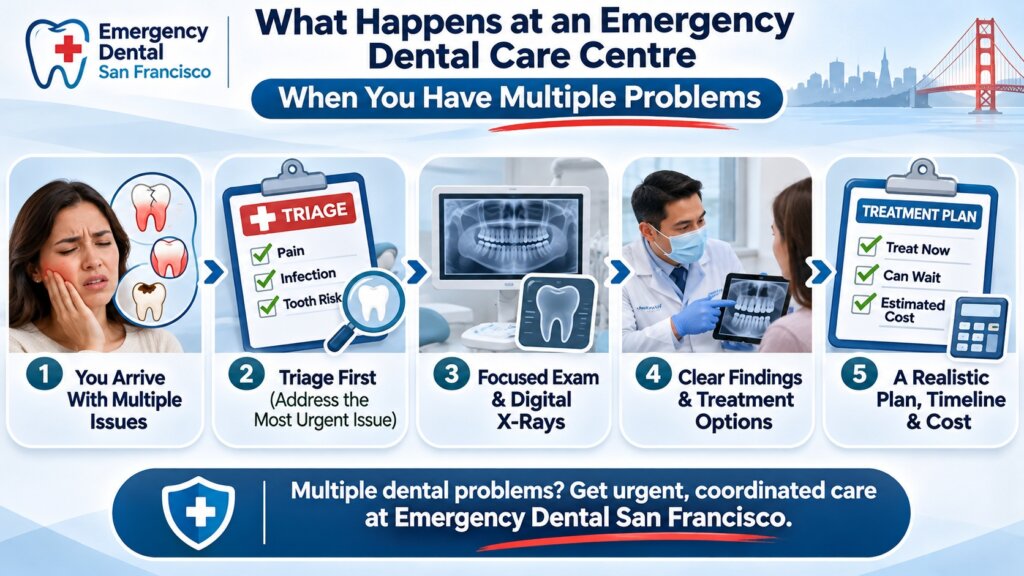
Walking into an urgent dental clinic with more than one issue does not mean you’ll be turned away or asked to schedule separate visits for each problem. At Emergency Dental San Francisco, the first step is always triage—identifying what is causing the most immediate harm and addressing that first. Pain, infection, and structural risk to the tooth guide that decision, not the number of issues on the list.
The clinical team performs a focused exam and takes digital X-rays during the same visit. This gives a clear picture of everything happening in your mouth, not just the one spot that hurts.
From there, the dentist walks you through the findings in plain language. You get a realistic breakdown of what needs to happen now, what can wait a few days, and what the estimated cost looks like for each path forward.
How Triage Works at a Dental Clinic Near Me for Complex Cases
Triage at an emergency dental care centre follows a clinical hierarchy based on risk, not convenience. The goal is to stop what is causing harm first, then work through secondary concerns in a logical order. Here is how that typically unfolds when multiple issues are present.
1. Airway and Systemic Risk Come First
If you have facial swelling with fever, difficulty swallowing, or any sign that an infection may be spreading toward the neck or airway, that is treated as a medical emergency. According to the Erie County Department of Health, breathing difficulty, neck swelling, or fever with facial swelling warrant emergency-room evaluation—not a dental chair. We will direct you to the ER immediately in those cases and coordinate your follow-up care once you are stable.
2. Uncontrolled Bleeding Is Addressed Immediately
Persistent or uncontrolled bleeding—whether from trauma, a failed extraction site, or soft-tissue injury—is managed before anything else. A peer-reviewed clinical review published in an indexed medical journal classifies uncontrolled bleeding as a condition requiring immediate management, separate from other dental concerns that may be present at the same time.
3. Acute Infection Without Airway Involvement
An abscess or localized infection that is painful and swollen but not threatening the airway is treated urgently but does not require an ER visit. Drainage, antibiotic therapy, and pain control are initiated at our clinic during the same appointment. If a root canal or extraction is needed to resolve the infection, that is discussed and often started the same day.
4. Severe or Moderate Dental Pain
Once life-threatening concerns are ruled out, severe pain becomes the next priority. Whether it stems from a cracked tooth, exposed nerve, or failing restoration, the goal is to get you out of pain quickly. This may involve temporary or permanent treatment depending on the clinical picture.
5. Structural Damage and Tooth Preservation
Fractured, broken, or knocked-out teeth fall into this tier. The University of Texas Health Science Center at San Antonio advises rapid care after a tooth is knocked out—ideally within 30 minutes—to preserve reimplantation potential. When multiple teeth are involved, the most restorable and most critical are prioritized first.
6. Secondary or Restorative Concerns
Lost fillings, loose crowns, or minor chips that are not causing pain are addressed last, or scheduled for a close follow-up visit if time or clinical complexity makes same-day treatment impractical.
Which Procedures Can Be Combined in a Single Emergency Visit at Our Dental Clinic
Not every combination of procedures can be completed in one sitting. Some can, and doing them together saves you time and reduces the number of times you need to get numb. Others need to be staged for clinical reasons—your safety, healing time, or the complexity of the work involved.
Here is a general comparison of what is typically manageable in one visit versus what is usually staged.
| Procedure Combination | Same-Day Possible? | Notes |
|---|---|---|
| Exam + X-rays + extraction | Yes | Standard same-day workflow |
| Abscess drainage + antibiotic prescription | Yes | Root canal or extraction may follow at next visit |
| Root canal + temporary crown | Often yes | Permanent crown requires a lab; placed at follow-up |
| Multiple extractions (non-adjacent) | Case-dependent | Depends on sedation, healing, and patient tolerance |
| Broken tooth repair + lost filling replacement | Often yes | If both are straightforward and in different quadrants |
| Soft-tissue injury + tooth fracture | Yes | Managed together when both are trauma-related |
| Full-mouth reconstruction | No | Requires planned staging over multiple appointments |
The dentist will tell you clearly what can be done today and what needs a follow-up. There is no guesswork, and there is no pressure to agree to more than you are comfortable with in one session.
What to Expect During a Multi-Procedure Emergency Dental Visit
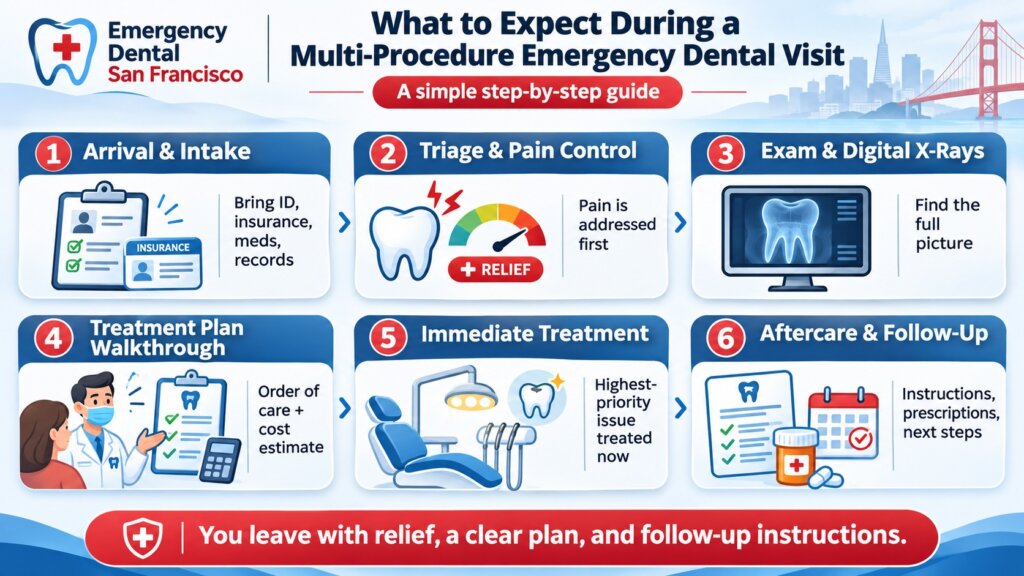
If you are coming in knowing that more than one issue needs attention, here is a realistic picture of how the visit flows from the moment you arrive.
1. Arrival and Intake
Arrive about 15 minutes early. Bring a government-issued ID, your insurance card (whether you use MetLife dental login, Delta Dental provider login, or another carrier), a list of current medications and allergies, and any recent dental records or X-rays if you have them. Our dental assistants—who, according to the U.S. Bureau of Labor Statistics, are trained in patient care, X-ray imaging, and record management—handle intake efficiently so you spend less time waiting and more time getting treated.
2. Triage and Pain Control
Before anything else, the team assesses your pain level and addresses it. You will not sit in discomfort while paperwork is processed. Pain control is the first clinical step, full stop.
3. Exam and Digital X-Rays
A focused clinical exam and digital X-rays give the dentist a complete picture. This is where secondary issues are often discovered—a tooth that looks fine from the outside but shows infection at the root on imaging, for example.
4. Treatment Plan Walkthrough
The dentist explains what they found, what needs to happen, and in what order. You get a cost estimate before anything starts. If your plan involves MetLife dental login or Delta Dental provider login for coverage verification, our front desk handles that in real time so you know what your out-of-pocket responsibility looks like.
5. Immediate Treatment
Work begins on the highest-priority issue. Depending on time and complexity, secondary procedures may follow in the same appointment or be scheduled within days. You are never left without a plan.
6. Aftercare Instructions and Follow-Up Scheduling
Before you leave, you receive written aftercare instructions, any prescriptions needed, and a clear follow-up plan. If swelling, rising pain, or fever develops after your visit, you are told exactly when and how to contact us.
How Insurance and Financing Work When Multiple Procedures Are Involved
You might be wondering how billing works when several procedures happen in one visit or across multiple visits. The short answer is that each procedure is coded and billed separately, which is standard practice across all dental insurance plans.
We accept most major dental insurance plans. If you use MetLife dental login or Delta Dental provider login to manage your benefits, our team can verify your coverage on the spot and give you an accurate estimate of what your plan covers. For patients without insurance, we accept cash and all major credit cards, and financing options are available for those who qualify.
Complex cases sometimes involve pre-authorization for certain procedures. We handle that communication with your insurer directly when possible, so you are not left navigating it alone. If you are searching for a dental clinic near me that is transparent about costs before treatment starts, that is exactly how we operate.
Our same-day urgent care services—including emergency exams, X-rays, extractions, root canal therapy, abscess drainage, crown recementation, and broken tooth repair—are all available without a referral. You can walk in, call 415-230-2783, or book online. If you are unsure whether your situation qualifies as an emergency, call us anyway. We will help you figure it out.
What to Do Before You Arrive for a Complex Emergency Visit
A few simple steps before you walk through the door can make the visit faster and more effective.
- Write down every symptom you are experiencing, including when it started and what makes it better or worse.
- List all medications and supplements you are currently taking, including blood thinners or diabetes medications, which can affect treatment decisions.
- Gather any recent dental X-rays or records if you have them—even a photo of a broken tooth fragment helps.
- If you have dental insurance, log into your MetLife dental login or Delta Dental provider login account to confirm your current coverage and annual maximum remaining.
- Eat a light meal beforehand if you are not in severe pain—some procedures take time, and you may not want to eat immediately after treatment.
- Arrange a ride if you think sedation or significant treatment may be involved.
These steps are not required, but they genuinely reduce delays and help the clinical team make faster, more informed decisions on your behalf.
A Note on Dental Assistant Jobs and the Team Behind Your Care
When you visit an emergency dental care centre for multiple procedures, you interact with more than just the dentist. Dental assistants play a central role in making complex visits run smoothly. The U.S. Bureau of Labor Statistics notes that dental assistants provide direct patient care, take and process X-rays, maintain clinical records, and coordinate scheduling—with projected employment growth of 7% from 2025 to 2035 and roughly 53,000 annual job openings nationwide. That growth reflects how much demand exists for skilled clinical support staff in urgent care settings like ours.
Our assistants are trained, credentialed professionals who follow CDC and OSHA infection-control standards. Every instrument is sterilized between patients, PPE is used consistently, and the clinical environment meets California state dental regulations. You are not just getting fast care—you are getting care that is clean, safe, and properly documented.
Conclusion
When you need multiple dental procedures, the process is structured, not chaotic—triage guides every decision, and your safety comes first. Emergency Dental San Francisco handles complex same-day cases across the Bay Area, from single extractions to multi-issue visits involving infection, trauma, and restorative work. Call 415-230-2783, book an appointment online, or walk in—we are here around the clock to help you get through it.
Emergency Dental San Francisco specializes in same-day multi-procedure care for urgent dental needs. We handle complex cases fast, with clear treatment plans and compassionate relief. Call 415-230-2783 or get started today.
FAQs
What Is Considered a Dental Emergency?
A dental emergency is any mouth or tooth problem that needs urgent care to stop severe pain, control bleeding or swelling, or prevent infection or tooth loss—such as a bad toothache, abscess, broken/cracked tooth, knocked-out tooth, facial swelling, or uncontrolled bleeding. If you’re unsure, call Emergency Dental San Francisco at 415-230-2783 for guidance and same-day options.
Can I Go to the ER for a Dental Emergency?
Yes—go to the ER for trouble breathing or swallowing, rapidly spreading facial/neck swelling, high fever with severe swelling, heavy uncontrolled bleeding, or major trauma. For most dental emergencies (toothaches, abscesses, broken teeth), an emergency dentist can treat the cause and provide faster, more definitive relief—Emergency Dental San Francisco offers same-day, after-hours, weekend, and holiday care.
How Much Does Emergency Dental Care Cost?
Costs vary based on the exam, X-rays, and what treatment is needed (such as a filling, root canal, extraction, or infection management). We accept most dental insurance plans, offer financing for those who qualify, and take cash and major credit cards—call 415-230-2783 for a clear estimate after a brief symptom review.
Do Emergency Dentists Accept Walk-Ins?
Many do, and we welcome walk-ins when possible, but calling ahead helps us get you in faster and prepare for your specific issue. Emergency Dental San Francisco also offers same-day appointments and 24/7 phone support for urgent dental problems.
What Should I Do If I Have a Toothache and Can’t See a Dentist Right Away?
Rinse with warm salt water, use a cold compress for swelling, take OTC pain medicine as directed (avoid aspirin on the gum), and keep the area clean; don’t place heat or pills on the tooth or gums. If you have swelling, fever, a bad taste/drainage, or worsening pain, call Emergency Dental San Francisco at 415-230-2783 for same-day or after-hours care.

Emergency Dental San Francisco is a dental office focused on providing same-day dental appointments to patients in San Francisco and the surrounding area. We provide urgent dental care services during weekends, evenings and holidays.
We accept several forms of payment and have financing options available to those who qualify. We accept most dental insurance.