

11 Sep Which Dental Complications Require Immediate Surgery and Which Can Be Stabilized First?
A dental surgery emergency can happen without warning. One moment you are eating lunch, and the next, you are dealing with sharp pain, a cracked tooth, or a swollen jaw that will not let up. Knowing what to do in those first few minutes can make a real difference in your outcome. At Emergency Dental San Francisco, we see these situations every day, and we want you to feel prepared, not panicked.
This article walks you through the most common dental surgery emergencies, what signs to watch for, how to respond before you reach a dentist office, and what to expect when you come in for same-day care. You will also find a quick comparison table, step-by-step guidance, and clear answers to the questions patients ask us most often.
Key Takeaways
- A dental surgery emergency includes severe pain, swelling, uncontrolled bleeding, knocked-out teeth, and post-procedure complications that need immediate attention.
- Acting within the first 30 to 60 minutes often determines whether a tooth can be saved or an infection can be stopped early.
- Not every dental crisis requires an ER visit — a qualified urgent-care dentist can handle most oral surgical emergencies faster and more effectively.
- Emergency Dental San Francisco offers same-day appointments, walk-ins, and 24/7 phone access at 415-230-2783 across the Bay Area.
- Patients with MetLife dental login access or other insurance plans can often use their benefits for emergency visits — always worth a quick check before you arrive.
- Bring your medication list, insurance card, and any recent X-rays to help the team triage you faster.
Understanding what qualifies as a dental surgery emergency is the first step toward getting the right care at the right time. Let that guide everything that follows.
What Counts as a Dental Surgery Emergency and Why It Matters to Find a Dentist Near Me Fast
A dental surgery emergency is any oral condition that causes significant pain, risk of infection, tooth loss, or threatens your airway or overall health. This is broader than most people realize. It is not just a knocked-out tooth — it includes abscesses with fever, dry socket after an extraction, fractured teeth with exposed nerves, uncontrolled post-surgical bleeding, and jaw swelling that spreads toward the throat.
Research published in peer-reviewed literature on orofacial surgical emergencies confirms that delays in treating oral infections can lead to life-threatening complications, including airway obstruction. A case report in the Journal of Surgical Case Reports documented a rare but serious airway emergency following a dental extraction — a stark reminder that post-procedure monitoring matters. The National Institute of Dental and Craniofacial Research (NIDCR) also recognizes oral infections as conditions requiring prompt clinical evaluation, not a wait-and-see approach.
So when you search for a dentist near me at 11 PM on a Friday, you are making the right call. Speed is not overreacting — it is the standard of care.
Common Dental Surgery Emergencies You Should Recognize at Any Dentist Office
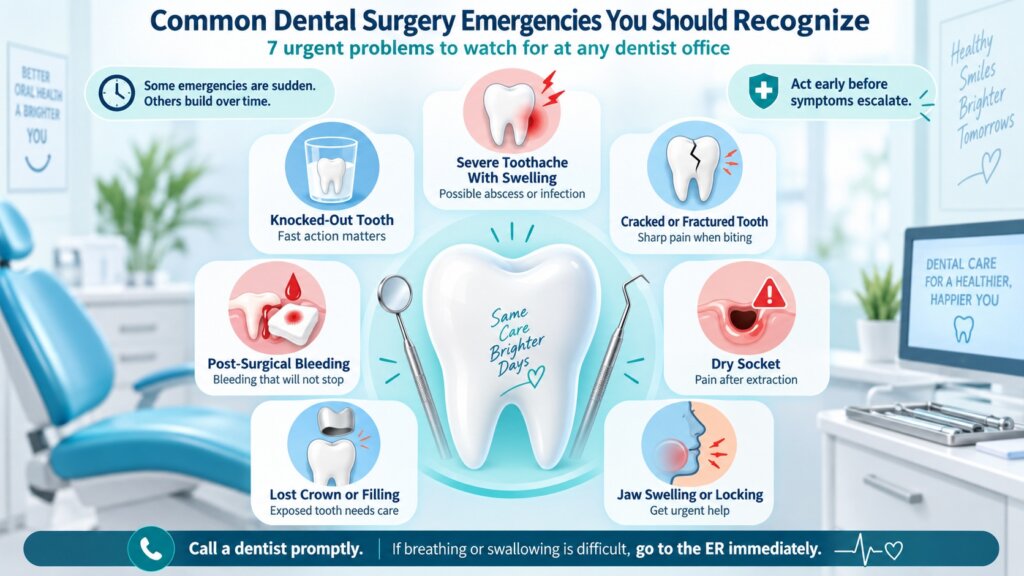
Some emergencies are obvious. Others creep up slowly until they become urgent. Knowing the difference helps you act before things escalate.
Here are the most common dental surgery emergencies our team treats:
1. Severe Toothache With Swelling
Pain that throbs continuously, especially with facial swelling or fever, often signals a dental abscess. This is an active infection that can spread to surrounding tissue and, in serious cases, to the jaw or neck. A warm salt-water rinse may offer brief comfort, but you need a dentist — not a pharmacy run.
2. Knocked-Out Tooth
This is one of the most time-sensitive dental surgery emergencies. Handle the tooth by the crown only, rinse it gently without scrubbing, and try to reinsert it into the socket. If that is not possible, keep it moist in milk or between your cheek and gum and get to a dentist within 30 minutes. After an hour, the chances of successful reimplantation drop significantly.
3. Cracked or Fractured Tooth
A crack that reaches the pulp causes intense, sharp pain — especially when biting or exposed to temperature changes. Save any broken fragments, avoid hard or sticky foods, and come in for an emergency exam and X-ray. Our clinic can assess whether the tooth needs a crown, root canal, or extraction.
4. Post-Surgical Bleeding That Will Not Stop
Some bleeding after an extraction is normal for the first hour. If it continues beyond that with no sign of slowing, apply firm pressure with clean gauze and call us immediately. Uncontrolled bleeding after oral surgery is a true emergency and should not be managed at home alone.
5. Dry Socket
Dry socket occurs when the blood clot at an extraction site dislodges or dissolves too early. It causes a dull, aching pain that radiates toward the ear, often starting two to four days after surgery. It is not dangerous, but it is painful and needs professional dressing to heal properly.
6. Lost Crown or Filling After a Procedure
A missing crown or filling after dental work exposes the tooth to bacteria and sensitivity. Keep the area clean, avoid chewing on that side, and bring the crown with you if you still have it. We can recementation or replace it the same day in most cases.
7. Jaw Swelling or Locking
Swelling that spreads below the jaw or causes difficulty opening your mouth can indicate a spreading infection or a serious post-surgical complication. This warrants immediate attention. If you also have difficulty breathing or swallowing, go directly to the ER — this is the one scenario where an emergency room is the right first stop.
When to Call Us Versus When to Go to the ER — A Clear Guide for Dental Surgery Emergency Decisions
You might be wondering whether your situation needs a dental office or a hospital. This is one of the most common questions we get, and the answer matters because ERs are not equipped for most dental procedures. They can manage pain and prescribe antibiotics, but they cannot perform root canals, extractions, or repair fractured teeth.
| Situation | Go to Emergency Dental SF | Go to the ER |
|---|---|---|
| Severe toothache or abscess | Yes — same-day treatment available | Only if breathing is affected |
| Knocked-out tooth | Yes — within 30 minutes for best outcome | No — ER cannot reimplant teeth |
| Uncontrolled post-surgical bleeding | Yes — call 415-230-2783 first | If bleeding is severe and unmanageable |
| Jaw swelling with difficulty swallowing | Call us immediately for guidance | Yes — possible airway risk |
| Cracked or fractured tooth | Yes — X-ray and repair same day | No |
| Suspected facial fracture | No | Yes — requires imaging and orthopedic care |
| Lost crown or filling | Yes — often fixed same visit | No |
When in doubt, call us first. Our team can help you triage over the phone and tell you exactly where to go.
What to Do Before You Arrive — Steps for Any Dental Surgery Emergency
Getting to care quickly is the goal, but a few steps before you walk in can improve your outcome and speed up your visit. Here is what to do depending on your situation.
- Control the pain safely. Take an over-the-counter pain reliever like ibuprofen as directed. Do not place aspirin directly on your gums — it can cause a chemical burn to the tissue.
- Manage swelling with a cold compress. Apply a cold pack to the outside of your cheek in 10-minute intervals. This helps reduce inflammation while you make your way to the clinic.
- Handle a knocked-out tooth correctly. Grip it by the crown, not the root. Rinse without scrubbing. Reinsert if possible, or store in milk. Time is critical here — do not delay.
- Save any broken pieces. If a tooth or restoration has fractured, collect any fragments and bring them in a clean container. This can help determine repair options.
- Rinse gently for infections or abscesses. A warm salt-water rinse can help reduce bacteria and provide mild comfort. It does not replace treatment, but it is a reasonable step while en route.
- Gather your documents. Bring a government-issued ID, your insurance card, a list of current medications and allergies, and any recent dental X-rays or records. Arriving with these ready helps our team move faster.
- Call ahead if possible. Reaching us at 415-230-2783 before you arrive allows us to prepare for your specific situation and reduce your wait time significantly.
These steps are not complicated, but they do matter. The goal is to arrive calm, informed, and ready to be seen.
What Happens During Your Dental Surgery Emergency Visit at Our Dentist Office
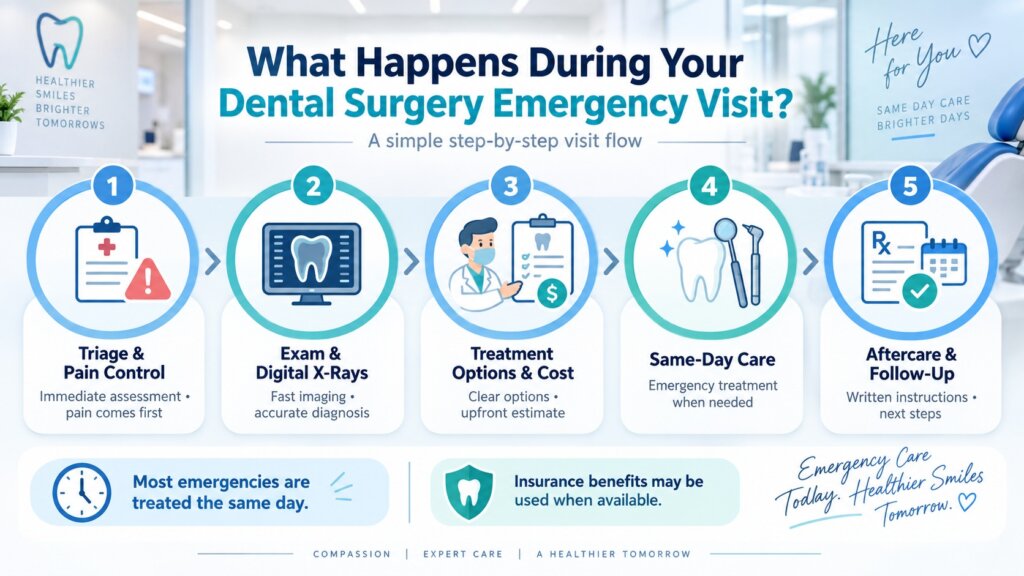
Walking into an emergency dental visit when you are in pain can feel disorienting. Knowing what to expect helps. At Emergency Dental San Francisco, we follow a clear, consistent process so nothing feels uncertain.
Here is how a typical visit flows:
- Triage and pain control first. We assess your situation immediately and prioritize stopping the pain. You will not be left waiting without acknowledgment.
- Exam and digital X-rays. Our licensed clinicians use modern imaging equipment to get a clear picture of what is happening. This step is fast and essential for accurate diagnosis.
- Plain-language explanation of options. We explain what we found, what your choices are — extraction, root canal, repair, or temporary relief — and provide an upfront cost estimate before any work begins.
- Immediate treatment when indicated. Most dental surgery emergencies are treated the same day. We do not send you home with just a prescription and a follow-up date three weeks out.
- Written aftercare instructions and prescriptions. Before you leave, you get clear written instructions, any needed prescriptions, and a realistic follow-up plan.
Patients who have MetLife dental login access or other insurance coverage can use their benefits here — we accept most major dental insurance plans. For those without coverage, we accept cash and all major credit cards, and financing is available for qualified patients. We work hard to keep emergency care accessible, not just available.
Pediatric Dental Surgery Emergencies — What Parents Need to Know About Finding a Pediatric Dentist Near Me
Children are not immune to dental surgery emergencies. Sports injuries, falls, and sudden toothaches happen to kids too, sometimes at the worst possible times. If your child knocks out a baby tooth, do not try to reinsert it — that can damage the developing permanent tooth underneath. For a knocked-out permanent tooth in a child, the same 30-minute rule applies.
Our clinic provides gentle pediatric urgent care for common issues including knocked-out teeth, broken braces, severe toothaches, and soft-tissue injuries. We understand that a child in pain is a frightened child, and a frightened child needs a calm, clear approach — not a rushed one. If you have been searching for a pediatric dentist near me during an after-hours emergency, we are available to help.
Custom mouthguards are one of the most practical preventive tools for active kids. If your child plays contact sports, ask us about same-day or next-visit fitting options. Prevention is always easier than emergency treatment.
How Emergency Dental San Francisco Handles Dental Surgery Emergency Care Across the Bay Area
We serve patients throughout San Francisco and the surrounding Bay Area, including South San Francisco, Alameda, Berkeley, Daly City, Fremont, Oakland, and San Leandro. Our clinic is open 24 hours a day, every day of the year — including holidays. Walk-ins are welcome, same-day appointments are available, and our phone line at 415-230-2783 is staffed around the clock.
Every procedure at our clinic is performed by licensed dental professionals in a clean, clinical environment. We follow CDC and OSHA infection-control standards, use strict sterilization protocols, and maintain HIPAA-compliant privacy practices. If you are dealing with a dental surgery emergency right now and need a trusted dentist office near me, we are ready to help — not tomorrow, today.
Book an appointment online or call us directly. You do not have to navigate a dental crisis alone.
Final Thoughts on Managing a Dental Surgery Emergency
A dental surgery emergency is serious, but it is manageable when you act quickly and get to the right place. Recognize the warning signs early, take the right steps before you arrive, and trust a qualified team to handle the rest. Emergency Dental San Francisco is here every hour of every day — because dental pain does not wait, and neither should you.
Emergency Dental San Francisco specializes in same-day urgent dental surgery care for fast, compassionate relief. We serve the Bay Area seven days a week, including holidays. Call 415-230-2783 or get started today.
FAQs
What Is Considered a Dental Emergency?
A dental emergency is any problem that needs urgent care to stop severe pain, control bleeding, reduce swelling, or prevent infection or tooth loss—such as a bad toothache, facial swelling, abscess, broken tooth, knocked-out tooth, or injury to the mouth.
Should I Go to the ER for a Dental Emergency?
Go to the ER for trouble breathing or swallowing, uncontrolled bleeding, severe facial swelling spreading rapidly, high fever, or signs of a serious allergic reaction. For most urgent dental issues (tooth pain, abscess, broken/knocked-out tooth), an emergency dentist can treat the cause faster and more directly—often the same day.
How Do You Know If You Need Emergency Oral Surgery?
You may need emergency oral surgery if you have severe swelling, an abscess that needs drainage, a tooth that can’t be saved and requires extraction, a cracked tooth with deep pain, or trauma to teeth/jaw. A focused exam and X-rays by a licensed clinician confirm the safest next step.
What Should I Do If I Have Severe Tooth Pain or Swelling?
Call an emergency dentist right away. Until you’re seen, use a cold compress, take OTC pain medicine as directed (if safe for you), keep your head elevated, and avoid heat and alcohol. Do not place aspirin on the gums, and seek immediate medical care if you have difficulty breathing/swallowing or rapidly worsening swelling.
Can an Emergency Dentist Treat an Abscess or Infection Right Away?
Yes—an emergency dentist can evaluate the infection, take X-rays, relieve pressure (such as drainage when appropriate), and start treatment to control pain and stop the source (like root canal therapy or extraction). Antibiotics may be prescribed when indicated, and you’ll get clear follow-up steps.

Emergency Dental San Francisco is a dental office focused on providing same-day dental appointments to patients in San Francisco and the surrounding area. We provide urgent dental care services during weekends, evenings and holidays.
We accept several forms of payment and have financing options available to those who qualify. We accept most dental insurance.