

20 Aug Dental Code for After Hours Emergency: What You Need to Know
A toothache does not wait for business hours. It hits on a Sunday night, during a holiday weekend, or at 2 a.m. when every dental clinic near you is closed. When you finally reach a dentist, you might notice something unfamiliar on your bill—a code labeled D9440. If you have no idea what that means or whether your insurance covers it, you are not alone.
This article breaks down the dental code for after-hours emergency visits, explains how billing and insurance work outside regular office hours, and walks you through what to expect when you need urgent care fast. You will also find practical steps to take before your visit, tips for checking your coverage, and guidance on when to call a dentist versus heading to the ER.
Key Takeaways
- CDT code D9440 is the official billing code used when a dentist sees you outside of regular office hours.
- D9440 covers the after-hours visit itself—actual treatment is billed separately using its own procedure code.
- Some dental insurance plans cover D9440, but coverage varies by plan, so verifying benefits in advance matters.
- Knowing this code helps you understand your explanation of benefits and avoid surprise charges.
- Emergency Dental San Francisco provides same-day, after-hours, and weekend urgent care across the Bay Area.
- If a dental emergency involves breathing difficulty or uncontrolled bleeding, go to the nearest emergency room immediately.
What the Dental Code for After Hours Emergency (D9440) Actually Means
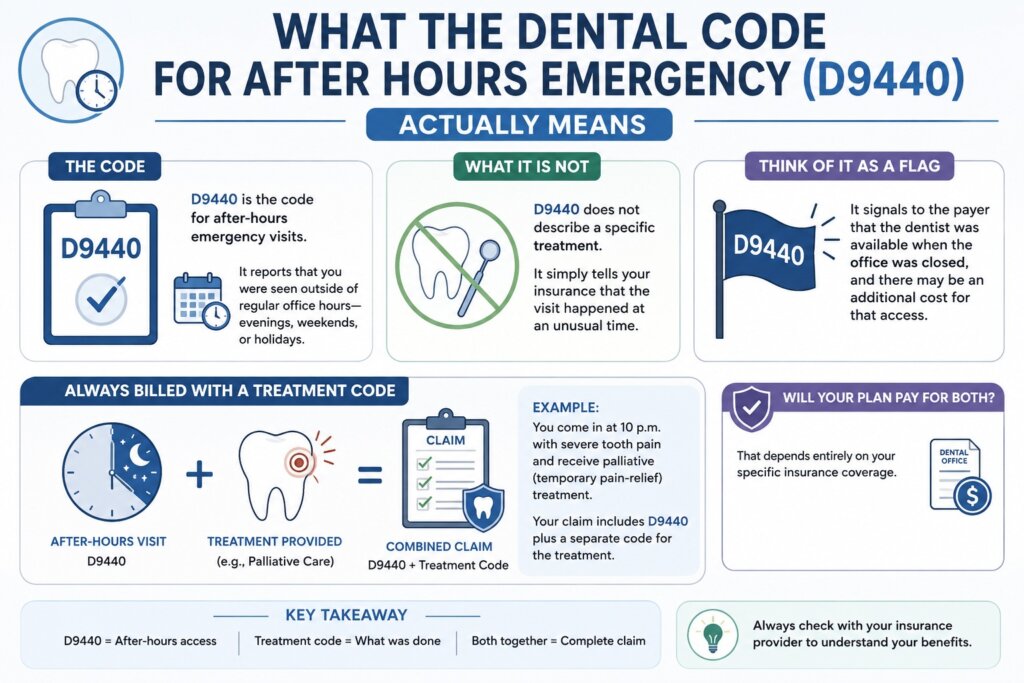
The dental code for after-hours emergency visits is D9440, defined by the American Dental Association’s Code on Dental Procedures and Nomenclature (CDT). It specifically reports that a patient was seen outside of a practice’s regularly scheduled hours—evenings, weekends, or holidays. The code does not describe a specific treatment. It simply tells the insurance company that the visit happened at an unusual time.
Think of D9440 as a flag on your claim. It signals to the payer that the dentist made themselves available when the office would normally be closed, and that there may be an additional cost associated with that access.
This distinction matters because D9440 is always billed alongside a separate treatment code. For example, if you came in at 10 p.m. with a severe toothache and received palliative (temporary pain-relief) treatment, your claim would include both D9440 for the after-hours visit and a separate code for the palliative care itself. The two codes work together but cover different things. You might be wondering whether your plan pays for both—and that depends entirely on your specific coverage.
How the Dental Code for After Hours Emergency Differs From a Standard Emergency Exam
A standard emergency exam has its own CDT code and is typically used during regular business hours when a patient walks in with an urgent problem. The dental code for after-hours emergency, D9440, is used instead of—or in addition to—that exam code when the visit occurs outside normal hours. Payer guidelines generally allow D9440 to be reported in place of a standard emergency exam code when the timing qualifies.
Here is a simple breakdown of how these codes compare:
| Scenario | Code Used | What It Covers |
|---|---|---|
| Emergency visit during office hours | Emergency exam code (e.g., D0140) | Clinical exam for urgent problem |
| Emergency visit after hours | D9440 | After-hours office visit (not the treatment) |
| Treatment provided at the visit | Separate procedure code | Extraction, root canal, palliative care, etc. |
| Both after-hours visit and treatment | D9440 + treatment code | Access fee plus the actual procedure |
One thing to keep in mind: payer guidelines typically do not allow both an emergency exam code and a palliative treatment code to be billed for the same visit. The dentist bills one or the other alongside D9440—not all three at once. Understanding this prevents confusion when you review your explanation of benefits.
Does Insurance Cover the Dental Code for After Hours Emergency?
Coverage for D9440 varies. Some dental insurance plans treat it like any other procedure and apply your standard benefits. Others exclude it entirely or require a specific benefit category to apply. If you use a plan like MetLife Dental, logging into your MetLife Dental provider login or MetLife Dental login portal is one of the fastest ways to check whether after-hours visit codes are covered under your plan before you arrive at a dental clinic near you.
A few things worth checking before or right after your visit:
- Whether D9440 is a covered benefit under your specific plan
- Whether it counts toward your annual maximum
- Whether a deductible applies before coverage kicks in
- Whether your dentist is in-network, which affects your out-of-pocket cost
- Whether pre-authorization is required for after-hours visits
At Emergency Dental San Francisco, we accept most dental insurance plans and work to provide up-front estimates whenever possible. For patients without insurance, we accept cash and all major credit cards, and we offer financing options for those who qualify. Our goal is to make urgent care accessible—not to add financial stress on top of physical pain. You can call us at 415-230-2783 to ask about your specific plan before you come in.
When Should You Use the Dental Code for After Hours Emergency—and When Should You Go to the ER?
Knowing when to call a dentist office near you versus heading to the hospital is a real question, and the answer depends on what is happening. The American Dental Association advises that practices should direct patients with life-threatening emergencies to call 911 or go to the nearest hospital emergency department. A dental office—even one open after hours—is not equipped to handle every situation.
Go to the emergency room if you experience:
- Difficulty breathing or swallowing due to swelling
- Uncontrolled bleeding that does not slow down
- Suspected jaw fracture from trauma
- Severe facial swelling spreading toward the eye or neck
- Signs of a systemic infection with high fever and confusion
Call a dentist for after-hours urgent care if you have:
- Severe or persistent toothache
- A knocked-out or cracked tooth
- A dental abscess with localized swelling
- A lost crown or filling causing pain
- Broken orthodontic hardware causing irritation
- Soft-tissue injuries inside the mouth
For most dental emergencies—infections without airway involvement, tooth pain, fractures, and lost restorations—a dentist office near you that offers after-hours care is the right first call. The ER can treat pain and prescribe antibiotics, but they typically cannot perform dental procedures.
What to Expect at an After-Hours Dental Visit and How D9440 Appears on Your Bill
Walking into a dental clinic near you after hours can feel uncertain, especially if you have never done it before. The visit generally follows a straightforward flow, and knowing what to expect can ease some of that anxiety. At our clinic, the process looks like this:
1. Triage and Immediate Pain Control
The first priority is reducing your pain. A team member assesses your symptoms quickly so the dentist can decide what needs to happen right away.
2. Exam and Diagnostic Imaging
The dentist performs a focused exam and takes X-rays as needed. This step determines the source of the problem and guides treatment decisions.
3. Treatment Options and Cost Estimate
You receive a clear explanation of your options—extraction, root canal, temporary relief, or repair—along with an estimate before anything begins. D9440 appears here as a line item for the after-hours visit itself.
4. Immediate Treatment When Indicated
If treatment is appropriate that same visit, the dentist proceeds. This might be palliative care to manage pain, a tooth extraction, or infection drainage depending on your situation.
5. Written Aftercare Instructions
Before you leave, you receive written aftercare instructions, any necessary prescriptions, and a plan for follow-up care. You leave knowing exactly what was done and what comes next.
D9440 will appear as a separate line on your claim alongside whatever procedure code applies to the treatment you received. If your plan covers it, the payer processes it like any other benefit. If it is not covered, it becomes part of your out-of-pocket cost—which is why getting an estimate upfront matters.
What to Bring to an After-Hours Emergency Dental Visit
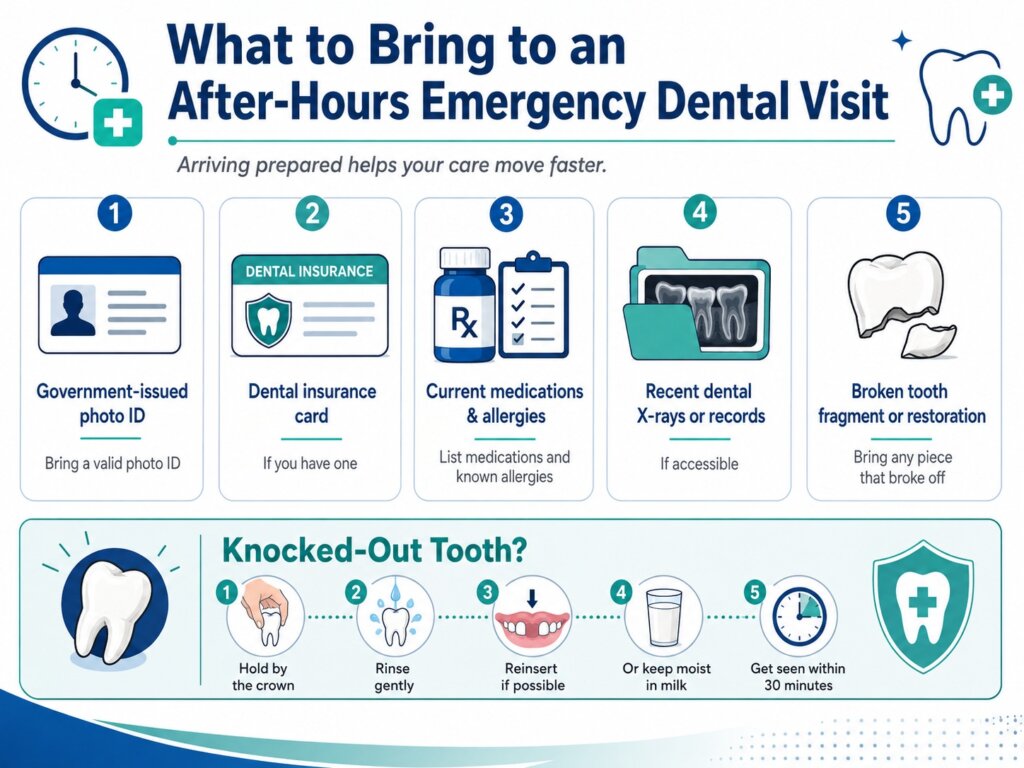
Arriving prepared helps the team move faster and keeps your visit focused on treatment rather than paperwork. A few things to bring:
- A government-issued photo ID
- Your dental insurance card (if you have one)
- A list of current medications and any known allergies
- Recent dental X-rays or records, if accessible
- Any tooth fragment or restoration that broke off
If you are coming in with a knocked-out tooth, handle it by the crown only, rinse it gently, and either reinsert it or keep it moist in milk or between your cheek and gum. Time matters—ideally, you want to be seen within 30 minutes of the injury.
How Dental Assistant Jobs Relate to After-Hours Emergency Care
You might not think about the people behind the scenes during an emergency visit, but they play a direct role in how quickly you get care. Dental assistants handle patient intake, take X-rays, keep records, and support the dentist throughout the procedure. According to the U.S. Bureau of Labor Statistics, dental assistant jobs (SOC 31-9091) are projected to grow about 6 percent from 2024 to 2034—faster than the average for all occupations—with a 2024 median pay in the high-$40,000s and strong demand driven by expanding healthcare needs.
That growth reflects real demand for accessible dental care, including after-hours and urgent services. Clinics that stay open evenings, weekends, and holidays rely on trained dental assistants to make that possible. When you walk into a dental clinic near you at 11 p.m. and someone is ready to take your X-rays and prep the room, that is a dental assistant doing their job—and doing it well.
At Emergency Dental San Francisco, our team includes licensed clinicians and trained support staff who follow CDC and OSHA infection-control standards. Every visit involves strict sterilization protocols, appropriate PPE, and HIPAA-compliant privacy practices. You are not getting a rushed, low-quality experience because it is after hours. You are getting the same clinical standard—just at a time that works for your emergency.
Finding a Dentist Office Near You for After-Hours Emergencies in the Bay Area
If you are searching for a dentist office near you after hours in San Francisco or the surrounding Bay Area, options can feel limited—especially on a Sunday night or a holiday. Emergency Dental San Francisco serves patients across San Francisco, South San Francisco, Alameda, Berkeley, Daly City, Fremont, Oakland, and San Leandro. Walk-ins are welcome, same-day appointments are available, and you can reach us 24/7 by phone.
Whether you need an urgent exam, a tooth extraction, infection treatment, a root canal, or same-day denture repair through our lab network, we handle it with the same calm, professional approach regardless of the hour. Call 415-230-2783 or book an appointment online to get started. If you want to check whether your plan covers the dental code for after-hours emergency visits before you come in, our team can help walk you through that too.
Conclusion
The dental code for after-hours emergency care, D9440, is a straightforward billing code that reports an after-hours visit—separate from the treatment itself. Knowing what it means helps you read your insurance explanation of benefits clearly and avoid confusion at billing time. When a dental emergency hits outside regular hours, Emergency Dental San Francisco is here—call 415-230-2783 or book online for same-day, after-hours care across the Bay Area.
Emergency Dental San Francisco specializes in same-day after-hours emergency care for urgent dental pain. We accept most insurance and offer affordable options for uninsured patients. Call 415-230-2783 or book online—get started today.
FAQs
What Is the Dental Code for After-Hours Emergency Care?
In most cases, after-hours emergency care is billed using standard emergency evaluation codes (commonly D0140 or D9110, depending on the situation), plus any needed diagnostic and treatment codes; some offices may also add an after-hours or extended-hours charge if allowed by the plan and properly documented.
Is There a CDT Code for After-Hours or Emergency Dental Visits?
There isn’t a single universal CDT code that automatically means “after-hours,” but emergency visits are typically billed with CDT emergency evaluation codes (often D0140 or D9110) along with procedure codes for what was done; coverage and allowances vary by insurer.
What Is D9110 in Dental Billing?
D9110 is commonly used for palliative (pain-relieving) treatment of dental pain—an urgent visit focused on diagnosing the problem and providing immediate relief (such as medication, dressing, or other same-day measures), with definitive treatment billed separately if performed.
What Is the Difference Between D9110 and D0140?
D0140 is a limited oral evaluation for a problem-focused exam (often used to assess an urgent issue), while D9110 is palliative treatment aimed at relieving pain; many emergencies involve both evaluation and treatment, but what’s billed depends on what was documented and performed.
Can Dentists Bill an After-Hours Fee for Emergency Treatment?
Sometimes—some plans allow an after-hours or extended-hours fee, but many do not, and any such charge must be clearly documented and disclosed; we verify benefits when possible and explain expected costs up front so there are no surprises.

Emergency Dental San Francisco is a dental office focused on providing same-day dental appointments to patients in San Francisco and the surrounding area. We provide urgent dental care services during weekends, evenings and holidays.
We accept several forms of payment and have financing options available to those who qualify. We accept most dental insurance.