

13 Oct Why Some Patients Qualify for Emergency Dental Grants While Others Don’t
A dental emergency does not wait for payday. Whether you are dealing with a cracked molar, a throbbing abscess, or a knocked-out tooth, the cost of urgent care can feel just as overwhelming as the pain itself. For many people in the Bay Area and across the country, the question is not just “where do I go?” but “how do I pay for this?”
This article breaks down who qualifies for emergency dental grants, what types of financial assistance programs exist, how to apply, and what to do if a grant is not an immediate option. You will also find practical guidance on accessing same-day care and financing options that can help you get treated now without waiting weeks for approval.
Key Takeaways
- Emergency dental grants are typically awarded based on income level, insurance status, and the urgency of the dental condition.
- Charitable organizations, state health programs, and nonprofit dental clinics are among the most common sources of dental grant funding.
- The American Dental Association notes that emergency department dental visits often cost significantly more than care received at a dental clinic.
- Some programs, like those referenced by the Missouri Department of Health, offer awards of up to $1,500 for qualifying patients with urgent dental needs.
- If a grant takes time to process, same-day financing through a dental clinic near me may bridge the gap while you await approval.
- Emergency Dental San Francisco offers financing options, accepts most insurance plans, and provides transparent cost estimates before treatment begins.
Understanding your options before a dental crisis hits can make a real difference. Let us start with the most direct question.
Who Qualifies for Emergency Dental Grants and What Do They Cover?
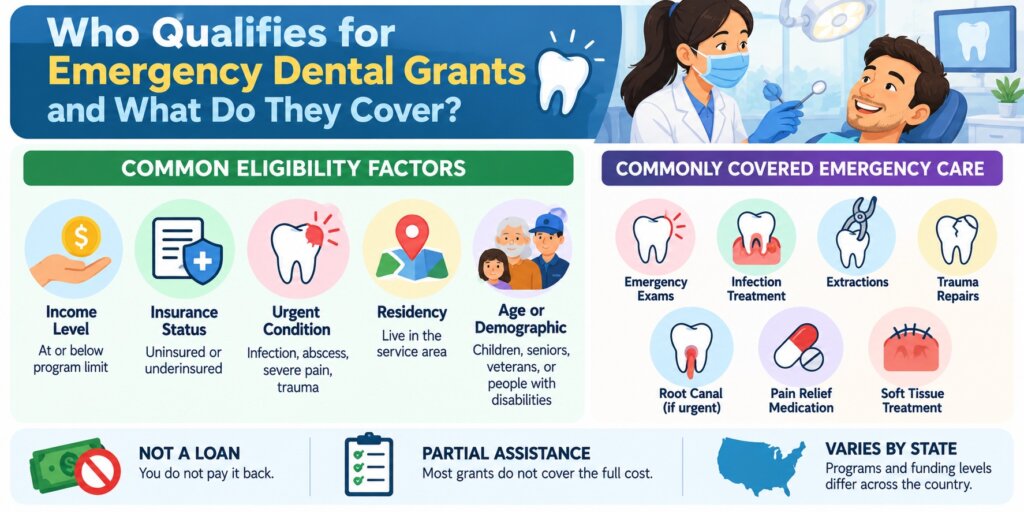
Emergency dental grants are financial awards designed to help people who cannot afford urgent dental treatment. They are not loans. You do not pay them back. Qualification typically depends on a combination of financial need, lack of dental insurance, and the clinical urgency of your condition.
Most programs look at the following factors when determining eligibility:
- Income level: Many grant programs require applicants to fall at or below a certain percentage of the federal poverty level, often 100 to 200 percent.
- Insurance status: Uninsured or underinsured patients are prioritized in most charitable dental assistance programs.
- Type of dental condition: Grants tend to cover conditions that pose a health risk if left untreated, such as abscesses, severe infections, or trauma-related injuries.
- Residency: Most programs are state-specific or county-specific. You generally need to prove you live in the service area.
- Age or demographic group: Some programs focus on children, seniors, veterans, or people with disabilities.
It is worth noting that grant availability varies widely by state. The Oklahoma State Department of Health’s dental care resource guide, for example, identifies emergency funds and limited assistance specifically for qualifying uninsured patients who need urgent dental care. Similar programs exist across the country, though funding levels and eligibility criteria differ.
You might be wondering whether these grants cover the full cost of treatment. In most cases, they do not. They are partial assistance tools. A program cited by the Missouri Department of Health, for instance, offers awards of up to $1,500, which may cover an extraction or infection treatment but may not cover a full course of restorative care.
Types of Emergency Dental Grants and Dental Clinic Options
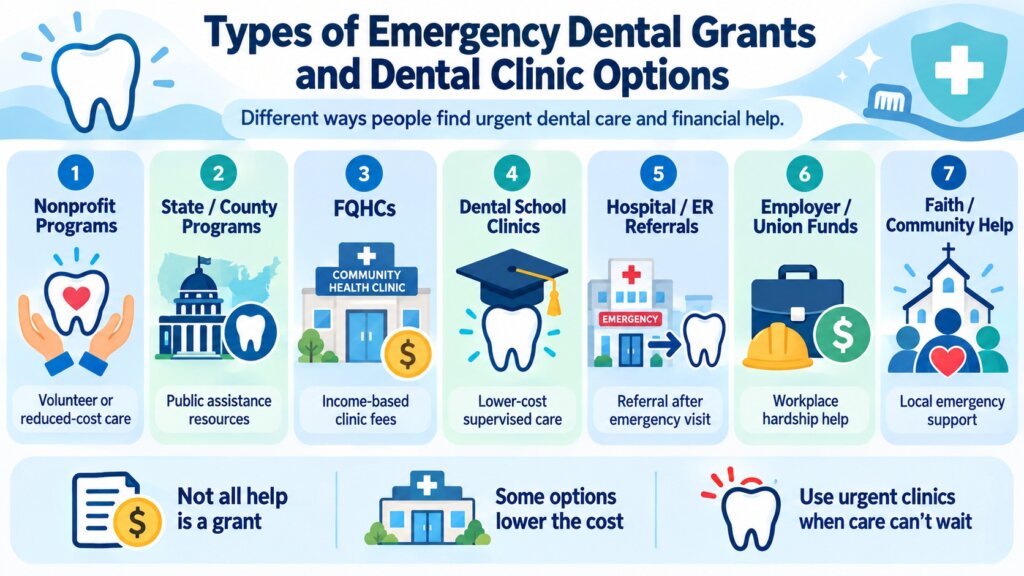
Not all dental financial assistance looks the same. Some programs are true grants. Others are sliding-scale fee arrangements, volunteer care networks, or charitable clinic partnerships. Knowing the difference helps you target the right resource.
1. Nonprofit Charitable Dental Programs
Organizations like the Dental Lifeline Network and local dental societies offer free or reduced-cost care through volunteer dentist networks. These programs often prioritize elderly, disabled, or medically fragile patients who cannot access a standard dental clinic near me due to cost or mobility.
2. State and County Health Department Programs
Several state health departments maintain lists of emergency dental assistance funds. The Oklahoma State Department of Health’s resource guide is one example, identifying funds available to uninsured patients facing urgent dental needs. California has its own county-level programs, and Medi-Cal covers certain emergency dental services for eligible adults.
3. Federally Qualified Health Centers (FQHCs)
FQHCs operate on a sliding fee scale based on income. They are not grants in the traditional sense, but they make dental care significantly more affordable for low-income patients. Many have same-day or next-day urgent care availability.
4. Dental School Clinics
Accredited dental schools provide care at reduced rates under licensed faculty supervision. Wait times can be longer, but costs are often 50 to 70 percent lower than private practice rates. These are not grants, but they are a practical option for non-emergency follow-up care after an urgent situation is stabilized.
5. Hospital and ER Referral Programs
The American Dental Association highlights that emergency department visits for dental issues often cost substantially more than clinic-based care. Some hospitals now have referral programs that connect patients with volunteer dentists or reduced-fee clinics after an ER visit, recognizing that the ER is not equipped to resolve the underlying dental problem.
6. Employer or Union Dental Assistance Funds
Some labor unions and large employers maintain hardship funds that can be applied toward dental emergencies. Check with your HR department or union representative if you are currently employed.
7. Faith-Based and Community Organization Grants
Local churches, community foundations, and social service organizations sometimes maintain small emergency funds for dental care. These are informal, often not widely advertised, and may require a referral from a social worker or case manager.
If you are searching for a dental clinic near me that can treat you today while you explore grant options, Emergency Dental San Francisco provides same-day urgent care across the Bay Area, including Oakland, Berkeley, Fremont, and Daly City. We accept most insurance plans and offer financing for patients who qualify. Call 415-230-2783 to discuss your situation before your visit.
How to Apply for Emergency Dental Grants: A Step-by-Step Guide
Applying for dental grant assistance can feel complicated when you are already in pain. The process is more straightforward than most people expect, especially if you gather your documents in advance.
- Identify the right program for your situation. Start with your state or county health department website. Search for dental assistance programs, emergency dental funds, or Federally Qualified Health Centers in your ZIP code. California’s Department of Health Care Services maintains updated resources for Medi-Cal dental benefits.
- Confirm your eligibility before applying. Review the income thresholds, residency requirements, and qualifying conditions for each program. Applying to programs you do not qualify for wastes time you may not have.
- Gather required documentation. Most programs ask for proof of income (recent pay stubs or tax return), proof of residency (utility bill or lease), proof of no dental insurance (or a denial letter from your insurer), and a description of your dental condition from a licensed provider.
- Get a clinical assessment first if possible. Some grant programs require a dentist’s written assessment of your condition before approving funds. Getting evaluated at a clinic first can actually speed up the grant process, not slow it down.
- Submit your application and follow up promptly. Many programs have limited funding that runs out quickly. Submit as soon as possible and follow up within 48 to 72 hours to confirm receipt.
- Ask about bridge financing while you wait. Grant approvals can take days or weeks. If you need care now, ask the dental office about payment plans or financing options that can be arranged immediately.
Emergency Dental San Francisco works with patients to provide upfront cost estimates and connect them with financing options for those who qualify. If you are waiting on a grant decision and need urgent treatment today, our team can walk you through payment arrangements that make same-day care possible. Learn more about our insurance and financing options here.
What Emergency Dental Grants Typically Do and Do Not Cover
Understanding the scope of grant coverage helps you plan realistically. The table below summarizes what most emergency dental grant programs include and exclude.
| Covered by Most Programs | Typically Not Covered |
|---|---|
| Emergency tooth extractions | Cosmetic dental procedures |
| Abscess drainage and infection treatment | Teeth whitening or veneers |
| Emergency exams and X-rays | Elective orthodontics |
| Temporary fillings or crowns | Full-mouth restorations (in most cases) |
| Antibiotics and pain management prescriptions | Implants (unless medically necessary) |
| Root canal therapy for acute infection | Routine cleanings or preventive care |
Coverage varies by program, so always confirm what is included before assuming a procedure will be funded. Some programs, particularly those tied to Medi-Cal or FQHCs, may cover a broader range of services than private charitable funds.
When Grants Are Not Immediately Available: Affordable Alternatives to Consider
Grant funding is limited and not always accessible on the same day you need care. If you are in pain right now, you have options that do not require waiting for a grant decision.
Dental financing programs like CareCredit or in-house payment plans allow you to receive treatment today and pay over time. These are similar to a credit arrangement but are designed specifically for healthcare costs. They differ from grants in that repayment is required, but they solve the immediate access problem.
Medi-Cal covers emergency dental services for eligible California adults, including extractions and infection treatment. If you are already enrolled, confirm your benefits before your visit. If you are not enrolled, the application process can sometimes be completed quickly through Covered California.
You might also check whether your employer offers a flexible spending account (FSA) or health savings account (HSA) that can be applied to dental expenses. These accounts use pre-tax dollars, which effectively reduces your out-of-pocket cost.
For patients in the Bay Area looking for immediate care without the wait, Emergency Dental San Francisco is open 24 hours a day, including weekends and holidays. We accept walk-ins, offer same-day appointments, and provide financing for qualified patients. Whether you found us by searching for a dental clinic near me or were referred by a provider, we will give you a clear cost estimate before any treatment begins. Call 415-230-2783 or book an appointment online.
Understanding the Role of Dental Assistants in Emergency Grant-Funded Care
When you visit a grant-funded clinic or a charitable dental program, you will likely interact with dental assistants as part of your care team. According to the U.S. Bureau of Labor Statistics, dental assistants provide patient care, take radiographs, maintain records, and schedule appointments. Employment in dental assistant jobs is projected to grow 7 percent from 2025 to 2035, reflecting the expanding demand for dental care access across the country.
Dental assistants play a meaningful role in triage, patient communication, and helping coordinate care for patients navigating financial assistance programs. At clinics that serve grant recipients, they often help connect patients with social workers or program coordinators who can assist with paperwork.
This growing workforce is part of why access to care is gradually improving, even in underserved communities. More dental assistant jobs mean more clinic capacity, which can translate to shorter wait times for grant-funded appointments.
MetLife Dental Login and Insurance Verification Before Your Visit
If you have dental insurance through an employer, verifying your benefits before your appointment can save you time and money. Patients with MetLife dental coverage, for example, can use the MetLife dental login portal to check their plan details, find in-network providers, and review what emergency procedures are covered under their current benefits.
The MetLife dental provider login is a separate portal used by dental offices to verify patient eligibility and submit claims. When you call ahead or book online, the front desk team can use this system to confirm your coverage before you arrive, so there are no surprises at checkout.
Not all emergency dental situations are fully covered by insurance, but partial coverage can significantly reduce your out-of-pocket cost. Knowing your benefits in advance, whether through MetLife dental login, Delta Dental, Cigna, or another carrier, helps you and the clinical team plan your treatment more effectively.
If you are unsure what your plan covers, our team at Emergency Dental San Francisco can help verify your insurance when you call or book online. We accept most major dental insurance plans and will walk you through your estimated costs before treatment begins. Check our accepted insurance plans here.
Final Thoughts on Emergency Dental Grants and Getting Care Now
Emergency dental grants can make a real difference for patients who have no other way to afford urgent care. They are not easy to access overnight, but they exist, and knowing where to look puts you ahead. If a grant is not immediately available, financing, Medi-Cal, and sliding-scale clinics are practical paths forward. Emergency Dental San Francisco is here when you need same-day care, clear pricing, and a team that will work with your situation. Call 415-230-2783 or book your appointment today.
Emergency Dental San Francisco offers affordable emergency dental care with financing options for qualifying patients. We accept most insurance and work to keep urgent treatment accessible for everyone. Call 415-230-2783 or book online today—get started now.
FAQs
What Is an Emergency Dental Grant?
An emergency dental grant is financial assistance (typically from a nonprofit, charity, or local program) that helps cover urgent dental treatment costs, often with specific eligibility rules and limited funding. If you’re in pain now, we can evaluate the problem the same day and give a clear, itemized treatment plan you can use to pursue assistance.
How Can I Get Emergency Dental Work With No Money?
Start by calling an urgent-care dental office to confirm what’s medically necessary and what can be staged; then ask about payment plans/financing, community clinics, dental schools, and local charity programs. At Emergency Dental San Francisco, we prioritize safe pain relief first and review insurance, financing (if you qualify), and affordable payment options.
Are There Grants for Dental Implants or Dentures in an Emergency?
Sometimes, but grants for implants or dentures are usually limited and often not “immediate” emergency funding; many programs prioritize infection control, extractions, or medically necessary stabilization first. We can treat the urgent issue (pain, swelling, infection) and then outline realistic next steps and costs for implants or dentures.
Who Qualifies for Emergency Dental Grants?
Eligibility varies by program, but common factors include low income, lack of insurance, medical necessity (infection/pain), residency in a specific area, and available funding; some programs prioritize seniors, veterans, or people with disabilities. We can document your diagnosis and urgency after an exam and X-rays, which many programs require.
How Do I Apply for Emergency Dental Grants Near Me?
Search local nonprofits, county health departments, community health centers, and dental school programs, then apply with proof of income, residency, and a treatment estimate from a dentist. If you’re in the Bay Area, we can see you quickly and provide the exam findings and written treatment plan you can submit with applications—call 415-230-2783 or book online.

Emergency Dental San Francisco is a dental office focused on providing same-day dental appointments to patients in San Francisco and the surrounding area. We provide urgent dental care services during weekends, evenings and holidays.
We accept several forms of payment and have financing options available to those who qualify. We accept most dental insurance.