

29 Sep What Changes When You Need Emergency Dental Treatment After Regular Office Hours?
Dental pain does not follow a schedule. It can hit at 11 PM on a Tuesday, or in the middle of a long weekend, or right after the last regular dental office has closed for the night. When that happens, knowing what to expect from emergency night dental treatment can make the difference between panic and getting the right care quickly.
This article walks you through what actually happens during an after-hours dental visit—from the moment you call to the moment you leave with relief. You will learn how to prepare, what treatments are available at night, how pain is managed, and when to go to an emergency room instead of a dental clinic. We will also cover costs, insurance, and what to do before your appointment to make the visit go smoothly.
Key Takeaways
- Emergency night dental treatment is available same-day and after hours at clinics like Emergency Dental San Francisco, which serves the Bay Area 24/7.
- Not every dental problem requires an ER visit—most urgent issues like toothaches, abscesses, and cracked teeth can be treated at a dental clinic.
- You can manage pain at home temporarily using warm salt-water rinses and over-the-counter NSAIDs, but professional care should not be delayed.
- Knowing what to bring and what to expect helps reduce stress and speeds up your visit.
- Most after-hours dental clinics accept insurance, offer financing, and can provide same-day treatment for a wide range of emergencies.
Understanding your options before an emergency happens puts you in a much better position when pain strikes at night.
What Emergency Night Dental Treatment Actually Looks Like
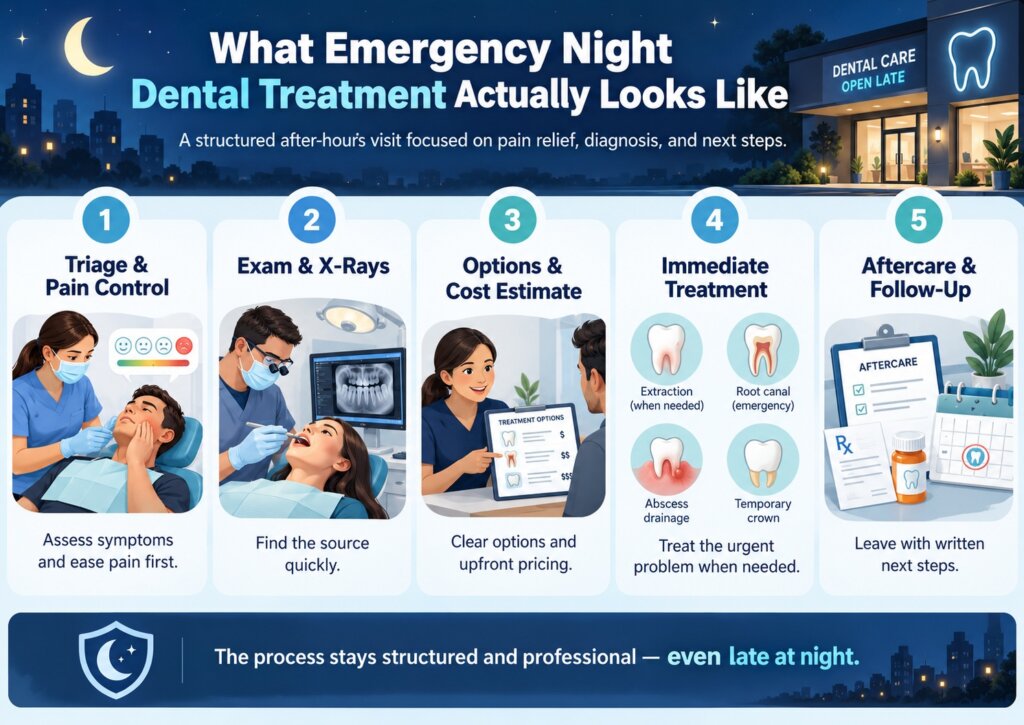
A lot of people imagine an after-hours dental visit as chaotic or rushed. In practice, a well-run urgent care dental clinic follows a clear, structured process—even at midnight. The goal is the same as any clinical visit: assess the problem, control the pain, and create a plan.
When you arrive, the first step is triage. A clinician will ask about your symptoms, how long the pain has lasted, and whether you have any swelling, fever, or difficulty swallowing. This helps determine how urgent your situation is and what treatment is needed first. From there, the visit typically follows this order:
1. Emergency Night Dental Triage and Pain Control
The team will assess your pain level and symptoms right away. If you are in severe pain, the priority is getting you comfortable before anything else—this may include a local anesthetic to numb the area while diagnostics are completed.
2. Emergency Night Dental Exam and X-Rays
Digital X-rays are taken to identify the source of the problem. This step is quick and gives the clinician a clear picture of what is happening beneath the surface, whether it is an abscess, a cracked root, or a failing filling.
3. Treatment Options and Cost Estimate
Once the diagnosis is clear, the clinician explains your options in plain language. You will receive an upfront cost estimate before any procedure begins, so there are no surprises.
4. Immediate Treatment When Indicated
Depending on the diagnosis, treatment may include a tooth extraction, root canal therapy, abscess drainage, a temporary crown, or another targeted procedure. Not every issue requires a complex fix the same night—sometimes a temporary solution with clear follow-up steps is the right call.
5. Written Aftercare Instructions and Follow-Up Plan
Before you leave, you will receive written aftercare instructions. If prescriptions are needed, those are provided as well. The team will also outline next steps for any follow-up care required after the emergency visit.
This process is consistent whether you come in at 8 AM or 2 AM. The clinical standards do not change based on the hour.
Emergency Night Dental Symptoms: When You Need Care Right Now
You might be wondering whether your situation actually qualifies as a dental emergency. Some symptoms can wait a day or two. Others cannot. Knowing the difference helps you act faster and avoid unnecessary complications.
The following symptoms typically require same-day or after-hours dental care:
- Severe toothache that does not respond to over-the-counter pain relief
- Swelling in the jaw, gums, or face—especially with fever
- A knocked-out permanent tooth (time is critical here—ideally within 30 minutes)
- A cracked or fractured tooth with sharp pain or exposed nerve
- A lost crown or filling causing significant sensitivity or pain
- Uncontrolled bleeding from the mouth following an injury or extraction
- Signs of abscess: throbbing pain, visible swelling, bad taste, or pus
According to MedlinePlus, dental emergencies may require immediate treatment when they involve potentially life-threatening conditions, uncontrolled bleeding, infection, or severe pain. If you are experiencing difficulty breathing, severe swelling affecting your airway, or uncontrolled bleeding, go to an emergency room first. For everything else on this list, an after-hours dental clinic is the appropriate and faster option.
Think of an after-hours dental clinic as the night lantern in a dark situation—it is the specific, focused source of care you need when regular options are unavailable and waiting is not reasonable.
How to Manage Pain Before Your Emergency Night Dental Appointment

Getting to a clinic as soon as possible is always the right move. But if there is a short wait before your appointment, a few steps can help reduce discomfort in the meantime.
Research published in peer-reviewed dental literature identifies nonsteroidal anti-inflammatory drugs (NSAIDs) such as ibuprofen, with or without acetaminophen, as first-line options for managing acute dental pain when clinically appropriate. Always follow label directions and consider your own medical history before taking any medication.
Here is what you can do safely at home while you wait:
- Rinse with warm salt water to reduce inflammation and clear debris
- Use a cold compress on the outside of your cheek to reduce swelling—apply for 15 minutes on, 15 minutes off
- Take an OTC NSAID as directed if you have no contraindications
- Do not place aspirin or any pain tablet directly on the gum or tooth—this can cause tissue damage
- For a knocked-out tooth, handle it by the crown only, rinse gently without scrubbing, and store it in milk or between your cheek and gum until you arrive
- Avoid eating on the affected side and skip very hot or very cold foods
These steps are temporary. They may reduce discomfort, but they do not treat the underlying problem. Professional care is still needed.
Emergency Night Dental Services: What Treatments Are Available After Hours
One common concern is whether a night visit offers the same range of treatments as a regular appointment. At a properly equipped urgent care dental clinic, the answer is yes—for most emergencies.
Emergency Dental San Francisco offers a full range of after-hours services, including:
| Condition | Available Night Treatment |
|---|---|
| Severe toothache | Exam, X-ray, pain relief, root canal or extraction if needed |
| Dental abscess | Drainage, antibiotic prescription, infection control |
| Knocked-out tooth | Reimplantation attempt, stabilization, or preservation plan |
| Cracked or broken tooth | Bonding, temporary crown, or extraction depending on severity |
| Lost crown or filling | Recementation or temporary restoration |
| Soft tissue injury | Assessment, wound care, referral if needed |
| Broken denture | Same-day repair through lab network when possible |
Our clinic follows CDC and OSHA infection-control standards at every hour of operation. Sterilization protocols, appropriate PPE, and licensed clinicians are in place whether you come in at noon or midnight. The clinical environment does not change based on the time of day.
If you are in the Bay Area and need urgent care tonight, call us at 415-230-2783 or book an appointment online. Walk-ins are welcome, and same-day slots are available across San Francisco, Oakland, Berkeley, Daly City, Fremont, Alameda, and San Leandro.
What to Bring to Your Emergency Night Dental Visit
Arriving prepared makes your visit faster and helps the clinical team work more efficiently. This is especially true late at night when you want to spend as little time waiting as possible.
Bring the following to your appointment:
- A government-issued photo ID
- Your insurance card, if you have one
- A written list of current medications and any known allergies
- Any recent dental X-rays or records, if available
- Any broken tooth fragments or an intact crown or filling you need re-cemented
Arriving about 15 minutes early allows the front desk to complete intake paperwork before you see the clinician. This small step can meaningfully reduce your total time in the chair.
Emergency Night Dental Costs: Insurance, Financing, and Payment Options
Cost is a real concern for many patients, especially when a dental emergency happens unexpectedly. You might be wondering whether after-hours care costs significantly more than a regular visit, or whether your insurance will cover it.
The short answer: it depends on your plan, but most standard emergency procedures are covered at least partially by dental insurance. Emergency Dental San Francisco accepts most dental insurance plans. For patients without coverage, we accept cash and all major credit cards. Financing options are also available for qualified patients.
We provide upfront cost estimates before any procedure begins. There are no surprise charges. If you are unsure about your coverage, our team can help you check your benefits when you call or arrive.
Think of after-hours dental care the way you might think of an emergency lantern during a power outage—it is not your first choice for everyday use, but when you need it, the cost of having it available is worth it. Delaying care for a dental abscess or a knocked-out tooth can lead to more complex and expensive treatment later. Acting quickly often saves both pain and money in the long run.
To review your insurance options or ask about financing, visit our Insurance and Financing page or call 415-230-2783 before your visit.
When to Go to the ER Instead of an Emergency Night Dental Clinic
Most dental emergencies are best handled at a dental clinic, not a hospital emergency room. ERs are not equipped to perform dental procedures, and in most cases, they can only provide temporary pain relief and a referral.
Go to the emergency room if you experience any of the following:
- Difficulty breathing or swallowing due to swelling
- Uncontrolled bleeding that does not slow after 15–20 minutes of pressure
- Signs of a facial fracture following trauma
- High fever with swelling spreading to the neck or floor of the mouth
- Loss of consciousness or severe head injury
For everything else—toothaches, abscesses, cracked teeth, lost crowns, knocked-out teeth, broken dentures—a dental clinic is the right call. It is faster, more targeted, and more likely to result in actual treatment rather than a referral.
A well-equipped after-hours dental clinic functions like a torch against the night—a reliable, focused source of care that cuts through the uncertainty of a dental crisis and gets you to a clear outcome. That is the standard we hold ourselves to at every hour we are open.
Conclusion
Emergency night dental treatment follows the same clinical standards as daytime care—triage, diagnosis, treatment, and a clear follow-up plan. Knowing what to expect removes the uncertainty and helps you act faster when pain strikes after hours. If you are in San Francisco or the surrounding Bay Area and need urgent dental care tonight, Emergency Dental San Francisco is available 24/7—call 415-230-2783 or book your same-day appointment now.
Emergency Dental San Francisco specializes in after-hours and same-day pain relief when you need it most. We serve the Bay Area nights, weekends, and holidays. Call 415-230-2783 or get started today.
FAQs
What Is Considered a Dental Emergency at Night?
A night-time dental emergency is any problem that can’t safely wait until morning—such as severe toothache, facial swelling, a suspected abscess, uncontrolled bleeding, a knocked-out or broken tooth, or trauma causing pain or bite changes. If you’re in significant pain or swelling is spreading, call for urgent evaluation.
Can I Go to the ER for a Dental Emergency at Night?
Yes—go to the ER for trouble breathing or swallowing, rapidly spreading facial/neck swelling, high fever, uncontrolled bleeding, or major trauma. For most dental problems (toothaches, broken teeth, abscesses without airway issues), an emergency dentist is usually the fastest way to get definitive treatment and pain relief.
How Can I Relieve Severe Tooth Pain at Night Until I See a Dentist?
Rinse gently with warm salt water, use a cold compress on the cheek, and take over-the-counter pain medicine as directed on the label (avoid aspirin on the gums). Keep your head elevated and avoid very hot/cold foods; don’t place clove oil or chemicals directly on the tooth or gums. If you have swelling, fever, or worsening pain, call right away.
Do Emergency Dentists Offer 24/7 or After-Hours Appointments?
Many emergency dental offices offer after-hours, weekend, and holiday care, and some provide 24/7 phone support. Emergency Dental San Francisco offers same-day and after-hours options, and you can reach us 24/7 by phone to triage symptoms and coordinate the soonest available visit.
How Much Does an Emergency Night Dentist Visit Cost?
Costs vary based on the exam, X-rays, and the treatment needed (such as drainage of an abscess, a filling, or an extraction). We accept most dental insurance plans, offer financing options for those who qualify, and provide clear, upfront estimates so you understand pricing before treatment begins.

Emergency Dental San Francisco is a dental office focused on providing same-day dental appointments to patients in San Francisco and the surrounding area. We provide urgent dental care services during weekends, evenings and holidays.
We accept several forms of payment and have financing options available to those who qualify. We accept most dental insurance.