28 Aug Dental Emergency Insurance: Why Coverage Differs for Extractions, Repairs, and Urgent Exams
A dental emergency rarely gives you a warning. One moment you are eating dinner, and the next you are dealing with a throbbing abscess or a cracked tooth that needs attention right away. The first question most people ask is not “where is a dentist near me?” but rather “will my insurance actually pay for this?” That is a fair and practical question, and the answer depends heavily on what type of coverage you have.
This article breaks down how dental emergency insurance works across private plans, Medicare, Medicaid, and marketplace coverage. You will learn what procedures are typically covered, where the gaps are, and what your options look like when coverage falls short. We will also share how Emergency Dental San Francisco can help you get care fast, whether you have insurance or not.
Key Takeaways
- Dental emergency insurance coverage varies widely depending on whether you have private dental insurance, Medicare, Medicaid, or a marketplace health plan.
- The American Dental Association defines a dental emergency as a potentially life-threatening condition requiring immediate treatment to stop bleeding, relieve severe pain, or address serious infection.
- Medicare generally does not cover routine dental services, but may cover certain dental procedures tied to a covered medical treatment.
- Medicaid must cover emergency dental care for children, but adult dental benefits have no federal minimum requirement and vary by state.
- Dental-related emergency room visits cost roughly three times more than a visit to a dentist and total about $1.6 billion annually nationwide.
- Emergency Dental San Francisco accepts most dental insurance plans and offers financing options for patients who qualify.
Understanding your coverage before a crisis hits can save you time, money, and a lot of stress. Let us start with what qualifies as a dental emergency in the first place.
What Dental Emergency Insurance Actually Covers at a Dentist Office
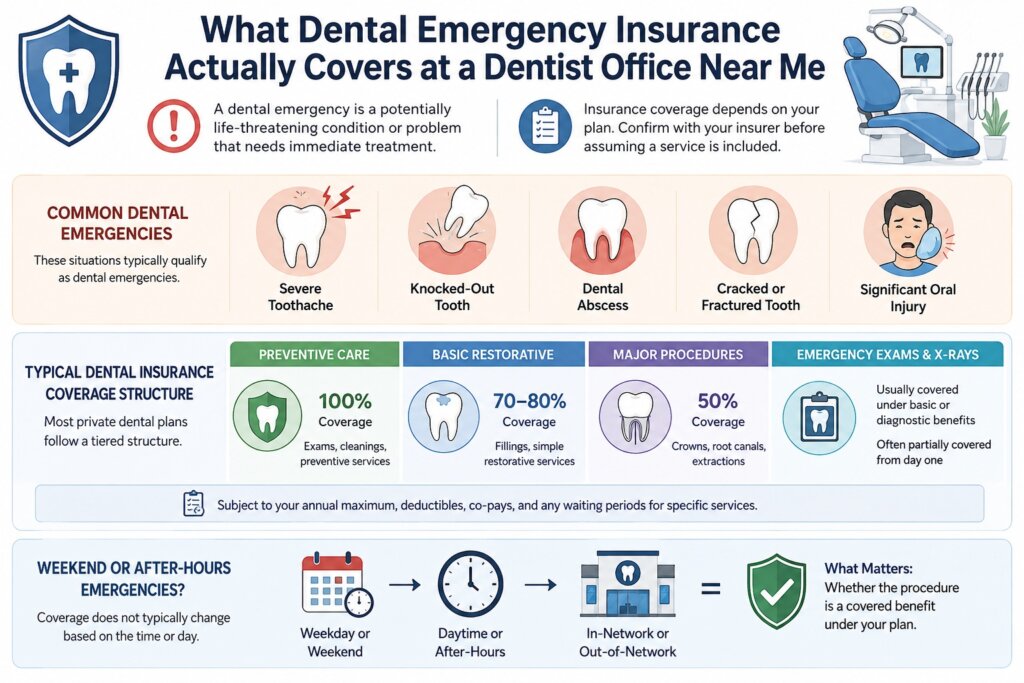
The American Dental Association defines a dental emergency as a potentially life-threatening condition that requires immediate treatment. This includes uncontrolled bleeding, diffuse soft-tissue infection with swelling that could compromise the airway, and facial bone trauma affecting breathing. Clinical literature also extends the definition to problems of the teeth or supporting tissues that need immediate action to prevent biological, functional, or aesthetic complications.
In practical terms, this means severe toothaches, knocked-out teeth, dental abscesses, cracked or fractured teeth, and significant oral injuries all fall under the umbrella of dental emergencies. Whether your insurance covers these situations depends on the type of plan you carry.
Most private dental insurance plans follow a tiered structure. Preventive care is covered at the highest rate, often 100 percent. Basic restorative services like fillings are covered at a lower percentage, usually around 70 to 80 percent. Major procedures such as crowns, root canals, and extractions are typically covered at 50 percent, subject to your annual maximum and any waiting periods. Emergency exams and X-rays usually fall under basic or diagnostic benefits, which means they are often partially covered from day one, even on plans with a dental insurance no waiting period structure.
You might be wondering whether your plan will cover an emergency visit on a weekend or after hours. Coverage does not typically change based on the time of day or day of the week. What matters is whether the procedure itself is a covered benefit under your plan. Always confirm with your insurer before assuming a service is included.
How Medicare and Medicaid Handle Dental Emergency Insurance for a Dentist
Medicare and Medicaid are two of the most common forms of public health coverage in the United States, and their dental benefits are limited in ways that often surprise patients. Knowing the rules before you need emergency care is important.
1. Medicare and Dental Coverage
Medicare generally does not cover routine dental services such as cleanings, fillings, or extractions. Original Medicare, which includes Part A and Part B, was not designed with dental care in mind. That said, Medicare may cover certain dental procedures when they are directly tied to a covered medical treatment.
For example, if you need a dental exam or tooth extraction before a heart valve replacement, organ transplant, or cancer therapy, Medicare may cover that dental work as part of the overall medical procedure. Outside of those specific situations, you are largely on your own for dental costs unless you have a Medicare Advantage plan that includes dental benefits.
2. Medicaid and Emergency Dental Care for Children
For children covered by Medicaid and separate CHIP programs, dental benefits must include services needed to prevent disease, restore oral structures, and treat emergency dental conditions. This is a federal requirement, and it reflects the American Academy of Pediatric Dentistry’s position that providing emergency oral care for infants, children, adolescents, and individuals with special health care needs is an essential duty of every dentist.
If you are searching for a pediatric dentist near me who accepts Medicaid, it is worth calling ahead to confirm participation, since not every dental office accepts all Medicaid plans.
3. Medicaid for Adults
Adult dental coverage under Medicaid has no federal minimum requirement. Some states offer comprehensive adult dental benefits, while others provide only emergency services or no dental coverage at all. In California, Medi-Cal does include some adult dental benefits, but the scope of coverage can be limited depending on the procedure.
4. Marketplace Health Plans and Dental Benefits
Federal marketplace health plans may offer separate dental coverage, but dental benefits are generally limited and not automatically included in all medical insurance. Consumers must actively select and enroll in available dental plans when shopping for coverage. Standalone dental plans purchased through the marketplace follow the same tiered structure as private plans, with varying deductibles, annual maximums, and waiting periods.
Some marketplace dental plans are marketed as dental insurance no waiting period options, which can be useful if you anticipate needing care soon after enrollment. Read the fine print carefully, because waiting periods often apply to major services even when basic care is covered immediately.
5. The Cost of Skipping the Dentist
When people lack dental coverage, they often delay care until the pain becomes unbearable. The American Dental Association notes that many people without dental coverage postpone treatment until they are forced to visit a hospital emergency department. Dental-related ER visits cost about three times as much as a visit to a dentist and total roughly $1.6 billion annually, with about one-third of those costs paid by Medicaid. That is a significant financial burden for a problem that a dentist office near me could often address at a fraction of the cost.
What Dental Emergency Insurance Typically Does Not Cover at Any Dentist
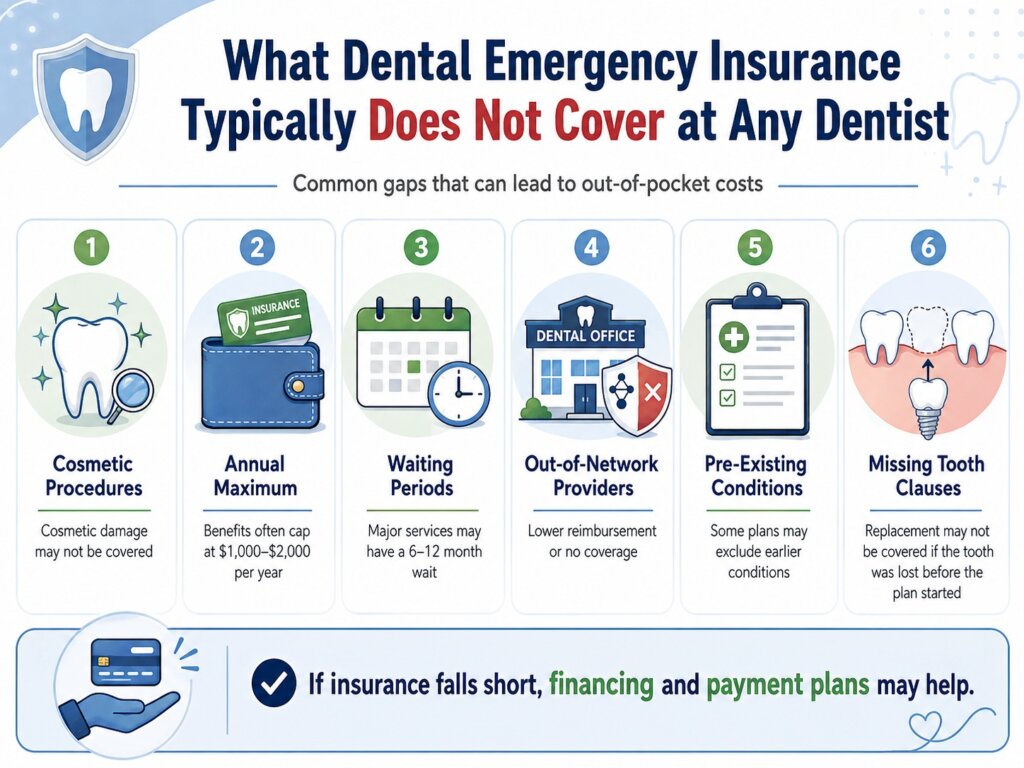
Even with solid dental coverage, there are gaps that catch people off guard. Knowing what is commonly excluded helps you plan ahead and avoid unexpected bills.
- Cosmetic procedures: If a tooth is cracked but the damage is purely cosmetic, your plan may not cover repair. Coverage usually requires a functional or medical justification.
- Services above the annual maximum: Most dental plans cap annual benefits between $1,000 and $2,000. Once you hit that limit, you pay out of pocket for the rest of the year.
- Waiting periods for major services: Many plans impose a 6 to 12-month waiting period before covering root canals, crowns, or extractions. Emergency exams may be covered sooner, but the treatment itself may not be.
- Out-of-network providers: If you visit a dentist who is not in your plan’s network, your reimbursement rate drops significantly, or the visit may not be covered at all.
- Pre-existing conditions: Some plans exclude treatment for conditions that existed before your coverage started, though this is less common in comprehensive dental plans.
- Missing tooth clauses: If a tooth was lost before your plan started, some insurers will not cover a replacement implant or bridge for that specific tooth.
The gaps in dental emergency insurance are real, but they do not have to leave you without options. Financing and payment plans can bridge the difference between what insurance pays and what you owe.
How to Use Dental Emergency Insurance at an Urgent Care Dentist
When a dental emergency happens, most people are not thinking clearly about insurance logistics. Here is a simple step-by-step process to follow so you can get care quickly without creating billing problems later.
Step 1: Call Your Dental Office First
Contact a dental office near me that offers same-day or emergency appointments. Describe your symptoms clearly so the team can triage your situation and prepare for your visit. Emergency Dental San Francisco is available 24/7 at 415-230-2783 for exactly this reason, including weekends and holidays when most dental offices are closed.
Step 2: Locate Your Insurance Card
Bring your insurance card to the appointment. If you do not have it on hand, your insurer’s member number is often accessible through their app or website. The dental office will verify your benefits before treatment when possible.
Step 3: Ask for a Pre-Treatment Estimate
Request an estimate before any major procedure begins. A reputable dentist office near me will provide an upfront cost breakdown based on your coverage. We do this at every visit so you know what to expect before treatment starts.
Step 4: Confirm Network Status
Ask whether the dental office participates in your insurance network. Out-of-network care is sometimes unavoidable in an emergency, but knowing the difference helps you anticipate your share of the cost.
Step 5: Ask About Financing Options
If your coverage leaves a gap, ask about payment plans or financing. We offer financing options for patients who qualify, and we accept cash and all major credit cards for those without insurance. Dental care should not be delayed because of cost concerns alone.
Step 6: Save Documentation
Keep a copy of your treatment records, X-rays, and itemized receipt. You may need these for insurance reimbursement, especially if you visited an out-of-network provider or paid out of pocket and plan to file a claim later.
Following these steps helps reduce confusion and keeps your focus where it belongs: on getting relief fast.
When to Seek Immediate Dental Emergency Care Regardless of Insurance
Some situations require care right away, regardless of what your dental emergency insurance covers. Delaying treatment to sort out billing details can make certain conditions significantly worse, and in rare cases, dangerous.
Seek immediate care if you experience any of the following:
- Uncontrolled bleeding from the mouth that does not stop with pressure
- Swelling in the jaw, neck, or floor of the mouth that affects swallowing or breathing
- A knocked-out permanent tooth (ideally treated within 30 minutes for the best chance of saving it)
- Severe, unrelenting tooth pain with fever
- A dental abscess with visible swelling and signs of spreading infection
- Significant facial trauma or suspected jaw fracture
For situations involving breathing difficulty or suspected fractures, go directly to the emergency room. For everything else, a same-day dental visit is almost always faster, more targeted, and far less expensive than an ER trip. The American Dental Association recommends seeking care from a dentist as soon as possible in these situations, rather than waiting it out.
Emergency Dental San Francisco provides same-day urgent exams, X-rays, pain relief, and treatment for the full range of dental emergencies across San Francisco and the greater Bay Area, including Oakland, Berkeley, Fremont, Daly City, and San Leandro. Walk-ins are welcome, and our team is ready to help you the moment you arrive.
Conclusion
Dental emergency insurance coverage is not one-size-fits-all, and the gaps can be significant depending on your plan. Knowing what your coverage includes before a crisis gives you a real advantage. When you need urgent care in San Francisco or the surrounding Bay Area, Emergency Dental San Francisco is here around the clock. Call 415-230-2783 or book a same-day appointment online to get the relief and answers you need without delay.
Emergency Dental San Francisco accepts most dental insurance plans to keep urgent care affordable. We also offer financing and accept cash or major credit cards. Call 415-230-2783 or book online today—get started now.
FAQs
Does Dental Insurance Cover Dental Emergencies?
Often, yes. Most dental plans cover emergency exams and X-rays, and may help pay for treatments like fillings, root canals, or extractions—though deductibles, waiting periods, and annual maximums can apply. We can verify benefits and explain your estimated costs before treatment.
What Is Considered a Dental Emergency?
A dental emergency is anything that needs prompt care to stop severe pain, control bleeding, treat infection, or save a tooth—such as a bad toothache, swelling/abscess, broken tooth, knocked-out tooth, or trauma to the mouth. If you’re unsure, call us 24/7 and we’ll help you triage next steps.
How Much Does an Emergency Dental Visit Cost Without Insurance?
Costs vary by what’s needed, but many visits start with an emergency exam and X-rays, then treatment (like a filling, drainage, or extraction) is priced based on complexity. We accept cash and major credit cards and offer financing options for those who qualify, and we’ll review fees clearly before proceeding.
Can I Get Dental Insurance That Covers Emergencies Immediately?
Sometimes, but many plans have waiting periods for major services; emergency exams may be covered sooner than procedures. If you need care today, it’s usually best to be seen first, then use insurance if eligible—our team can help you understand what your plan may cover.
Does Medical Insurance Cover Emergency Dental Care?
Usually not for routine dental problems, but it may help in specific situations like facial trauma, severe infection requiring hospital treatment, or medically necessary surgery. For most tooth-related emergencies, dental insurance (or self-pay) applies, and we can provide documentation if your medical plan requests it.

Emergency Dental San Francisco is a dental office focused on providing same-day dental appointments to patients in San Francisco and the surrounding area. We provide urgent dental care services during weekends, evenings and holidays.
We accept several forms of payment and have financing options available to those who qualify. We accept most dental insurance.